Mastering Earned Value Management (EVM): Track Cost, Schedule & Performance
A complete, step-by-step guide to Earned Value Management — the PMBoK-standard technique that integrates cost, schedule, and scope into a single performance measurement framework for any engineering or manufacturing project.
What is Earned Value Management (EVM)?
Earned Value Management (EVM) is a project performance measurement technique that integrates three critical dimensions — scope, schedule, and cost — into a single, unified framework. Rather than tracking cost and schedule separately, EVM compares what you planned to spend, what you actually spent, and what you earned (the budgeted value of work actually completed). As a result, project managers can detect problems early, forecast final costs accurately, and make evidence-based decisions at every stage.
Traditional project reporting often misleads managers. For example, a project that has spent exactly 50% of its budget sounds healthy. However, if it has only completed 35% of its scope, the project is in serious trouble. EVM makes this problem immediately visible — because it measures progress against the budget for that work, not just the passage of time or the spending of money.
Why EVM Matters in Engineering Projects
Engineering and manufacturing projects are particularly vulnerable to cost and schedule overruns. Therefore, EVM is widely used across aerospace, construction, defence, and industrial engineering. Furthermore, both PMBoK (6th and 7th editions) and ANSI/EIA-748 define EVM as the standard for project performance measurement on government and major commercial projects.
EVM does not prevent problems — it reveals them early enough to do something about them. A CPI below 0.9 in the first 20% of a project almost never recovers without intervention. — PMBoK 6th Edition, Project Cost Management
When Should You Use EVM?
EVM works best on projects where you can define scope in advance, assign a budget to each work package, and track actual costs at that level. Consequently, it suits most engineering, construction, product development, and manufacturing projects. However, it is less effective on highly exploratory or research projects where scope changes constantly and budget allocation at task level is impractical.
The Three Core EVM Values: PV, EV and AC
Every EVM calculation begins with three fundamental values. Together, these three numbers reveal the complete health of a project at any point in time. Understanding each one precisely is therefore the essential first step in applying EVM correctly.
Planned Value is the authorised budget assigned to the work that was scheduled to be completed by a specific point in time. It represents the project's time-phased baseline — what you planned to spend by today. As a result, PV defines the performance baseline against which actual progress is measured. At project completion, PV equals the total project budget, which is also called the Budget at Completion (BAC).
Earned Value is the budgeted cost of the work that has actually been completed by the status date. This is the most important and most misunderstood value in EVM. EV does not measure how much money you spent — instead, it measures how much budget you earned by completing work. Therefore, a work package worth £10,000 that is 60% complete has earned £6,000, regardless of what it actually cost.
Actual Cost is the total cost incurred for the work completed during a specific time period. It is the straightforward answer to "how much have we spent so far?" — drawn directly from cost accounting records, timesheets, and purchase orders. However, AC on its own tells you nothing about whether that spending represents good value. Only when compared to EV does AC become meaningful.
How the Three Values Relate
Consider a simple analogy to clarify the relationship. Suppose you plan to build 10 machine fixtures in 5 days at £100 per fixture (PV = £500 per day × 5 days = £2,500 total). After 3 days, you have built 6 fixtures. Therefore, EV = 6 × £100 = £600. Your actual cost was £750, so AC = £750.
From these three numbers, you can immediately see that the project is behind schedule (you earned only £600 against a plan of £1,000 after 3 days) and over budget (you spent £750 to earn £600). Furthermore, you can now calculate precisely how far behind and how much over budget — using the variance and index formulas in the next two sections.
Variance Analysis: Schedule Variance (SV) and Cost Variance (CV)
Once you have the three core values, calculating variances is straightforward. Variances answer a direct question: how far off plan are we? A positive variance is good — it means you are ahead of schedule or under budget. Conversely, a negative variance signals a problem that requires investigation and action.
Schedule Variance (SV)
Schedule Variance measures whether the project is ahead or behind its planned schedule — expressed in cost terms, not time. Specifically, it compares the value of work completed (EV) to the value of work that should have been completed by now (PV). Therefore, the formula is simply:
SV = 0: Exactly on schedule
SV < 0: Behind schedule (problem)
SV = £18,000 − £22,000 = −£4,000 (behind schedule by £4,000 of earned value)
SV% = (−4,000 / 22,000) × 100 = −18.2% behind schedule
Cost Variance (CV)
Cost Variance measures whether the work completed cost more or less than planned. It compares the budgeted cost of completed work (EV) to the actual cost of that work (AC). Consequently, CV reveals true cost efficiency — independent of how much work was scheduled.
CV = 0: Exactly on budget
CV < 0: Over budget (problem)
CV = £18,000 − £21,500 = −£3,500 (over budget by £3,500)
CV% = (−3,500 / 18,000) × 100 = −19.4% over budget
Notice that SV and CV answer different questions. A project can be behind schedule but under budget (slow but efficient), or ahead of schedule but over budget (fast but expensive). Therefore, you must always evaluate both variances together to understand the full picture.
Performance Indices: SPI and CPI
While variances tell you how far off plan you are in absolute terms, performance indices tell you how efficiently you are using time and money. Furthermore, indices are dimensionless ratios — which means you can compare the performance of projects with different budgets and durations on the same scale. Both indices use 1.0 as the baseline: above 1.0 is better than planned, and below 1.0 is worse.
Schedule Performance Index (SPI)
The Schedule Performance Index measures how efficiently the project is using scheduled time. Specifically, it answers: "For every £1 of scheduled work, how much work are we actually completing?" As a result, SPI is a useful leading indicator of whether the project will finish on time.
SPI = 1.0: Exactly on schedule
SPI < 1.0: Behind schedule
Cost Performance Index (CPI)
The Cost Performance Index is the most powerful single metric in EVM. Research consistently shows that a project's CPI at 20% completion predicts its final cost within approximately ±10%. Therefore, CPI gives early, reliable warning of cost problems — long before traditional budget reports would reveal them.
CPI = 1.0: Exactly on budget
CPI < 1.0: Over budget (inefficient)
Reading SPI and CPI Together
In practice, you should always interpret SPI and CPI together. The following table summarises the four possible combinations and their meaning:
| SPI | CPI | Project Status | Recommended Action |
|---|---|---|---|
| > 1.0 | > 1.0 | Ahead of schedule AND under budget | Investigate — verify data is correct before celebrating |
| > 1.0 | < 1.0 | Ahead of schedule BUT over budget | Review costs — fast progress may be driving overspend |
| < 1.0 | > 1.0 | Behind schedule BUT under budget | Assess schedule risk — slow but efficient; consider acceleration |
| < 1.0 | < 1.0 | Behind schedule AND over budget | Escalate immediately — root cause analysis and recovery plan required |
Forecasting: EAC, ETC, VAC and TCPI
One of EVM's most valuable capabilities is forecasting — predicting where the project will end up based on current performance. Rather than waiting until the project is nearly finished to discover a cost overrun, EVM provides statistically reliable final-cost forecasts from as early as 20% completion. Consequently, managers can take corrective action while there is still time for it to make a difference.
Estimate at Completion (EAC)
The Estimate at Completion (EAC) is the expected total cost of the project when it is finished. There are four widely used EAC formulas, each based on a different assumption about future performance. Therefore, selecting the right formula requires judgement about what has caused the current variance.
Estimate to Complete (ETC), VAC and TCPI
Three additional metrics complete the EVM forecasting toolkit. Each one answers a specific management question about the project's future.
Formula: ETC = EAC − AC
ETC is the expected cost to finish all remaining project work. It answers: "How much more money do we need from today until the end?" Consequently, ETC is essential for budget reforecasting and cash flow planning.
Formula: VAC = BAC − EAC
VAC predicts the total cost overrun (negative) or saving (positive) at project completion. Therefore, VAC is the headline number that sponsors and steering committees focus on — it directly answers "how much over or under budget will we finish?"
Formula: TCPI = (BAC − EV) ÷ (BAC − AC)
TCPI tells you the cost efficiency the team must achieve for all remaining work to finish within the original budget. For example, a TCPI of 1.25 means the team must be 25% more efficient than planned for the rest of the project — which is rarely achievable and signals that a revised budget is needed.
Worked Example: Machining Cell Installation Project
The following example applies all EVM metrics to a realistic manufacturing engineering project. Work through each calculation step by step to reinforce your understanding of the formulas and their interpretation.
Project Scenario
A new CNC machining cell is being installed in a production facility. The total approved budget (BAC) is £120,000. The planned project duration is 12 weeks. After 8 weeks (the status date), the project office reports the following:
- Planned work scheduled for completion by week 8: 70% of total project
- Work actually completed by week 8: 60% of total project
- Actual costs incurred to date: £78,000
Step 1 — Calculate the Three Core Values
PV = BAC × % work scheduled = £120,000 × 70% = £84,000
EV = BAC × % work complete = £120,000 × 60% = £72,000
AC = actual costs to date = £78,000
Step 2 — Calculate Variances
SV% = (−12,000 / 84,000) × 100 = −14.3% behind schedule
CV = EV − AC = £72,000 − £78,000 = −£6,000 (over budget)
CV% = (−6,000 / 72,000) × 100 = −8.3% over budget
Step 3 — Calculate Performance Indices
Meaning: For every £1 of scheduled work, only 86p of work is being completed.
Status: Behind schedule — the project is running at 85.7% schedule efficiency.
CPI = EV ÷ AC = £72,000 ÷ £78,000 = 0.923
Meaning: For every £1 spent, only 92.3p of budgeted work is being delivered.
Status: Over budget — the project is running at 92.3% cost efficiency.
Step 4 — Forecast the Final Cost (EAC, ETC, VAC)
Forecast: If current cost efficiency continues, the project will cost £130,012 — £10,012 over budget.
ETC = EAC − AC = £130,012 − £78,000 = £52,012
Meaning: An additional £52,012 is needed to complete the remaining 40% of work.
VAC = BAC − EAC = £120,000 − £130,012 = −£10,012
Meaning: The project is forecast to finish £10,012 over the original budget.
TCPI = (BAC − EV) ÷ (BAC − AC) = (120,000 − 72,000) ÷ (120,000 − 78,000)
= 48,000 ÷ 42,000 = 1.143
Meaning: To finish within the original £120,000 budget, the team must achieve 14.3% better cost efficiency than planned for the remaining work. This is challenging — therefore, a revised budget of approximately £130,000 should be discussed with the sponsor.
Management Summary
In summary, the machining cell project is both behind schedule (SPI = 0.857) and over budget (CPI = 0.923). The forecast final cost is £130,012 — approximately £10,000 over budget. Furthermore, the TCPI of 1.143 indicates that finishing within the original budget is unlikely without significant corrective action. Therefore, the PM should immediately present this analysis to the sponsor and recommend either a formal budget revision or an acceleration plan with associated cost-benefit analysis.
How to Implement EVM on Your Project — Step by Step
Implementing EVM does not require expensive software. However, it does require disciplined planning upfront and consistent data collection throughout the project. Follow these five steps to establish a working EVM system on any engineering or manufacturing project.
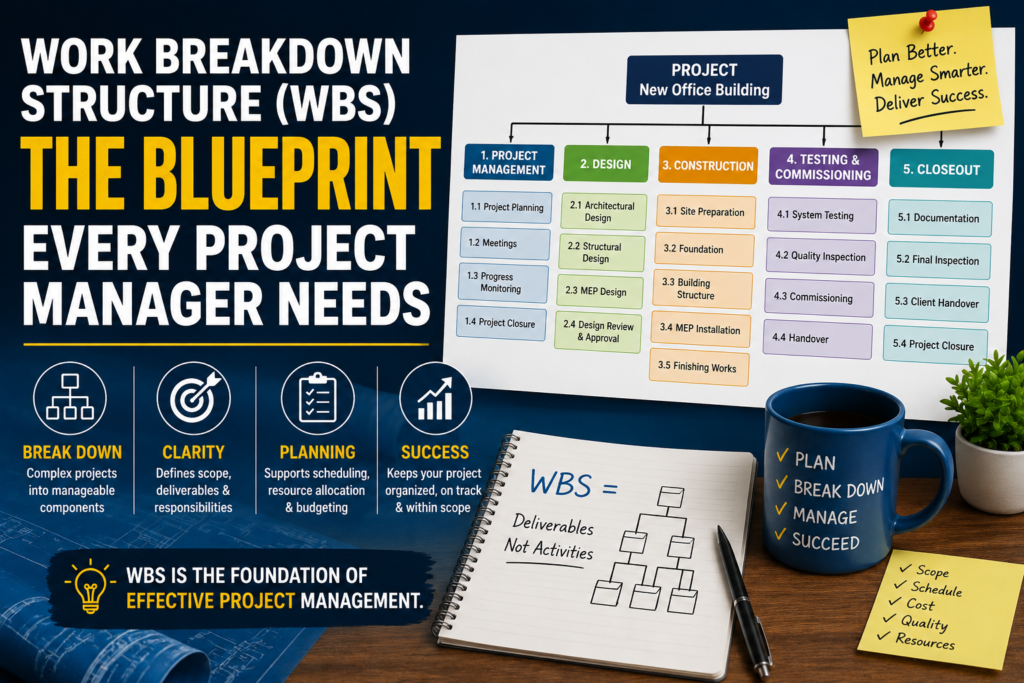
Break the total project scope into work packages — the lowest-level elements of the WBS — each small enough to be estimated, assigned, and tracked individually. As a result, each work package becomes an independently measurable unit of scope. EVM requires this granularity because PV and EV are calculated at the work-package level, not at the total project level. A rule of thumb: no work package should span more than two reporting periods or represent more than 5% of the total project budget.
Define clear completion criteria for each work package — "design drawing approved by engineering" rather than "design 80% done." Consequently, % complete is objective, not estimated.
Work packages that are too large prevent meaningful EV calculation and allow problems to hide until it is too late to correct them.
Allocate the total project budget (BAC) across all work packages. Then spread each work package budget across the time periods when that work is scheduled — creating a time-phased budget known as the Performance Measurement Baseline (PMB). The cumulative PMB curve gives you PV at any point in time. Furthermore, ensure the sum of all work package budgets equals BAC — leaving any unallocated management reserve outside the baseline.
Select how progress (% complete) will be measured for each work package. Common methods include: 0/100 (no credit until complete — good for short tasks), 50/50 (50% credit when started, 50% when complete), Milestones with Weighted Steps (credit at defined completion points), and % Physical Complete (based on measurable physical progress, such as metres of pipe installed or units assembled). Choosing the right method prevents teams from claiming progress on work that is not verifiably done.
Set up your cost accounting system to collect actual costs (AC) at the same WBS level as your work packages. Without this discipline, you can calculate PV and EV but not CV, CPI, or any forecast. Therefore, work with your finance team to ensure that timesheets, purchase orders, and subcontractor invoices are coded to the correct work packages. Weekly data collection is the minimum frequency for meaningful EVM — fortnightly or monthly intervals allow problems to grow too large before they are detected.
Calculate all EVM metrics at each reporting period (weekly or fortnightly). Plot the PV, EV, and AC curves on an S-curve chart — the visual gap between the three lines reveals schedule and cost position at a glance. Report SPI, CPI, EAC, and VAC to the project sponsor at every steering meeting. Most importantly, use the data to trigger management action. EVM is not a reporting exercise — it is a decision support tool. Consequently, any CPI or SPI below 0.9 should trigger a formal investigation and recovery plan within one reporting cycle.
If EV is below PV: behind schedule. If AC is above EV: over budget. If both gaps are growing: the project needs immediate intervention.
Define clear escalation thresholds in the charter: for example, CPI < 0.9 or SPI < 0.85 triggers an automatic sponsor review within 5 working days.
EVM Tools and Software
Although EVM can be run entirely in a spreadsheet, several software tools make the process more efficient. Microsoft Project supports EVM natively — once the baseline is set and actual costs entered, it calculates all metrics automatically. Similarly, Primavera P6, Oracle Fusion Project Management, and specialist EVM tools such as Deltek Cobra and wInsight provide more advanced capabilities for large programmes. However, for most engineering and manufacturing projects, a well-structured Excel workbook with WBS, budget baseline, actuals, and automated EVM formulas is entirely sufficient.
- Provides early warning of cost and schedule problems — before they become unrecoverable
- Integrates scope, schedule, and cost in a single, objective framework
- Produces statistically reliable final-cost forecasts from as early as 20% completion
- Creates a common language for project reporting across all stakeholders
- Enables data-driven management decisions rather than intuition-based responses
- Supports objective comparison of performance across multiple projects
- Required for government and major commercial contracts in many industries
- Forces good upfront planning — WBS, budget allocation, and baseline schedule
- Inaccurate % complete estimates — teams report "80% done" for weeks, hiding real progress
- Actual costs not coded at work package level — AC cannot be calculated correctly
- Baseline changed without formal change control — EVM comparisons become meaningless
- EVM used for reporting only — not to trigger management action on variances
- Work packages too large — problems hide until it is too late to correct them
- % complete assessed subjectively — use objective completion criteria for every work package
- EVM applied to "level of effort" work (management, administration) — distorts indices
- CPI below 0.9 accepted without investigation — the most costly mistake in project management
Summary — The Complete EVM Reference
| Metric | Formula | Good Result | Meaning |
|---|---|---|---|
| PV | BAC × % scheduled | — | Budget for work planned to date |
| EV | BAC × % complete | — | Budget earned by work done |
| AC | Actual spend to date | — | Real money spent so far |
| SV | EV − PV | Positive | Schedule position (£ terms) |
| CV | EV − AC | Positive | Cost position (£ terms) |
| SPI | EV ÷ PV | > 1.0 | Schedule efficiency ratio |
| CPI | EV ÷ AC | > 1.0 | Cost efficiency ratio |
| EAC | BAC ÷ CPI | ≤ BAC | Forecast total project cost |
| ETC | EAC − AC | ≤ remaining budget | Cost to complete remaining work |
| VAC | BAC − EAC | Positive | Forecast over/under at completion |
| TCPI | (BAC−EV) ÷ (BAC−AC) | ≤ 1.10 | Required efficiency to finish on budget |
Key Takeaway
Earned Value Management transforms project reporting from a historical narrative into a forward-looking management tool. Instead of telling you where the project has been, EVM tells you where it is going — and gives you the evidence you need to change course before a problem becomes a crisis. The mathematics are straightforward once you understand the three core values: PV, EV, and AC. Every other metric flows from these three numbers.
In engineering and manufacturing projects, where budgets are large and schedules are tight, EVM provides the objective, data-driven visibility that sponsors and project managers need to make confident decisions. Moreover, it forces the disciplined planning — detailed WBS, time-phased budget, objective completion criteria — that makes projects more likely to succeed regardless of whether EVM reporting is required.
If your CPI falls below 0.9 at any point in the first half of a project, do not wait for it to recover on its own — it almost never does. Instead, investigate immediately, identify the root cause, and present a credible recovery plan to your sponsor. Projects do not fail at the end; they fail silently in the middle while everyone hopes the numbers will improve. EVM removes that hope — and replaces it with evidence and accountability.