What is Project Management — and Why Does It Fail?
Project management is the application of knowledge, skills, tools, and techniques to project activities to meet the project requirements. A project is a temporary endeavour undertaken to create a unique product, service, or result — distinguishing it from operations (ongoing, repetitive work) by its defined start, defined end, specific scope, and unique outcome. Project management is the discipline that ensures this temporary endeavour delivers its intended outcome within the agreed constraints of time, cost, scope, quality, resources, and risk.
A project is successful when it delivers the defined scope of work at or below the approved budget, on or before the agreed completion date, meeting the required quality standards — and the deliverable achieves the business objective it was created to serve. All four conditions must be met. A project that finishes on time and on budget but delivers a product nobody uses has failed. A project that delivers brilliant results three years late and three times over budget has also failed.
The statistics on project performance are sobering. According to PMI’s Pulse of the Profession 2024, 70% of projects fail to meet at least one of their original time, cost, or scope targets. The leading causes are consistent across industries and decades: poorly defined scope at the outset, inadequate risk management, insufficient stakeholder engagement, poor communication, and — especially in manufacturing and engineering environments — the failure to adapt the project management approach to the nature of the specific project. A New Product Introduction (NPI) project in an automotive supplier, a plant expansion project, a quality management system implementation, and a capital equipment installation all require project management — but they require different methodologies, different levels of formality, and different tools.
Companies with high project management maturity outperform their competitors by 32% in revenue growth. The difference is not the tools — it is the discipline of defining work clearly, managing risk proactively, communicating transparently, and learning systematically from what goes wrong.
— PMI Pulse of the Profession 2024History — From Gantt Charts to PMBOK 8th Edition
Project management has existed as long as humans have undertaken complex endeavours — building the pyramids, constructing medieval cathedrals, organising military campaigns. But the systematic, codified discipline of project management emerged in the 20th century, driven by the complexity of industrial projects that exceeded the capacity of any individual to coordinate from memory and experience alone.
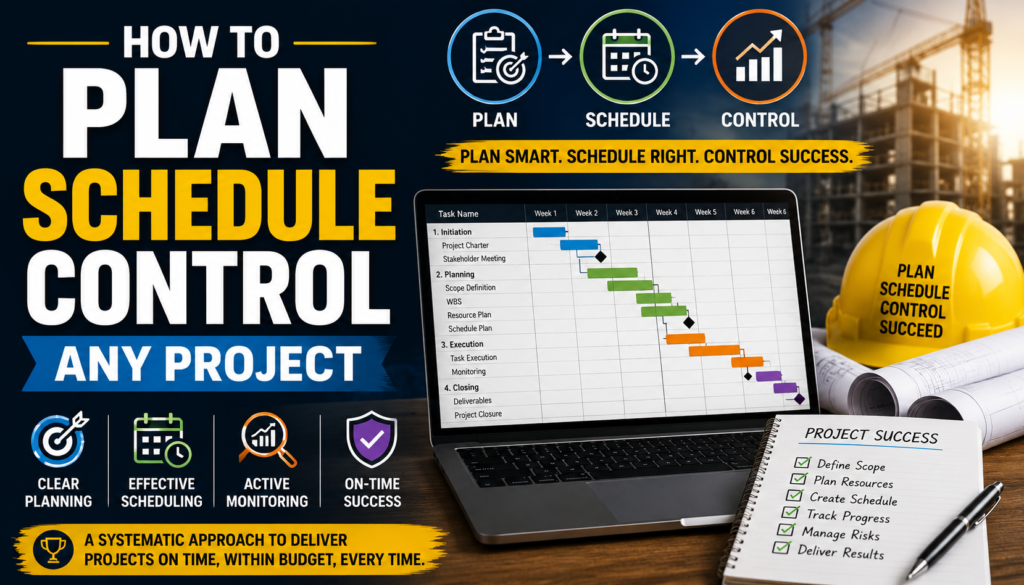
Henry Gantt developed his famous bar chart for visualising project schedules during World War I — a tool so fundamentally useful that it remains the most widely used project scheduling tool 100 years later. The Gantt chart makes time, tasks, and sequencing visible in a single view, enabling both planning and progress tracking.
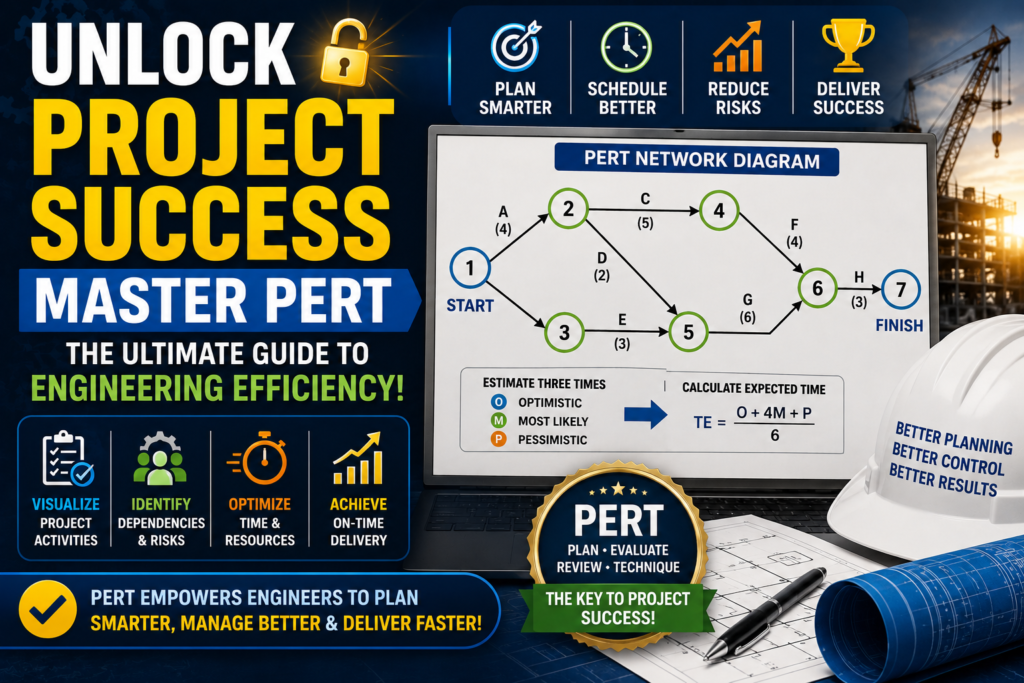
DuPont and Remington Rand developed CPM (1957) for industrial plant maintenance projects; the US Navy developed PERT (1958) for the Polaris submarine missile programme. Both techniques identify the critical path — the longest sequence of dependent activities — enabling project managers to identify which tasks drive the completion date and where schedule compression is most effective.
The Project Management Institute was founded in 1969, establishing project management as a professional discipline with defined competencies, ethics, and qualifications. PMI published the first edition of the PMBOK Guide in 1996 — now in its 8th Edition (2024/2025), it is the globally recognised standard for project management knowledge and practice, with over 700,000 PMP (Project Management Professional) certified practitioners worldwide.
The UK government developed PRINCE2 as a process-based project management method. PRINCE2 is widely used in Europe, UK government projects, and IT infrastructure projects. It emphasises defined roles and responsibilities, phased project execution with formal stage-gate reviews, and a business case that must remain justified throughout the project life.
Seventeen software developers published the Agile Manifesto in 2001, establishing four values and twelve principles that prioritised individuals and interactions over processes and tools, working software over comprehensive documentation, customer collaboration over contract negotiation, and responding to change over following a plan. Agile transformed software project management and has since expanded into engineering and manufacturing project contexts.
The PMBOK 8th Edition (2024/2025) continues the shift from rigid process groups to principles-based approaches with enhanced focus on value delivery and adaptability. It defines 12 project management principles (stewardship, collaboration, value, systems thinking, leadership, tailoring, quality, complexity, risk, adaptability, change, and sustainability) and replaces the fixed process groups with flexible performance domains — reflecting how project management has evolved from rule-following to outcome-delivering.
The Project Lifecycle & Five Process Groups
Every project — regardless of its size, industry, or methodology — passes through a lifecycle of phases from initiation through closure. The PMBOK framework organises the activities that occur throughout this lifecycle into five Process Groups: Initiating, Planning, Executing, Monitoring & Controlling, and Closing. These are not sequential phases that happen once — they are groups of activities that recur iteratively throughout the project, with Monitoring & Controlling running continuously alongside all other groups.
The Triple Constraint (or Iron Triangle) is the foundational model of project management: every project is bounded by Scope (what will be delivered), Time (when it will be delivered), and Cost (what it will cost). These three constraints are interdependent — changing any one forces adjustment in at least one of the others. Add more scope without extending time or increasing cost and quality suffers. Compress the schedule without reducing scope and cost increases. The project manager’s core skill is managing these tradeoffs explicitly and transparently — ensuring that every change to one constraint is deliberately weighed against its impact on the others, rather than letting changes accumulate invisibly until the project is unrecoverable.
The PMBOK 8th Edition (2025) replaces the traditional five process groups with eight Performance Domains — Stakeholders, Team, Development Approach & Life Cycle, Planning, Project Work, Delivery, Measurement, and Uncertainty. This shift recognises that project management is not a linear sequence of activities but an integrated system of interrelated activities that must be tailored to the specific project context, team, and organisation.
Project Management Methodologies — Choosing the Right Approach
No single project management methodology is universally optimal. The choice between Waterfall, Agile, Lean, Hybrid, Scrum, or Kanban depends on the project’s complexity, the stability of requirements, the team’s experience, the organisation’s culture, and the urgency of delivery. Manufacturing and engineering teams typically work across multiple methodologies simultaneously — Waterfall for capital projects, Agile for product development, Lean PM for continuous improvement, and Kanban for operational workflow management.
Waterfall is the original structured project management methodology — a linear, sequential approach where each phase must be completed and formally approved before the next begins. Requirements are fully defined upfront, design is completed before build begins, testing occurs after build is complete. This structure provides predictability, clear accountability, and comprehensive documentation — critical for regulated industries, legal contracts, and projects where changes are expensive or impossible once construction begins.
In manufacturing and engineering, Waterfall remains the dominant methodology for capital projects (new factory construction, plant expansion, major equipment installation), EHS compliance projects, and any project where the physical sequence is non-negotiable — you cannot pour the concrete slab after the building is erected. The key discipline in Waterfall is thorough front-end planning: poorly defined requirements at the start propagate through every subsequent phase, becoming exponentially more expensive to correct as the project progresses. The cost to fix a requirements error in the design phase is roughly 10× the cost of fixing it in the requirements phase; in the construction phase, 100×; after commissioning, potentially 1,000×.
Agile project management delivers value in short, iterative cycles (sprints of 1–4 weeks) rather than as a single final deliverable at project end. Requirements are not defined in full at the start but evolve through continuous collaboration with the customer and feedback from working increments. The team prioritises a backlog of requirements, selects the highest-priority items for each sprint, delivers a working increment at the end of each sprint, reviews it with the customer, and adjusts the backlog based on feedback. This continuous feedback loop is Agile’s core advantage — it minimises the risk of delivering a complete but unwanted product.
In manufacturing and engineering, Agile is increasingly applied to: new product development (design-build-test cycles for prototypes and MVPs), software-intensive product development (EV software, embedded systems, Industry 4.0 applications), process improvement projects (where the optimal solution is not known upfront and must be discovered through experimentation), and R&D programmes (where scientific uncertainty makes rigid planning impossible). Scrum is the most widely used Agile framework — with defined roles (Product Owner, Scrum Master, Development Team), events (Sprint Planning, Daily Scrum, Sprint Review, Sprint Retrospective), and artifacts (Product Backlog, Sprint Backlog, Increment).
Lean Project Management applies the five principles of lean manufacturing — Define Value, Map the Value Stream, Create Flow, Establish Pull, Seek Perfection — to the project management process itself. Where conventional project management focuses on managing constraints (time, cost, scope), Lean PM focuses on eliminating waste in the project process: unnecessary approvals, redundant documentation, waiting time between project activities, rework caused by unclear requirements, and over-specification. The result is a project process that delivers more value with less effort — faster, cheaper, and with higher stakeholder satisfaction.
In manufacturing environments, Lean PM is the natural complement to the operational lean tools (VSM, Kaizen, 5S, SMED) already in use on the factory floor. A Lean PM approach to a quality improvement project might use A3 thinking (Toyota’s one-page problem-solving format) as the project charter, VSM to define the scope and target condition, PDCA as the project management cycle, and Kanban to manage the project team’s work backlog. The PMI-published alignment between PMBOK process groups and Lean principles creates a complete, coherent system for organisations that are simultaneously lean in operations and structured in project delivery.
Hybrid project management combines elements of Waterfall and Agile within a single project — applying each where its strengths are most valuable. A typical manufacturing NPI (New Product Introduction) project naturally fits a hybrid model: the overall programme follows a Waterfall gate structure (Gate 1: Concept, Gate 2: Feasibility, Gate 3: Design, Gate 4: Validation, Gate 5: Launch) with defined deliverables and formal approvals at each gate. But within the design and development phases, the team uses Agile sprints to design, prototype, test, and iterate — delivering design increments rapidly and incorporating customer and manufacturing engineering feedback before committing to final tooling.
The PMBOK 8th Edition explicitly supports hybrid approaches through its Development Approach and Life Cycle performance domain, recognising that most complex engineering and manufacturing projects are neither purely sequential nor purely iterative. The key skill is matching the approach to the work: use Waterfall discipline where physical or contractual constraints require it, and Agile flexibility where discovery and iteration create value. 71% of organisations now use hybrid approaches, reflecting the practical reality that no single methodology handles all situations optimally.
Scope Management & Work Breakdown Structure (WBS)
Scope management — defining precisely what the project will and will not deliver — is the foundation of project success. Scope creep (the gradual, uncontrolled expansion of project scope without corresponding adjustment to time, cost, or resources) is the leading cause of project failure. It begins with good intentions — a stakeholder suggests a small addition, an engineer spots an improvement opportunity, a customer requests “just one more feature” — and compounds until the project is unrecognisable from its original definition.
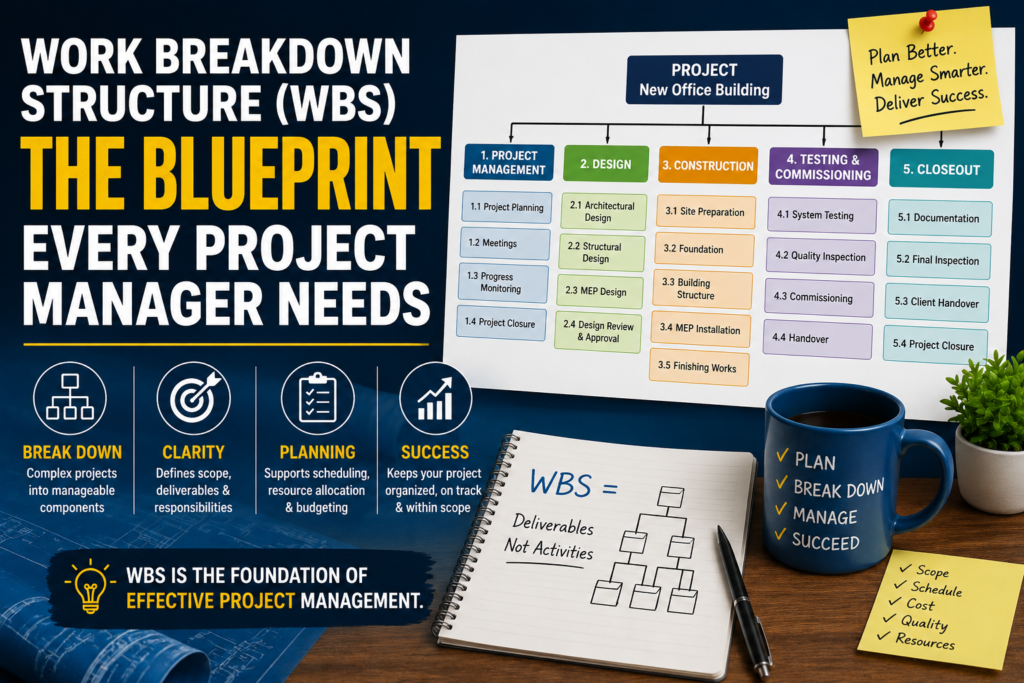
The Work Breakdown Structure (WBS) is the deliverable-oriented hierarchical decomposition of the total scope of work the project team must execute to accomplish the project objectives. It decomposes the project into progressively smaller components — from the project itself (Level 0), to major deliverables (Level 1), to sub-deliverables (Level 2), down to Work Packages (the lowest level — specific, assignable, measurable pieces of work, typically 8–80 hours of effort). The critical rule is the 100% Rule: the WBS must include 100% of the project scope. Nothing outside the WBS is authorised work; nothing inside the WBS can be omitted without a formal scope change.
The WBS is not a task list or an activity list — it is a deliverable list. Each element of the WBS is a noun (a thing that will be produced), not a verb (an action that will be performed). “Install motor control panel” is an activity. “Motor Control Panel” is a WBS deliverable. This distinction matters: a deliverable-oriented WBS forces the team to think about outcomes, not just activities — preventing the common failure mode where all planned activities are completed but the deliverable is not actually ready.
Schedule Management — CPM, Gantt & Critical Path
Schedule management translates the WBS into a time-phased execution plan — defining the sequence of activities, their durations, their dependencies, and the resulting project timeline. The two most important tools are the Gantt chart (a bar chart showing activity durations against a calendar timeline) and Critical Path Method (CPM) analysis (a network analysis technique that identifies the longest path through the project schedule — the critical path whose delay will delay the entire project).
The Critical Path Method (CPM) identifies the critical path — the sequence of project activities that add up to the longest overall duration. Activities on the critical path have zero float (slack), meaning any delay to a critical path activity delays the entire project completion by the same amount. Non-critical activities have positive float — they can be delayed by their float amount without affecting the project completion date. CPM enables the project manager to focus acceleration efforts (crashing — adding resources to shorten duration; fast-tracking — overlapping activities normally done sequentially) where they will actually compress the schedule, rather than wasting acceleration effort on non-critical activities that have available float.
PERT (Programme Evaluation and Review Technique) extends CPM by incorporating uncertainty in duration estimates — using three estimates for each activity (Optimistic O, Most Likely M, and Pessimistic P) to calculate a weighted expected duration: PERT Duration = (O + 4M + P) / 6. This probabilistic approach produces more realistic schedule estimates for novel or complex activities where duration uncertainty is significant — common in engineering development projects where technical challenges are not fully known at the planning stage.
Risk Management — Identifying, Assessing & Responding
Risk management is the systematic process of identifying events that could positively or negatively affect project objectives, assessing their probability and impact, and planning responses to maximise opportunities and minimise threats. In manufacturing and engineering projects, risk management is not optional — it is the difference between a plant expansion that stays on schedule and one that sits idle while waiting for a delayed equipment delivery, or between an NPI programme that hits SOP and one that requires an emergency PPAP extension.
The four risk response strategies for threats are: Avoid — change the plan to eliminate the risk entirely (most effective when the risk is too high and an alternative path exists); Transfer — shift the financial consequence to a third party through insurance, bonds, or contractual clauses; Mitigate — reduce the probability or impact of the risk through preventive action; and Accept — acknowledge the risk and create a contingency reserve or response plan if it occurs (appropriate for low-priority risks where mitigation cost exceeds the risk exposure). For opportunities, the corresponding strategies are: Exploit, Share, Enhance, and Accept.
In manufacturing and engineering, the most critical risk category is supply chain risk — single-source supplier failure, long-lead-time equipment delay, and raw material availability — followed by technical risk (design not performing to specification during validation), regulatory risk (approval or certification delays), and resource risk (skilled personnel unavailability). A well-constructed risk register for a plant expansion project typically contains 30–60 identified risks, of which 5–10 require active mitigation strategies with named owners, completion dates, and budget allocation.
Stakeholder Management & Communication
Projects are ultimately delivered by people — and the most technically perfect project plan fails when the people whose support, decisions, and resources it requires are not engaged, informed, and aligned. Stakeholder management is the systematic identification of all individuals and organisations who can affect or be affected by the project, understanding their interests and influence, and developing strategies to engage them appropriately throughout the project lifecycle.
| Stakeholder Communication Tool | Purpose | Frequency | Audience | Format |
|---|---|---|---|---|
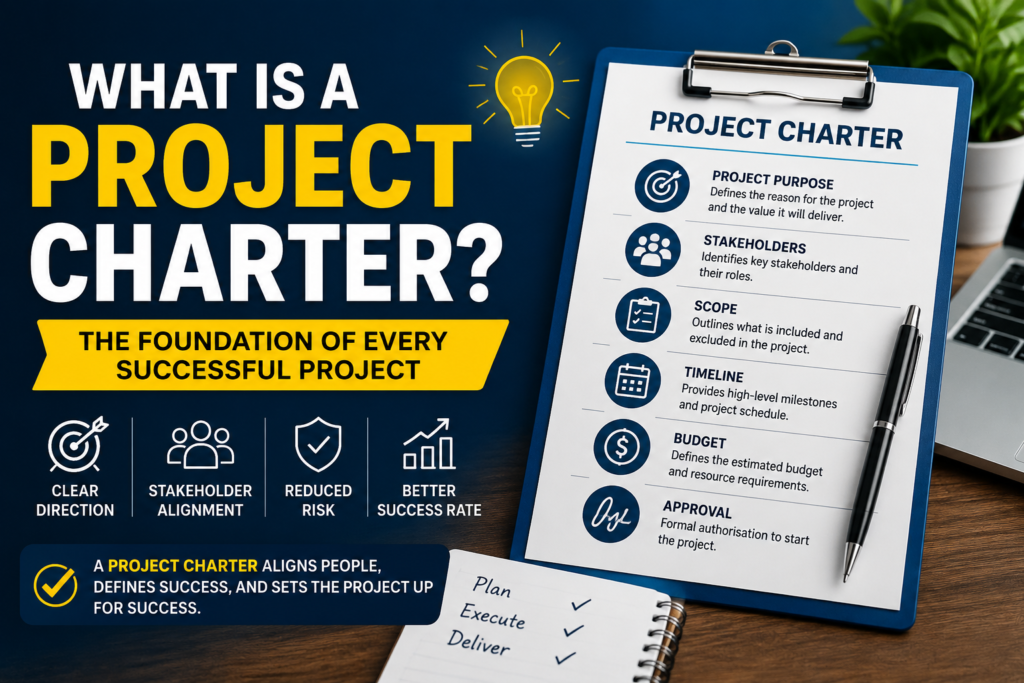
| Project Charter | Formally authorises the project; defines objectives, scope, budget, sponsor, and PM authority | Once — at initiation | Sponsor, senior leadership, key stakeholders | 1–2 page formal document |
| Kickoff Meeting | Aligns all team members and stakeholders on scope, plan, roles, and ground rules at project start | Once — at planning completion | Full project team + key stakeholders | Structured meeting + slides |
| Status Report | Concise update on schedule, cost, scope, risks, issues, and next actions | Weekly or biweekly | Sponsor, steering committee, team | 1-page RAG (Red/Amber/Green) dashboard |
| Steering Committee Review | Escalation of major decisions, risks, and changes requiring executive authority | Monthly or at stage gates | Sponsor, executives, key stakeholders | Structured meeting + decision log |
| Team Standup (Agile) | Daily 15-minute coordination: What did you do yesterday? What will you do today? What is blocking you? | Daily | Project team only | Standing meeting — no chairs |
| Change Control Board | Formal review and approval/rejection of proposed changes to scope, schedule, or budget | As changes arise | PM, sponsor, affected stakeholders | Change request form + impact assessment |
| Lessons Learned Register | Continuous capture of what worked and what didn’t — the organisational memory of the project | Throughout + at close | PM, team, PMO | Structured register in project management tool |
The RACI Matrix (Responsible, Accountable, Consulted, Informed) is the most practical stakeholder management tool for manufacturing and engineering project teams. For every key project decision and deliverable, the RACI matrix defines exactly one person who is Accountable (the decision-maker, the one person who must approve the deliverable — if there is more than one, there is none), one or more people who are Responsible (those who do the work), those who must be Consulted (subject matter experts whose input is needed before the decision), and those who must be Informed (those who need to know the outcome but not contribute to it). A RACI matrix eliminates the two most common project failure modes: decisions made without the right people in the room, and key stakeholders surprised by outcomes they should have been consulted on.
Project Management Tools & Software
Project management tools range from a pencil-and-paper Gantt chart drawn on graph paper (still entirely valid for small projects) to enterprise project portfolio management platforms integrating AI-driven scheduling, resource management, and predictive analytics. The right tool is the simplest one that adequately supports the project’s complexity, the team’s collaboration needs, and the organisation’s reporting requirements.
The industry-standard scheduling tool for Waterfall and hybrid projects. Full CPM analysis, Gantt charts, resource levelling, baseline tracking, and integration with Microsoft 365. Steep learning curve but unmatched for complex schedule management. Widely used in manufacturing, construction, and engineering projects.
The dominant Agile project management platforms — backlog management, sprint planning, burndown charts, velocity tracking. Jira is ubiquitous in software and product development; Azure DevOps integrates with Microsoft development tooling. Both support Scrum and Kanban boards natively.
Visual, collaborative work management platforms ideal for cross-functional teams. Flexible between Gantt, Kanban, and list views. Lower learning curve than MS Project. Excellent for stakeholder communication dashboards, task tracking, and hybrid project management in manufacturing teams.
Simple, visual Kanban boards for teams managing work-in-progress across workflow stages. Trello (digital) and physical Kanban boards on the shop floor or office wall work equally well for lean project management, kaizen event management, and daily team coordination.
Enterprise project portfolio management for large capital projects — oil & gas, construction, EPC projects. Handles complex multi-project environments with thousands of activities, resource pools across projects, and earned value management (EVM) for budget control. Standard in large infrastructure and plant construction.
For lean organisations, the A3 format (Toyota’s one-page structured problem-solving and project planning format) provides all essential project information — background, current state, target state, root causes, countermeasures, implementation plan, and follow-up — on a single A3 sheet. The constraint of one page forces clarity and prevents bureaucratic over-engineering of small to medium projects.
Project Management in Manufacturing & Engineering
Manufacturing and engineering teams face a distinctive project management challenge: they must manage simultaneously the technical complexity of what is being built and the operational complexity of building it without disrupting ongoing production. A quality improvement project, a new product launch, a plant expansion, and a capital equipment installation all have different risk profiles, different stakeholder maps, different optimal methodologies — yet all must coexist in the same operational environment with shared resources and competing priorities.
| Project Type | Best Methodology | Key Success Factor | Critical Risk | PM Tool |
|---|---|---|---|---|
| Common Manufacturing Project Types | ||||
| New Product Introduction (NPI) | Hybrid (APQP gate + Agile design) | Cross-functional team ownership · APQP timing plan maintained rigorously · PPAP evidence built in parallel | Late design changes after tooling committed · Single-source supplier delays · Scope creep from customer ECNs | MS Project + APQP tracking sheet |
| Plant / Line Expansion | Waterfall with stage gates | Front-end engineering complete before construction · Phased commissioning plan · Operator training tracked as project deliverable | Equipment delivery delays (long-lead items) · Civil works scope changes · Commissioning compressed by fixed SOP date | Primavera P6 or MS Project |
| Quality Improvement Project (Six Sigma / Kaizen) | Lean PM with DMAIC / PDCA | Clear problem statement and measurable target · Data-driven root cause identification · Sustained management attention past initial improvement | Reversion to old habits after project closes · Root cause misidentified (treating symptom) · Resistance from production team | A3 / DMAIC templates · Simple tracking sheet |
| Capital Equipment Installation | Waterfall + commissioning Agile | Pre-installation qualification (IQ) planning · Operator and maintenance training · Spare parts inventory before first production run | Integration with existing systems (electrical, MES, ERP) · Safety validation and LOTO procedure development · Production schedule impact during installation | MS Project + Gantt chart |
| ISO / IATF Certification | Waterfall with clear milestones | Comprehensive gap analysis as first deliverable · Internal audit programme completing before Stage 2 · Management commitment visible and sustained | Documentation created but not embedded in daily practice · Internal auditors lacking core tools competency · Certification body audit finding major NCs | Asana / Monday.com + document register |
| ERP / MES System Implementation | Hybrid (phased rollout + Agile config) | Data migration quality as a formal workstream · Super-user training before go-live · Parallel run period with old system | Data migration failures causing production disruption · User adoption resistance · Integration with existing equipment and systems | Jira or Monday.com for implementation sprints |
- NPI projects that hit SOP on schedule with approved PPAP — no interim approvals, no emergency containment
- Capital projects completed within budget with no unplanned production disruption during installation
- Quality improvement projects that sustain their gains beyond the initial celebration — because the PM plan included a control phase
- Cross-functional teams that collaborate effectively because roles, responsibilities, and decisions are explicitly defined in the RACI matrix
- Executive stakeholders who support the project because they are informed proactively and consulted on decisions that affect them
- Organisational learning from project to project — because lessons learned are captured, published, and actually used in subsequent projects
- Project manager is a technical expert given PM responsibility without PM training — manages the technical content but not the project
- No project charter — team not aligned on what success looks like, enabling disagreement at every decision point
- WBS not created — scope not decomposed into assignable, measurable work packages, making progress tracking impossible
- Risk register created at kickoff and never updated — risks materialise as surprises rather than managed events
- Schedule baseline not maintained — changes accumulate without impact assessment, project slides invisibly
- Stakeholder communication reactive (we report bad news when forced) rather than proactive (we report status weekly whether good or bad)
- No formal project closure — lessons learned not captured, success not celebrated, team not officially released from project obligations
Summary & Implementation Roadmap
Project management is not a bureaucratic overhead imposed on engineering teams — it is the systematic discipline that turns good engineering intentions into delivered results, on time, within budget, and to the quality that stakeholders need. The organisations with high project management maturity consistently outperform their competitors — not because they follow more rules, but because they define their work more clearly, manage their risks more proactively, and learn from their failures more effectively than organisations that treat project management as optional.
Audit your current projects. Categorise them by type (NPI, capital, quality improvement, system implementation). For each type, identify the most appropriate methodology and document it. Create standard templates: project charter, WBS template, risk register, RACI matrix, status report format. These templates reduce the overhead of project initiation and ensure consistency across the project portfolio.
Train all project managers and project team leads in PM fundamentals: triple constraint, WBS creation, schedule management, risk management, and stakeholder communication. Focus particularly on defining scope — this is the highest-return PM skill for manufacturing teams, where scope creep is endemic. Consider CAPM (Certified Associate in Project Management) or PMP certification for dedicated project managers.
Select 2–3 current high-priority projects and apply the full PM discipline — formal charter, WBS, schedule with critical path, risk register, and weekly status reporting. Assign a PM coach (internal or external) to support project managers through the first application. Display project dashboards visibly — a RAG status board on the team wall or a shared digital dashboard creates the accountability culture that makes PM sustainable.
Establish a lightweight Project Management Office (PMO) — a function that maintains project standards, provides PM coaching, manages the portfolio view across all active projects, and captures lessons learned in a searchable library. The PMO should be an enabler, not a police force — its value is creating the shared infrastructure (templates, tools, training, portfolio reporting) that individual project managers rely on rather than recreating from scratch for every project.
Track project performance metrics: schedule performance index (SPI = earned value / planned value), cost performance index (CPI = earned value / actual cost), on-time delivery rate, stakeholder satisfaction, and lessons learned implementation rate. Use these metrics to identify where the PM system is weakest and invest in targeted improvement. PM maturity is not a destination — it is a continuous improvement journey, and the organisations that sustain the discipline of measuring and improving their project delivery are the ones that consistently outperform their peers.
The Central Truth of Project Management
Every project begins with optimism: the scope seems clear, the schedule looks achievable, the budget appears adequate, and the team is energised. Six months later, many of those same projects are late, over budget, and delivering less than the stakeholders expected — not because the engineers were incompetent, but because the project lacked the discipline to make its assumptions explicit, its risks visible, its decisions documented, and its progress measured against a baseline. Project management is not the enemy of engineering creativity — it is the system that ensures creativity is channelled into delivered results rather than dissipated in unmanaged complexity.
The manufacturing and engineering teams that master project management — that write charters before they start work, build WBS before they build schedules, manage risks before they become crises, and communicate proactively rather than reactively — are the teams that hit SOP on NPI programmes, deliver capital projects without production disruption, and sustain quality improvements beyond the initial kaizen event. The tools are learnable. The discipline is a choice. And the returns — measured in on-time project delivery, reduced rework, and stakeholder confidence — compound with every successful project.
Define the scope before you start. Plan before you act. Measure against the baseline, not against memory. Communicate bad news faster than good news. The project that surfaces its problems early, when they can still be managed, always outperforms the project that hides its problems until they cannot be avoided. That is project management — not the elimination of problems, but the creation of a system in which problems are visible, manageable, and continuously resolved before they become crises.
Project Management · PMBOK 8th Edition · Agile · Lean PM · Waterfall · Hybrid · WBS · CPM · Risk Management · Manufacturing NPI · PMI · PRINCE2 · RMG Tech