What is EV Manufacturing & Why It Transforms Everything
Electric vehicle manufacturing is not simply automotive manufacturing with a different powertrain. It is a fundamentally different engineering and manufacturing system — one that requires mastery of electrochemistry, power electronics, software-defined vehicle architecture, and precision manufacturing at scales and tolerances that the automotive industry has never previously encountered. The transition from internal combustion engine (ICE) to battery electric vehicle (BEV) is the most consequential industrial transformation since Henry Ford introduced the moving assembly line in 1913.
A Battery Electric Vehicle (BEV) replaces the ICE powertrain — engine, transmission, exhaust, fuel system, starter motor, alternator — with three primary electrified systems: a high-voltage battery pack (the energy source), one or more electric motors (the propulsion system), and a power electronics assembly (the energy conversion and control system). These three systems, plus their thermal management, interact with a sophisticated software layer that did not exist in conventional vehicles, creating a product that is radically simpler mechanically but dramatically more complex electronically and thermally.
The numbers tell the story of the transformation: a conventional four-cylinder ICE has approximately 113 moving parts. The equivalent electric motor has 3 moving parts. A conventional powertrain — engine, transmission, exhaust, cooling — represents roughly 30% of a vehicle's manufacturing cost and involves thousands of precision components from hundreds of suppliers. The EV powertrain involves far fewer components, but the battery pack alone accounts for up to 50% of the vehicle's total value, and requires entirely new chemistry, materials, manufacturing processes, and quality management approaches that most traditional automotive suppliers are not equipped to provide.
The lithium-ion battery pack alone can account for up to 50% of the value of today's EVs. The share of a car's value attributable to the powertrain and electronics will rise significantly, at the expense of the chassis, body, and interior components. This structural shift is redefining who creates value in the automotive supply chain.
— PwC Strategy&, Electric Vehicles and the Automotive Supply ChainBattery Technology & Cell Chemistry
The lithium-ion battery is an electrochemical energy storage device that stores and releases electrical energy through reversible chemical reactions. During discharge, lithium ions migrate from the anode (typically graphite) through a liquid electrolyte and porous separator to the cathode (a lithium metal oxide compound), while electrons flow through the external circuit to power the motor. During charging, the process reverses. The performance, cost, safety, and longevity of the EV are determined primarily by the cathode chemistry — which defines the specific energy, power capability, thermal stability, and cycle life of the cell.
The four dominant cathode chemistries in 2025 are:
- Energy density 250–280 Wh/kg
- Voltage 3.6–3.7 V
- Cycle life 1,000–2,000
- Thermal stability Moderate
- Cost Higher (cobalt)
- Used by BMW, Mercedes, VW
- Energy density 150–200 Wh/kg
- Voltage 3.2–3.3 V
- Cycle life 3,000–5,000+
- Thermal stability Excellent
- Cost Lower (no cobalt)
- Used by Tesla SR, BYD, CATL
- Energy density 260–300 Wh/kg
- Voltage 3.6 V
- Cycle life 500–1,000
- Thermal stability Lower
- Cost High
- Used by Tesla LR/Panasonic
- Energy density 300–400+ Wh/kg
- Voltage Higher than liquid
- Cycle life 100,000+ (target)
- Thermal stability Excellent
- Cost Very high (2025)
- Status CATL/Toyota 2026–27
Cell formats are equally important as chemistry. Cylindrical cells (18650, 21700, 4680) offer mechanical robustness, high energy density at cell level, and mature manufacturing — Tesla's 4680 cell achieves 5× the energy and 6× the power of the 2170, with 16% range improvement and 14% cost reduction per kWh. Prismatic cells (used by CATL, BYD, BMW) pack efficiently into modules, offer good structural rigidity, and enable the Cell-to-Pack (CTP) integration approach. Pouch cells (used by LG Energy Solution, SK On) offer the highest gravimetric energy density but require careful mechanical management to handle swelling during charge-discharge cycles. In 2026, the industry is converging on large-format cylindrical (4680 and larger) and prismatic CTP as the dominant formats for cost and energy density leadership.
Battery Pack Design, BMS & Cell-to-Pack Technology
The battery pack is the complete assembly that integrates individual cells into a safe, manageable, structurally sound unit that can be installed in the vehicle. Traditionally designed as Cell → Module → Pack — cells grouped into modules, modules assembled into the pack — this hierarchy adds weight, volume, and cost at each stage. The industry is aggressively eliminating this hierarchy:
Cell-to-Pack (CTP) — pioneered by CATL's Blade Battery and adopted by BYD — eliminates the module layer entirely, arranging cells directly in the pack enclosure. CTP increases volumetric energy density by 15–50%, reduces part count, and lowers manufacturing cost. The structural rigidity normally provided by modules is instead achieved by the cell arrangement and pack enclosure design. Cell-to-Body (CTB) and Cell-to-Vehicle (CTV) go further — integrating the battery pack as a structural load-bearing component of the vehicle body, enabling the Tesla Model Y's structural pack approach where the pack floor replaces the traditional vehicle underbody structure entirely.
The Battery Management System (BMS) is the electronic system that monitors and controls every parameter of the battery pack in real time: individual cell voltages (to 1mV accuracy), temperatures (to 0.1°C), state of charge (SoC), state of health (SoH), state of power (SoP), current, and insulation resistance. The BMS protects against overcharge, over-discharge, over-temperature, and short circuit — the four failure modes that lead to thermal runaway. It also performs cell balancing (redistributing charge between cells to maintain uniform SoC across the pack), communicates with the vehicle control unit, and manages the charging profile. The BMS software is now classified as safety-critical embedded software requiring development per ISO 26262 (Automotive Functional Safety) at ASIL-D — the highest safety integrity level.
The pack enclosure is increasingly produced using large-format aluminium die casting — Tesla's Giga Press casts the entire battery pack tray as a single component, replacing 100+ individual stampings and welded assemblies. CATL, Volkswagen, and other OEMs are adopting similar approaches. The structural requirements are demanding: the pack must withstand a 25kN vertical crush load (UN GTR 20 test), prevent thermal runaway propagation between adjacent cells for a minimum of 5 minutes after any single cell event, and maintain watertight integrity at IP67 standard (1m water immersion for 30 minutes).
Electric Motors — PMSM, Induction & BLDC
The electric motor is the defining component of EV performance — converting electrical energy from the battery into mechanical torque at the wheels with efficiencies of 85–97%, compared to 25–40% for a gasoline engine. Three motor types dominate EV applications:
Permanent Magnet Synchronous Motor (PMSM) — the dominant EV motor. Uses rare-earth neodymium-iron-boron (NdFeB) permanent magnets embedded in the rotor to create the magnetic field, with AC current in the stator windings providing torque. PSMMs achieve 93–97% peak efficiency, exceptional power density (3–10 kW/kg), and maintain high efficiency across a wide speed range. The limitation is rare-earth dependency: NdFeB magnets require neodymium and dysprosium, of which China controls approximately 90% of global production. Every major OEM is actively researching reduced rare-earth or rare-earth-free alternatives. Hairpin winding — where the stator windings are rectangular-cross-section copper conductors bent and laser-welded into the stator slots (rather than round wire wound) — increases copper fill factor by 40–50%, reducing resistance, heat generation, and losses while enabling higher current density. Hairpin stators are now the manufacturing standard for high-performance EV motors, with laser welding of hundreds of hairpin conductor ends per stator being a new and critical manufacturing challenge.
Induction Motor (IM) — used by Tesla (front motor in dual-motor variants) and historically the dominant industrial motor. No permanent magnets — the rotor field is induced by the stator AC current, eliminating rare-earth dependency. Slightly lower peak efficiency (85–92%) than PMSM but no cogging torque, simpler rotor manufacturing, and better high-speed performance. Increasingly challenged by PMSM for new EV designs due to PMSM's superior efficiency and power density, particularly at part-load (the dominant driving condition).
Synchronous Reluctance and Switched Reluctance Motors — emerging rare-earth-free alternatives that use the variation in magnetic reluctance of a specially designed rotor to generate torque without permanent magnets. Lower power density than PMSM but significant cost and supply chain advantages. Companies including Renault (with their E-Tech system) and multiple Chinese OEMs are adopting these for cost-sensitive segments. The motor efficiency comparison across all types is critical: even a 1% efficiency improvement at the motor translates directly to battery pack cost reduction or range increase, with compound effects across the entire vehicle system.
Power Electronics — The Brain of Energy Flow
Power electronics are the electronic control and conversion systems that manage the flow of electrical energy between the battery, motors, charging system, and auxiliary loads. They are arguably the most technology-intensive and fastest-evolving component group in the EV, and the transition from silicon (Si) to silicon carbide (SiC) semiconductor devices is the single most significant power electronics development of the decade.
The Traction Inverter is the primary power conversion unit — converting the battery's DC voltage (typically 400V or 800V) into three-phase AC voltage at variable frequency and amplitude to control motor speed and torque. It must manage power levels from a few kilowatts (city driving) to 200–700 kW (peak acceleration) with efficiency exceeding 96–98%. The semiconductor switching devices — IGBTs (Insulated Gate Bipolar Transistors) in older designs, SiC MOSFETs in modern designs — switch at frequencies of 5–20 kHz, controlling current pulses that determine the motor's speed and torque. SiC MOSFETs enable: higher switching frequency (reducing motor noise and filter size), higher operating temperature (reducing cooling requirements), lower on-state resistance (reducing conduction losses), and support for 800V architectures (SiC handles 1,200V rated voltage vs Si's practical 600–750V limit). Tesla's Model 3 and Y use a full-SiC inverter — and have demonstrated 5–8% system-level efficiency improvement over comparable Si-IGBT systems, translating directly to increased range for the same battery capacity.
The 800V architecture is the most significant system-level power electronics trend. At 800V (versus 400V), the same power level requires half the current — reducing cable cross-section, connector size, motor winding resistance, and I²R losses throughout the drivetrain. Most importantly, 800V enables ultra-fast DC charging at up to 350 kW (Hyundai Ioniq 6 charges at 350 kW, adding 100km range in 5 minutes). The Porsche Taycan pioneered the 800V architecture in 2019; by 2026, it is becoming the standard for premium EVs globally, with cost-segment vehicles expected to follow by 2028–2030.
The Onboard Charger (OBC) converts AC from the charging point (Type 2, 7.4–22 kW AC) to DC at the battery pack voltage. Modern OBCs achieve 94–97% conversion efficiency. The DC-DC Converter steps down the high-voltage bus (400V or 800V) to the 12V or 48V auxiliary bus that powers lights, infotainment, HVAC blower, and ancillary systems — replacing the conventional alternator. Integration is the trend: Tesla's Model Y, BYD's e-platform, and Volkswagen's MEB platform all consolidate inverter, OBC, and DC-DC into a single Power Distribution Unit (PDU) or integrated e-axle unit, reducing part count, wiring complexity, and overall system cost.
Thermal Management — The Hidden Critical System
Thermal management is the most underappreciated and technically demanding system in EV engineering. The battery pack operates optimally in a narrow temperature window of 15–35°C — below this range, battery capacity and power capability are significantly reduced (a LFP pack loses 30–40% capacity at −20°C); above 45°C continuously, degradation accelerates and the risk of thermal runaway increases. The motor, inverter, and charging system all generate heat that must be precisely managed. And the passenger cabin must be heated in winter without the waste heat of an ICE engine that conventional vehicles exploit. All of these thermal loads must be managed by a single integrated system that is simultaneously efficient, lightweight, compact, and fail-safe.
Battery cooling uses liquid cooling plates (aluminium plates with serpentine coolant channels pressed against the cell bottom or sides), cold plate cooling beneath CTP packs, or — in the most advanced systems — immersion cooling where cells are directly submerged in a dielectric fluid. Immersion cooling achieves dramatically superior thermal uniformity across the pack (reducing cell-to-cell temperature differential from ±5°C to ±1°C), enables faster charging with less degradation, and eliminates the thermal interface material layers that add resistance in conventional cooling approaches. Immersion cooling is beginning to appear in stationary storage applications and will enter vehicle applications by 2027–2028.
The heat pump is the most impactful single thermal efficiency improvement in EV engineering. A conventional resistive cabin heater draws directly from the battery — in cold weather, up to 3–5 kW of continuous heating load reduces vehicle range by 20–40%. A heat pump extracts ambient heat from the outside air and transfers it to the cabin at 2–4× the energy efficiency of resistance heating, reducing the heating energy consumption by 50–70%. Tesla's Model Y heat pump (introduced in 2020) uses a novel octovalve system that can route refrigerant between battery, motor, inverter, and cabin heat exchangers in multiple configurations — using waste heat from the motor and power electronics to pre-condition the battery and heat the cabin simultaneously.
EV Manufacturing Processes — The Gigafactory Revolution
Battery cell manufacturing is the most capital-intensive and process-sensitive manufacturing operation in the EV supply chain. A modern cylindrical or prismatic cell production line — an electrode-to-cell line — involves: electrode slurry mixing (cathode and anode active materials mixed with binder and solvent), electrode coating (slurry cast onto aluminium or copper foil at 60–120 m/min in a coating machine), calendering (compression of the electrode to achieve target porosity), slitting (cutting coated foil to cell width), winding or stacking (spirally winding or stacking electrode layers with separator between), electrolyte filling in a dry room (less than 1% relative humidity — a critical process step where moisture causes irreversible battery degradation), formation charging (the first charge-discharge cycle that forms the SEI layer and determines initial cell capacity), and grading and binning (sorting cells by capacity, impedance, and self-discharge for matched cell grouping). The entire line represents an investment of $200–400 million per GWh of capacity.
Battery pack assembly — integrating cells into the pack — involves: cell receipt and incoming inspection (capacity, impedance, and dimensional checks), laser welding of cell interconnects (connecting cell tabs to the busbars that connect cells in series and parallel — hundreds or thousands of laser welds per pack, each requiring ±0.1mm positional accuracy and in-process monitoring for weld quality), thermal interface material (TIM) application between cells and cooling plates, module or CTP assembly, BMS PCB installation, pack enclosure sealing, and leak testing. 100% electrical performance testing of every pack — charging, discharging, capacity verification, isolation resistance, and BMS function check — is mandatory before installation.
Tesla's Giga Press innovation — introduced in Model Y production at Giga Texas — uses the world's largest die casting machines (6,000–9,000 tonne clamping force) to cast the entire rear underbody structure as a single aluminium component, replacing 70–100 individual stamped and welded parts. This eliminates hundreds of welds, reduces the number of body shop robots, and cuts manufacturing floor space by 30%. The structural battery pack approach (integrating the pack as a structural body component) extends this further, eliminating the separate pack enclosure and enabling a lighter, more rigid vehicle structure. BYD's e-platform 3.0 and Volkswagen's MEB platform are adopting equivalent large-casting approaches.
The New Autopart Ecosystem — Winners & the Challenged
The transition to EVs is not simply a powertrain change — it is a structural reorganisation of the entire automotive value chain. The $400 billion global automotive parts industry is being remapped. Components that took decades to optimise for ICE vehicles — exhaust systems, fuel injectors, transmissions, timing belts, camshafts, oil pumps, spark plugs, catalytic converters — simply do not exist in an EV. Simultaneously, entirely new component categories worth hundreds of billions of dollars are being created from scratch, with new entrants — battery manufacturers, semiconductor companies, software firms — competing directly with established Tier 1 automotive suppliers for supply chain position.
- Battery cell manufacturers (CATL, BYD, LG Energy Solution, Panasonic, Samsung SDI) — controlling up to 50% of vehicle value
- Power electronics suppliers (Infineon, STMicroelectronics, ON Semiconductor) — SiC device demand growing 40%+ annually
- Electric motor & e-axle suppliers (Nidec, BorgWarner, Vitesco, ZF) — replacing ICE powertrain revenue
- Thermal management specialists (Hanon Systems, Modine, Gentherm) — EV thermal complexity drives new content per vehicle
- High-voltage wiring harness suppliers (Aptiv, Lear, Sumitomo) — EV harnesses are larger, more complex, and higher-margin
- Aluminium die casting specialists — Giga Press-scale structural casting and battery enclosure demand expanding rapidly
- Semiconductor companies — microcontrollers, SiC devices, and BMS ICs: completely new content in every EV
- Battery recycling & second-life companies — EU Battery Regulation 2023 mandates recycled content targets from 2031
- Exhaust system manufacturers (Tenneco, Faurecia/Forvia) — catalytic converters, mufflers, DPF: zero content in BEV
- Transmission specialists — complex automatic and manual gearboxes replaced by single-speed reduction gear
- Fuel system suppliers — fuel pumps, injectors, fuel rails, fuel tanks eliminated in BEV
- Spark plug and ignition system suppliers — completely eliminated in BEV
- ICE-specific cooling system suppliers — radiators, water pumps, thermostat housings: partially replaced
- Conventional starter motor and alternator suppliers — replaced by DC-DC converter and integrated motor-generator
- Oil and filter manufacturers — engine oil, oil filters: zero requirement in BEV (gear oil requirement much smaller)
- Brake component suppliers — partial pressure as regenerative braking reduces friction brake wear significantly
Supply Chain, Critical Materials & Geopolitics
No analysis of EV manufacturing is complete without confronting its most consequential challenge: the extraordinary geographical concentration of its critical supply chains. The EV transition has created new dependencies that are as strategically significant as oil — and considerably more concentrated.
| Critical Material / Component | China's Global Share | Key Risk | Strategic Response |
|---|---|---|---|
| Battery Supply Chain — Extreme Concentration | |||
| Battery cell production | 80% (IEA 2024) | CATL + BYD dominate globally; LGES, Panasonic, Samsung trail significantly | EU Gigafactories (Northvolt, ACC, CATL EUR); US IRA incentives for domestic production |
| Lithium processing | ~60–70% | Australia and Chile hold largest lithium reserves but China controls processing | SQM/Albemarle (Americas), Lithium Americas, direct investment in processing |
| Cathode active materials (CAM) | >70% | NMC/LFP cathode precursor and active material production nearly entirely China | Umicore (Belgium), BASF (Germany), SK, Posco building ex-China CAM capacity |
| Anode (graphite) | >90% | Most critical single-country dependency in battery supply chain | Synthetic graphite (Novonix), silicon anode (Sila), US domestic graphite mining |
| Motor & Power Electronics Supply Chain | |||
| NdFeB permanent magnets | ~90% | Rare earth magnet export controls — China imposed in 2023, escalated in 2025 | RE-free motor development; MP Materials (US), Lynas (Australia) rare earth mining |
| SiC wafers | ~35–40% | Wolfspeed (US), ROHM (Japan), STMicro (EU/Morocco) diversifying | CHIPS Act funding; US domestic SiC capacity expansion |
| Semiconductor MCUs | Growing | TSMC (Taiwan) remains critical; vulnerability highlighted by 2021 chip shortage | Intel Foundry, Samsung, EU Chips Act |
The geopolitical dimension is intensifying. China's March 2023 export controls on rare earth processing technology and its 2025 expansion of those controls to cover neodymium magnet exports have created direct supply chain vulnerability for every OEM using PMSM motors. The US Inflation Reduction Act (IRA) and EU Battery Regulation 2023 are simultaneously pushing for domestic battery supply chains with blunt incentive and penalty mechanisms. By 2026, the EV supply chain is bifurcating into two distinct ecosystems — Chinese and Western — with significant implications for cost, technology access, and production efficiency. Battery pack prices have fallen to $108 per kWh at the pack level, but China's faster pace of battery cost reduction has been enabled by fierce competition that has driven down profit margins while driving up manufacturing efficiency — a competitive dynamic that Western producers are struggling to replicate outside China's vertically integrated supply chain.
EV Quality Standards & Safety Requirements
EV manufacturing introduces quality and safety requirements that have no precedent in conventional automotive manufacturing. The combination of high-voltage systems (400–800V), electrochemical energy storage (thermal runaway risk), and safety-critical software (ASIL-D functional safety requirements) creates a quality and compliance framework of extraordinary breadth and depth.
| Standard / Regulation | Scope | Key Requirement | Applies To |
|---|---|---|---|
| Battery Safety | |||
| UN GTR 20 | Global electric vehicle safety | Battery must not propagate thermal runaway for ≥5 minutes after single cell event — sufficient for passenger evacuation | All BEV battery packs globally |
| IEC 62133 / IEC 62619 | Li-ion cell & battery safety | Overcharge, short circuit, crush, thermal abuse, altitude, vibration testing at cell and module level | Cells, modules, and battery systems |
| EU Battery Regulation 2023 | EU market access | Battery passport (traceability from mineral to vehicle); recycled content targets (2031–2036); carbon footprint declaration | All EV batteries sold in EU |
| Functional Safety & Cybersecurity | |||
| ISO 26262 | Automotive functional safety | BMS software at ASIL-D (highest); traction inverter control at ASIL-C/D; fault tree analysis, FMEDA, hardware and software safety requirements | All safety-critical EV software and electronics |
| ISO 21434 | Automotive cybersecurity | Threat analysis and risk assessment (TARA) for connected vehicle systems; cybersecurity management system across supply chain | Connected EV systems — OTA, V2G, telematics |
| Electrical & Charging Safety | |||
| IEC 61851 | EV conductive charging | AC charging modes (Mode 1–4), safety requirements for EVSE (Electric Vehicle Supply Equipment), communication protocols | Onboard chargers and charging infrastructure |
| ISO 15118 | Vehicle-to-Grid (V2G) communication | Plug-and-charge (PnC) authentication, smart charging negotiation, bi-directional V2G power transfer protocol | EV charging communication systems |
The most manufacturing-critical quality challenge in EV production is battery cell variability management. Individual cells from the same production lot vary in capacity (±2–3%), impedance (±5–10%), and self-discharge rate (±0.5–2% per month). Cells with mismatched capacity or impedance cause the BMS to limit the pack to the weakest cell's capability — degrading range, power, and cycle life disproportionately. Cell binning (sorting by performance category and matching cells within each bin for assembly) is the standard approach but adds complexity and cost. AI-based formation data analysis — using machine learning to predict final cell capacity from the early formation curve — is being adopted by leading cell manufacturers to detect and sort marginal cells before the expensive formation and aging steps are completed, improving yield and reducing waste.
Summary — The Engineering Imperative of the EV Era
Electric vehicle manufacturing is the defining engineering challenge of the 2020s and 2030s. It demands mastery of disciplines that have historically existed in separate engineering communities — electrochemistry, power electronics, software-defined systems, thermal engineering, precision manufacturing — and it demands that these disciplines be integrated into a single, cost-optimised, safety-critical, high-volume product that must achieve consistent quality at scales of millions of units per year. The companies that master this integration will define the automotive industry for the next half-century.
The Central Truth of EV Manufacturing
The electric vehicle is not a car with a battery instead of an engine. It is a software-defined, electrochemically powered, thermally managed mobile energy system that happens to transport people. Every engineering decision — cell chemistry, motor type, inverter architecture, thermal management strategy, pack format, manufacturing process — propagates through the entire vehicle system with compound effects on range, performance, safety, cost, and longevity. The engineers who understand this system-level interdependency — who can trace how a 1% improvement in inverter efficiency reduces battery cost, reduces weight, reduces thermal load, and extends range — are the ones who will design the EV generation that wins the market.
The supply chain dimension is equally decisive. Battery costs have fallen 40% in five years — but 80% of global cell production is in China, 90% of NdFeB magnets come from China, and 90% of graphite anode material comes from China. The EV era has created the most geographically concentrated critical supply chain in the history of manufacturing — and the race to diversify it will define geopolitics, trade policy, and industrial competitiveness for a generation. Every engineering and procurement decision in EV manufacturing today is simultaneously a strategic supply chain decision that will shape the competitive landscape for decades.
Master the battery first — it determines everything else. Understand the thermal system as deeply as the electrical system. Recognise that software is not a feature layer on top of hardware — in an EV, software is the powertrain. And never stop tracking where your critical materials come from, because in EV manufacturing, supply chain resilience is not a procurement function — it is an engineering design requirement. The EV that cannot be manufactured reliably at scale is no different, commercially, from the EV that cannot be designed at all.
EV Manufacturing · Battery Technology · Electric Motors · Power Electronics · Thermal Management · Gigafactory · EV Supply Chain · BloombergNEF · IEA · PwC · RMG Tech · April 2026
Frequently Asked Questions (FAQs) – Electric Vehicle Manufacturing
What is electric vehicle manufacturing?
Electric vehicle (EV) manufacturing is the process of producing electric cars, including battery production, motor assembly, vehicle body manufacturing, and final assembly with testing and validation.
What are the main steps in EV manufacturing?
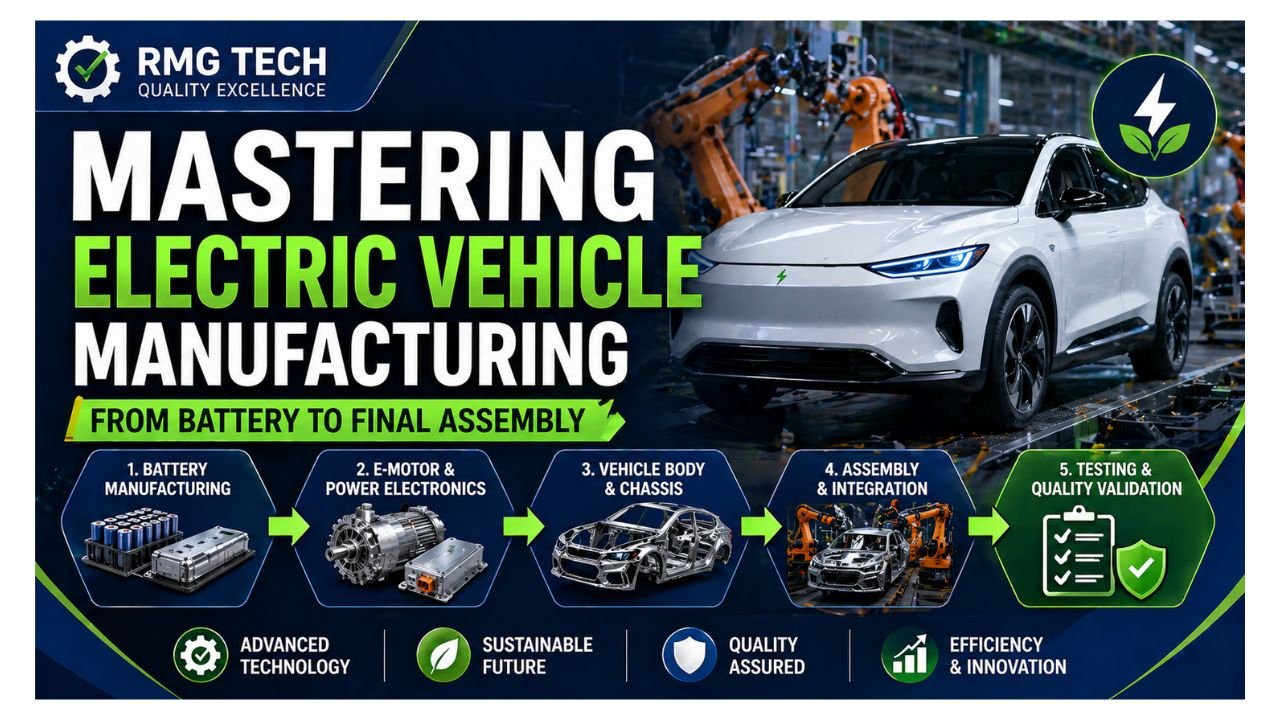
The key steps include battery manufacturing, electric motor and power electronics assembly, vehicle body and chassis production, final assembly, and quality testing.
Why is battery manufacturing important in EVs?
The battery is the most critical component of an electric vehicle as it determines range, performance, and overall efficiency.
What is the difference between EV manufacturing and traditional vehicle manufacturing?
EV manufacturing focuses more on battery systems, electric motors, and electronics, whereas traditional vehicles rely on internal combustion engines and fuel systems.
What quality tools are used in EV manufacturing?
Common tools include APQP, PPAP, FMEA, SPC, and MSA to ensure product quality and process control.
What are the challenges in EV manufacturing?
Key challenges include battery cost, thermal management, supply chain complexity, and maintaining consistent quality during production.
How does automation help in EV manufacturing?
Automation improves precision, reduces defects, increases production speed, and ensures consistent quality in EV assembly lines.
What is the future of EV manufacturing?
The future includes advanced battery technology, increased automation, sustainable materials, and smart manufacturing systems.

Randhir Singh
Manufacturing professional and Lean practitioner
Randhir Singh is a manufacturing professional and Lean practitioner with hands-on experience in machining, forging, and production systems. He specializes in implementing core quality tools such as MSA, SPC, FMEA, APQP, and 5S on the shopfloor.