Waterfall vs Agile vs Hybrid:
Choosing the Right PM Methodology
A complete decision guide for manufacturing and engineering project managers — covering the full depth of Waterfall's sequential discipline, Agile's iterative power, and the spectrum of Hybrid approaches that combine both. Includes a practical selection framework, industry-specific guidance, real-world examples from Tesla, Philips, and Toyota, and a comprehensive comparison matrix to choose the right methodology every time.
Why Project Management Methodology Matters
Selecting the wrong project management methodology is one of the most expensive invisible decisions in business. It is invisible because the decision is rarely made consciously — most teams default to the methodology they learned first, the methodology their organisation uses habitually, or no methodology at all. The cost appears later, in delayed launches, budget overruns, scope disputes, and frustrated teams delivering outputs that customers no longer want. The PMI reports that only 28% of projects are delivered successfully — and methodology mismatch is consistently cited as a leading contributing factor.
A project management methodology is a framework of principles, processes, tools, and rules that governs how a project is planned, executed, monitored, and closed. The right methodology aligns the project's management approach with the nature of the work — the degree of certainty in requirements, the acceptable pace of change, the regulatory and compliance context, and the culture and capability of the team. The wrong methodology applies discipline where flexibility is needed, or flexibility where discipline is essential.
The three dominant methodologies in manufacturing and engineering — Waterfall, Agile, and Hybrid — are not competing ideologies. They are context-specific tools. Waterfall provides predictability and documentation for projects with stable, well-defined requirements. Agile provides speed and adaptability for projects with high uncertainty or rapidly changing requirements. Hybrid intelligently combines both, applying each where it is most appropriate within the same programme. The engineer or project manager who understands all three — and makes a deliberate, justified choice among them — consistently outperforms the ideologue who defends one approach regardless of context.
The most effective project managers don't pick one methodology and defend it — they match the approach to the project type, the regulatory environment, the team's maturity, and the tolerance for ambiguity.
— Mustard Seed PMO, Agile vs Waterfall vs Hybrid, March 2026Waterfall — Sequential Discipline & Predictable Delivery
FALL
Waterfall is the original structured project management methodology — a sequential, linear approach where project activities flow from one phase to the next like water descending a series of steps, with each phase fully completed and approved before the next begins. First formalised in manufacturing and construction engineering in the 1960s and 1970s, Waterfall reflects the engineering principle that problems are far cheaper to resolve in the planning phase than in the execution phase. A design error caught on paper costs an engineer's afternoon; the same error caught after tooling is manufactured costs a programme.
Waterfall's defining characteristic is its upfront completeness requirement: all requirements must be fully defined and documented before design begins; all design decisions must be finalised before construction begins; construction must be complete before testing begins. This sequential rigidity is not a limitation — it is the feature. For projects where the requirements are genuinely stable, where regulatory or quality standards mandate comprehensive documentation at each phase, and where downstream activities depend entirely on the correctness of upstream ones (you cannot change the die casting tool after 10,000 parts have been made), Waterfall's discipline prevents the most expensive category of project failures: discovering fundamental requirements errors at the point of delivery.
The Stage-Gate Process (Robert Cooper's product development framework) is Waterfall applied to new product development — the dominant framework in automotive, pharmaceutical, food and beverage, and aerospace product launches. Each stage (phase) delivers specific outputs evaluated at a Gate review, where a cross-functional management team decides whether to proceed, recycle (do the stage again with changes), hold, or kill the project. APQP (Advanced Product Quality Planning) in the automotive supply chain is Stage-Gate applied specifically to supplier new product launches — defining exactly what must be delivered at each gate and in what quality before the next phase is authorised.
- Maximum predictability — schedule, cost, and scope are defined at the start and tracked against the baseline throughout
- Comprehensive documentation at each phase — essential for regulatory compliance, knowledge transfer, and audit trails
- Clear accountability — each phase has a defined owner, defined deliverables, and a formal approval gate
- Ideal for physical deliverables — when building something that cannot be "sprint-iterated" without incurring physical rework costs
- Familiar to senior manufacturing managers — the gate review model is deeply embedded in automotive and aerospace engineering cultures
- Excellent for contract management — clear scope and milestones enable fixed-price, performance-based contracts with suppliers
- Customer sees no working product until the final phase — customer misunderstandings about requirements are discovered late and expensively
- Change is costly — requirements changes discovered mid-project require phase reviews, redesign, and budget revision
- Risk accumulation — all testing happens late; fundamental flaws are not discovered until the build phase is complete
- Assumes requirements stability that rarely exists in full — market conditions, technology, and customer preferences change during long projects
- Can encourage "waterfall-washing" — completing documentation without genuinely solving problems, just to pass the gate
- Less suitable for novel, exploratory work — where the right solution emerges through learning rather than planning
Agile — Iterative Delivery & Adaptive Planning
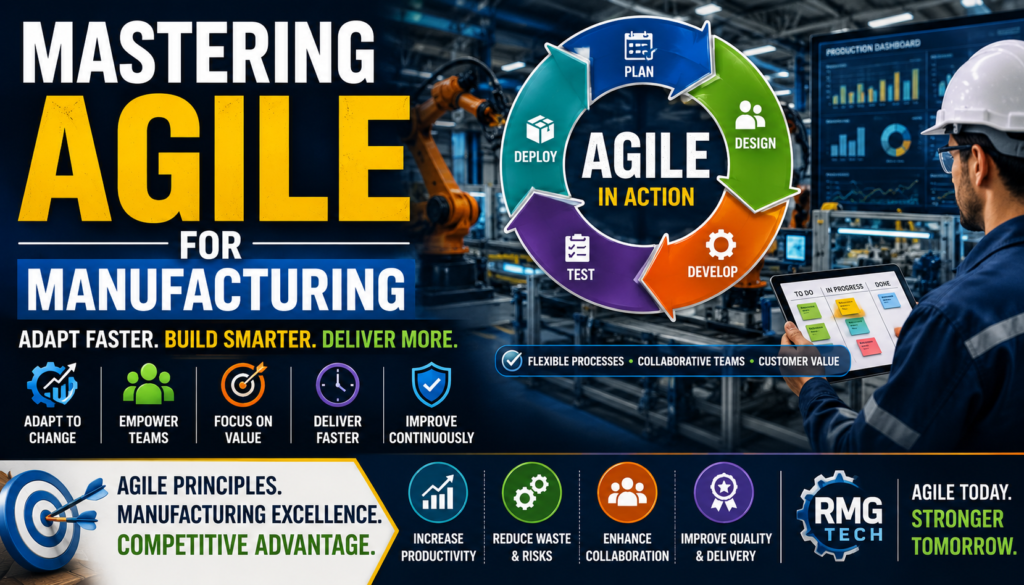
Agile emerged from the software development community in the late 1990s as a direct challenge to Waterfall's assumption that requirements can be fully defined at the start. The Agile Manifesto (2001), signed by 17 software practitioners, articulated four value statements that fundamentally reoriented project management thinking: individuals and interactions over processes and tools; working software over comprehensive documentation; customer collaboration over contract negotiation; responding to change over following a plan. These four values — with 12 accompanying principles — describe an approach to project delivery that is the philosophical inverse of Waterfall's planning-first, build-after approach.
The practical foundation of Agile is the sprint — a fixed, short development cycle (typically 1–4 weeks) at the end of which working, demonstrable output is delivered to the customer or product owner for feedback. Rather than delivering everything once at the end of a long project, Agile delivers incrementally — each sprint adds value, each sprint's output is reviewed, and the product backlog (the prioritised list of remaining work) is updated based on what was learned. This creates a continuous feedback loop between the team and the customer that catches requirement misunderstandings immediately, when they are cheap to correct, rather than at project end when they are catastrophic.
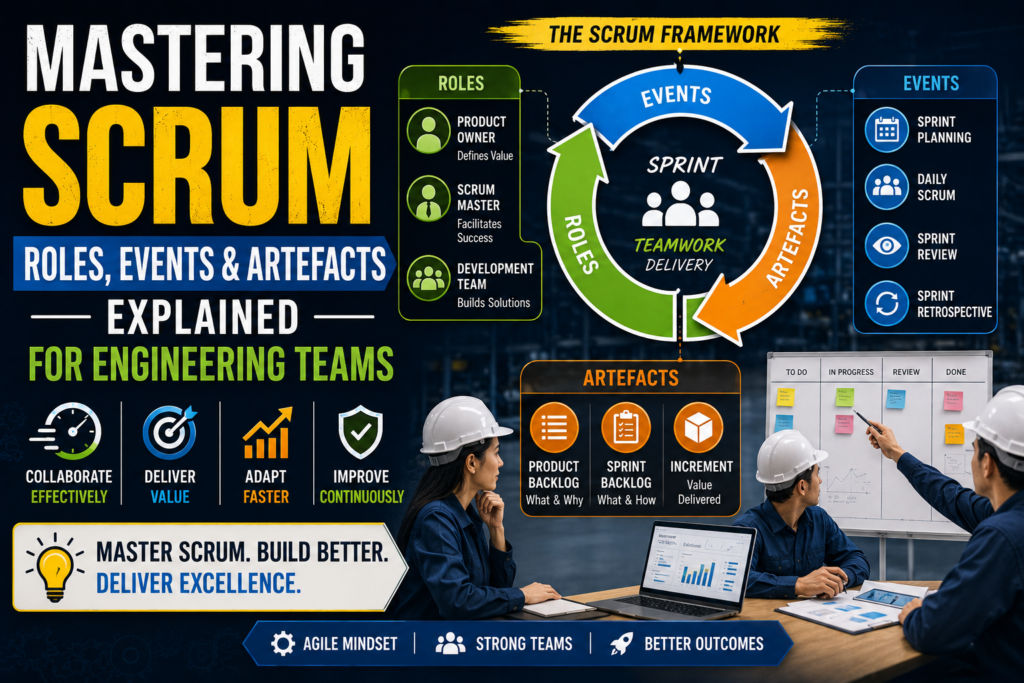
The three most widely used Agile frameworks in engineering contexts are: Scrum (the most common — fixed-length sprints with defined roles: Scrum Master, Product Owner, Development Team; defined ceremonies: Sprint Planning, Daily Standup, Sprint Review, Sprint Retrospective), Kanban (continuous flow based on visual boards with work-in-progress limits — pulls work through the system rather than pushing batches; particularly effective for operational and maintenance work rather than project development), and SAFe (Scaled Agile Framework) (extends Agile to large organisations with multiple teams — used by Boeing, Lockheed Martin, and large automotive OEMs for coordinating hundreds of engineers across multiple workstreams on a single programme).
- Customer sees working output early and often — misunderstandings are caught and corrected in the first sprint, not at project end
- Adapts to change — requirements discovered or changed mid-project are accommodated without expensive phase reviews
- Reduces risk of building the wrong thing — continuous feedback from the product owner ensures the team builds what is actually needed
- Higher team engagement — self-organising cross-functional teams with daily standups and retrospectives create ownership and accountability
- Faster time-to-value — useful deliverables are available after Sprint 1; customers don't wait months for the first result
- Transparency — the sprint board, backlog, and burndown charts make progress and problems visible to all stakeholders daily
- Difficult to predict final cost and timeline upfront — makes fixed-price contracts with external suppliers problematic
- Not suited to physical manufacturing projects where rework is expensive — you cannot "sprint-iterate" a die casting tool
- Requires highly engaged product owner — if the customer or product owner is unavailable for regular sprint reviews, the feedback loop breaks
- Documentation can suffer — Agile's "working software over documentation" value can produce poorly documented systems that create maintenance problems
- Scaling is hard — Agile works naturally for teams of 5–12; coordinating 100+ engineers in multiple Agile teams requires SAFe or similar framework
- Not compatible with strict regulatory compliance in pure form — FDA, IATF 16949, and DO-178C require documentation at levels that pure Agile resists
Hybrid — The Intelligent Combination
In real-world manufacturing and engineering organisations, most complex programmes do not fit neatly into either pure Waterfall or pure Agile. A new vehicle platform programme involves IATF 16949-compliant NPI processes (which are inherently Waterfall Stage-Gate) for mechanical and electrical components, concurrent Agile development sprints for the embedded software, and Lean daily management cadence on the production ramp. Pretending these must all follow the same methodology is both unnecessary and counterproductive. Hybrid project management deliberately combines elements of Waterfall and Agile at the right levels and in the right proportions for the specific project.
The most common hybrid patterns in manufacturing engineering are: Waterfall overall structure with Agile within phases — the programme follows Stage-Gate gates (Waterfall), but within each phase, teams use sprint cycles and daily standups to execute the phase deliverables (Agile). This gives the programme the documentation rigour and gate-controlled progression of Waterfall while allowing the execution flexibility and continuous feedback of Agile. Rolling Wave Planning — the near-term phases are planned in full Waterfall detail, while later phases are planned only at a high level (because the detailed requirements for those phases depend on what is learned in earlier ones). The plan is progressively elaborated as the project advances — a direct acknowledgement that more detail is available closer to execution. Agile R&D with Waterfall productionisation — used by Tesla, Philips, and many technology-intensive manufacturers: the research, design, and software development phases use Agile, while the manufacturing scale-up, validation, regulatory approval, and production launch phases use Waterfall/Stage-Gate.
The Selection Framework — Choosing the Right Methodology Every Time
Methodology selection is not a one-time decision made at project kickoff — it is a continuous judgement that should be revisited whenever the project context changes significantly. The following framework provides a structured approach to the decision, organised around the five factors that most reliably predict which methodology will succeed.
Fully defined and unlikely to change → Waterfall. The requirements for a new factory building are stable: floor loadings, column spacings, power supply specification, environmental controls. Designing and building to those specifications sequentially is appropriate. Uncertain or likely to evolve → Agile. The requirements for a new vehicle infotainment system will evolve as market feedback is gathered and technology advances — Agile allows the team to build, show to customers, learn, and adjust. Partly defined → Hybrid or Rolling Wave. Requirements for the hardware are known; requirements for the embedded software will emerge iteratively.
Physical, irreversible deliverables → Waterfall bias. You cannot sprint-iterate a die casting tool. You cannot retrospectively change a building's foundations. Physical deliverables have high change costs that justify the upfront planning investment of Waterfall. Digital, reversible deliverables → Agile bias. Software code can be refactored in Sprint 3 based on Sprint 2 feedback at relatively low cost. Digital products inherently support iterative delivery. Mixed → Hybrid. A product with physical hardware (Waterfall for tooling and hardware validation) and embedded software (Agile for firmware development) requires both approaches running in parallel with a defined integration interface.
High regulatory compliance requirements → Waterfall bias. IATF 16949 (automotive quality), FDA 21 CFR (pharmaceutical), DO-178C (aerospace software), ISO 13485 (medical devices) — all require systematic documentation, traceability, and sequential verification activities that are incompatible with pure Agile. Low regulatory constraint → Agile is available. Internal R&D projects, digital tools, process improvement initiatives, and software for non-regulated applications can use pure Agile without compliance concerns. Regulated product, iterative development → Hybrid. Use Agile during development; apply Waterfall discipline for formal verification, validation, and regulatory submission phases.
Customer available for regular review → Agile works well. Agile's sprint review ceremonies are only valuable if the product owner or customer can meaningfully assess the sprint increment and provide actionable feedback. If the customer can review working output every 2 weeks and has the authority to reprioritise the backlog, Agile delivers its full value. Customer unavailable or engagement is batch/milestone-based → Waterfall is safer. If the customer will only review the project at defined milestones (e.g. end of each APQP phase), Waterfall's gate structure naturally aligns with that engagement model.
Agile requires trained, empowered, self-organising teams. Agile fails when teams are not trained in Scrum/Kanban, when product owners are disengaged, when managers micromanage sprint decisions, or when the organisation's culture rewards individual output over team velocity. A Waterfall team attempting Agile without training and cultural alignment will produce "fake Agile" — sprints that are just mini-Waterfall phases with daily meetings. Hybrid requires maturity in both. The most effective hybrid teams are those who deeply understand both methodologies and can intelligently apply each where it fits — which requires experience with both, not just theoretical knowledge.
Methodology by Industry — What the World's Best Manufacturers Choose
| Industry | Dominant Methodology | Why | Specific Frameworks Used |
|---|---|---|---|
| Manufacturing & Engineering | |||
| Automotive (Tier 1 & OEM) | Waterfall / Stage-Gate | IATF 16949 mandates sequential APQP phases with gate reviews; tooling is irreversible; PPAP requires documented sequential validation | APQP Stage-Gate for hardware; Agile sprints for embedded software; SAFe for cross-functional programme teams |
| EV Manufacturing (New) | Hybrid | Physical battery/motor/chassis follows Waterfall; software-defined vehicle architecture requires Agile; integration requires both | SAFe for software + Stage-Gate for hardware + Lean daily management for production ramp |
| Aerospace & Defence | Waterfall / Stage-Gate | DO-178C, AS9100, and MIL-SPEC require rigorous sequential documentation and verification; cost of failure is catastrophic | SAFe Agile for software development; Waterfall for hardware design and certification |
| Pharmaceutical & Biotech | Hybrid | FDA 21 CFR requires sequential validation stages (Phase I/II/III clinical trials); early R&D is highly iterative; regulatory submissions are strictly Waterfall | Agile for early discovery and R&D; Stage-Gate for clinical and regulatory phases |
| Construction & Infrastructure | Waterfall | Foundation-first physical sequencing is literally irreversible; fixed-price contracts require defined scope; regulatory permits require sequential approvals | Last Planner System (Lean) within Waterfall; BIM for design collaboration |
| Technology & Services | |||
| Software / IT Development | Agile | Requirements evolve rapidly; code is inherently reversible; continuous integration and deployment is native to software; customer feedback is available immediately | Scrum, Kanban, SAFe, XP, DevOps CI/CD pipelines |
| Product Design (Consumer) | Hybrid | Physical prototyping has cost; but market testing and iteration are essential; design sprints and MVP testing are now standard in hardware product development | Design Thinking + Agile sprints for concept phase; Waterfall for manufacturing scale-up |
Real-World Examples — How Leading Manufacturers Use These Methodologies
Tesla applies rigorous Waterfall-style safety validation and physical engineering disciplines to battery, motor, and structural systems (required for FMVSS compliance and manufacturing repeatability). Simultaneously, Tesla develops its Autopilot/FSD software and over-the-air update capability using continuous Agile deployment — pushing software improvements to the fleet weekly. This Hybrid approach lets Tesla maintain safety-critical hardware rigour while moving at software speed on digital features.
Hybrid: Waterfall HW + Agile SWPhilips adopted a flexible Agile framework with a predictable systematic approach inspired by Waterfall for developing its HealthSuite digital health platform. This approach resulted in faster delivery of a high-quality software product (Agile) while teams maintained extensive documentation and compliance guidelines (Waterfall). The compliance documentation requirement of regulated healthcare devices necessitated Waterfall discipline; the digital-first nature of the platform enabled Agile execution.
Hybrid: Compliance + Agile sprintsToyota's new product development process (Toyota Product Development System) uses a sophisticated hybrid: a Stage-Gate overall structure with defined decision points (comparable to APQP gates), simultaneous (concurrent) engineering across multiple workstreams (which reduces the strictly sequential character of Waterfall), and Lean daily management cadence for cross-team coordination. Toyota's obeya (big room) concept — where cross-functional teams work in a shared physical space — is arguably a precursor of Agile's co-location principle.
Stage-Gate + Concurrent Engineering + LeanBoeing adopted SAFe (Scaled Agile Framework) to coordinate hundreds of software engineers across its commercial aircraft programmes. The physical aircraft design, manufacturing, and certification processes remain strictly Waterfall (FAA DO-178C certification requires sequential phase documentation that cannot be bypassed), but avionics software, flight management systems, and diagnostic software development now use SAFe Agile sprints — reducing the time required to develop and certify new software features.
Hybrid: Waterfall HW certification + SAFe SWThe pharmaceutical industry uses the most rigorous Stage-Gate Waterfall process in any industry — FDA's IND/NDA submission pathway requires sequential Phase I, II, and III clinical trials, each requiring full completion and regulatory review before the next begins. However, the early-stage discovery and lead compound identification phases increasingly use Agile sprint-based research cycles. The gate from discovery to clinical development is a strict Waterfall transition point.
Agile Discovery → Waterfall RegulatoryThe construction industry is overwhelmingly Waterfall in its phase structure (foundation before walls before roof — literally irreversible sequencing), but has adopted Lean construction tools that inject Agile principles at the operational level. The Last Planner System (LPS) introduces weekly "pull planning" cycles that look and feel like Agile sprints — 6-week look-ahead schedules, weekly commitment planning with collaborative team pull, and percent plan complete metrics that parallel Agile velocity tracking.
Waterfall structure + Lean/LPS executionMaster Comparison Matrix — Waterfall vs Agile vs Hybrid
| Dimension | Waterfall | Agile | Hybrid |
|---|---|---|---|
| Planning & Structure | |||
| Planning Approach | Comprehensive upfront planning — full project scope, schedule, and budget defined before work begins | Progressive planning — sprint-by-sprint with backlog refinement; only near-term sprints planned in detail | Upfront planning for stable phases; progressive planning for uncertain workstreams |
| Scope Management | Fixed scope — changes go through formal change control; cost and schedule impact assessed before approval | Scope evolves — new requirements added to backlog; prioritisation changes each sprint | Fixed scope for regulated/physical deliverables; flexible scope for digital/software workstreams |
| Documentation | Comprehensive — full documentation at each phase; mandatory for regulatory compliance | Minimal — working output over documentation; user stories, sprint notes, retrospective logs | Context-specific — comprehensive for regulatory phases; minimal for development sprints |
| Execution & Delivery | |||
| Delivery Rhythm | Single delivery at project end — customer receives complete product once, after all phases complete | Continuous delivery — working increments delivered every sprint (1–4 weeks) | Phase deliverables at gates (Waterfall) + incremental within-phase delivery (Agile) |
| Customer Involvement | Milestone-based — customer reviews at defined gates; limited mid-project interaction | Continuous — customer/product owner engaged every sprint for review and backlog prioritisation | Gate reviews for phase transitions; frequent feedback within development phases |
| Change Management | High cost — formal change control required; may require re-entering previous phase | Low cost — changes accommodated in next sprint; backlog reprioritisation is a normal activity | Expensive in Waterfall phases; cheap in Agile sprints |
| Risk & Performance | |||
| Risk Profile | Front-loaded risk resolution — requirements and design risks resolved upfront; execution risks remain | Continuous risk identification and resolution — each sprint surfaces and resolves risks iteratively | Front-loaded for physical components; iterative for digital/software components |
| Cost Predictability | High — fixed-price contracts possible; stakeholders see full cost at project start | Lower — cost depends on total number of sprints; harder to commit to fixed final cost | High for Waterfall phases; variable for Agile workstreams |
| Schedule Predictability | High — Gantt chart provides full programme timeline from Day 1 | Medium — velocity tracking improves over time; initial estimates are less reliable | High for gated milestones; variable for development sprint completion |
| Team & Organisation | |||
| Team Structure | Functional — team members contribute to their phase then hand off to the next phase/function | Cross-functional sprint teams — all skills needed for a sprint within one team; self-organising | Cross-functional teams for Agile workstreams; functional hand-offs for Waterfall phases |
| Management Style | Command and control — PM plans, assigns, and tracks; team executes to plan | Servant leadership — Scrum Master removes impediments; team self-organises; PO prioritises | PM governs at phase gate level; teams self-organise within sprints |
| Best Suited Industries | Automotive NPI · Aerospace · Construction · Pharmaceutical clinical trials · Infrastructure | Software development · R&D · Digital products · EV firmware · Data analytics | EV platforms · Medical devices · Complex engineering programmes · Digital manufacturing |
Implementation Roadmap — Adopting or Transitioning Methodologies
Before changing methodologies, understand what is actually happening in your organisation's projects — not what the methodology documents say, but what teams are actually doing. Many organisations describe themselves as "Agile" but are running Waterfall with daily standups and renamed phases ("sprints" that are actually 2-month sequential phases). Many describe themselves as Waterfall but are constantly accepting uncontrolled scope changes that erode the baseline. Honest assessment of the current state is the prerequisite for effective methodology improvement.
Review your current project portfolio and apply the five-factor selection framework (requirements stability, deliverable type, regulatory context, customer engagement, team maturity) to each programme. Identify which projects are well-matched to the methodology being used, which are mismatched, and which are candidates for a Hybrid approach. Start the methodology transition with a single mid-size project where the right methodology is clear — not with the largest, most critical programme in the portfolio.
If transitioning to Agile: ensure the Scrum Master is certified (CSM or PSM), the Product Owner understands backlog management and sprint review responsibilities, and the development team has participated in at least one Scrum workshop. If transitioning to Hybrid: the PM must be proficient in both Waterfall and Agile, and able to explain the rationale for using each approach to each workstream without the team perceiving it as inconsistency. Training is not optional — untrained Agile is more chaotic than bad Waterfall.
Implement the chosen methodology on a single pilot project with a committed, experienced team. Define clear success metrics before the pilot begins: velocity improvement, reduction in scope creep, improvement in customer satisfaction at gate reviews, reduction in post-delivery defects. Run the pilot for a full project cycle (or at least 3 sprints for Agile). Conduct a structured retrospective — what worked, what did not, what would you change? Apply those lessons to the next project before declaring the methodology as the organisational standard.
Methodology consistency across projects requires standardised templates, tools, and governance. For Waterfall: standardised gate review checklists, WBS templates for common project types, change request forms, and risk register formats. For Agile: backlog templates, sprint planning guides, Definition of Done checklists, and velocity tracking dashboards. For Hybrid: a clear decision framework documenting which phases/workstreams use which methodology and why. The goal is to make the right approach the easy approach — not an individual PM's ad hoc choice.
Common Mistakes — What Goes Wrong with Each Methodology
- (Waterfall) Gates are real decision points — projects are recycled or killed when deliverables don't meet gate criteria, not rubber-stamped to maintain schedule
- (Waterfall) Change control is active — scope changes require formal assessment and approval, and the baseline is protected
- (Agile) Sprint reviews produce genuine stakeholder feedback that changes the next sprint's priorities — not just status updates
- (Agile) The team's velocity is stable or increasing — indicating predictable execution and process improvement
- (Hybrid) Each workstream uses the methodology that fits its nature — not a single approach forced on all workstreams regardless of fit
- (All) The PM can explain why the chosen methodology was selected for this specific project — not just "it's what we always do"
- Fake Agile: Sprints that are just mini-Waterfall phases — 4-week "sprints" with full upfront planning, no backlog, and no customer review of working output
- Waterfall-washing Agile projects: Forcing Agile software development into a Waterfall gate structure that requires full documentation before any code is demonstrated to the customer
- Cargo-cult methodology: Doing daily standups and calling them Scrum without a backlog, product owner, or sprint planning — the ceremonies without the substance
- Hybrid as an excuse for no methodology: "We use hybrid" as justification for having no consistent approach — switching between Waterfall and Agile based on whatever is convenient in the moment rather than what fits the context
- Ignoring regulatory requirements: Applying Agile to phases where regulatory compliance mandates Waterfall-style sequential documentation and verification
- Methodology imposed without team buy-in: Senior management mandates "we are now Agile" without training, role changes, or cultural support — producing resistance and poor execution
Summary
Waterfall, Agile, and Hybrid are not competing religions — they are complementary tools in the project manager's toolkit. Waterfall excels where requirements are stable, deliverables are physical, and regulatory documentation is non-negotiable. Agile excels where requirements are uncertain, deliverables are digital, and customer feedback drives value. Hybrid intelligently applies both where the project demands both — which describes the majority of complex manufacturing and engineering programmes in 2025–2026.
The project manager who can fluently read the context of a project — who looks at a new programme's requirements stability, physical vs digital deliverables, regulatory context, customer engagement model, and team maturity — and selects the right methodology (or the right blend) rather than defaulting to habit, is the PM who consistently delivers. That ability is not a theoretical skill. It is built through deliberate study of all three approaches, honest reflection on past project failures, and the discipline to choose the right tool for the job even when it is not the familiar one.
The Master Principle of Methodology Selection
The right project management methodology is the one that matches the nature of the work, not the preference of the manager. Waterfall's discipline is not bureaucracy — it is the appropriate response to the reality that some decisions cannot be reversed cheaply, and that preventing an error in Phase 1 is always cheaper than correcting it in Phase 4. Agile's flexibility is not lack of discipline — it is the appropriate response to the reality that in complex, novel, digital work, requirements emerge through doing, and a plan that cannot respond to learning is a plan that will produce the wrong thing very efficiently.
Hybrid's virtue is recognising that most real engineering programmes are not pure Waterfall or pure Agile — they are sequences of phases, some of which demand sequential rigour and some of which demand iterative flexibility. The Tesla vehicle programme that uses Waterfall for crash safety certification and Agile for over-the-air software updates is not being inconsistent — it is being precisely matched to the nature of each workstream. That precision is the goal: not methodological purity, but methodological intelligence.
1. Are the requirements for this project stable enough to be fully defined now, or will they emerge as we work? Stable → Waterfall. Emerging → Agile. Mixed → Hybrid. 2. Can we deliver value in small increments and get customer feedback on each, or must the entire deliverable be complete before it has value? Incremental value → Agile. Whole-or-nothing → Waterfall. 3. Are there regulatory, compliance, or physical irreversibility constraints that require sequential, documented phases? Yes → Waterfall for those phases. No constraint → Agile available. These three questions, answered honestly for each specific project, will select the right methodology more reliably than any amount of theoretical preference.
Waterfall vs Agile vs Hybrid · Project Management Methodology · Scrum · Stage-Gate · APQP · SAFe · Agile Manifesto · Manufacturing PM · Engineering Teams · RMG Tech