Table of Contents
Mastering Agile for Manufacturing: Sprints, Backlogs & Iterative Development on the Shop Floor
A complete guide to applying Agile methodology in manufacturing — how Sprints, Product Backlogs, Daily Stand-ups, and iterative development dramatically improve shop-floor flexibility, quality, and team engagement beyond what traditional project management alone can achieve.
What is Agile — and Why Does Manufacturing Need It?
Agile is a philosophy and set of practices that prioritise flexibility, collaboration, iterative progress, and rapid response to change over rigid, long-range plans. Although Agile originated in software development with the publication of the Agile Manifesto in 2001, its core principles translate directly to the challenges that modern manufacturing faces every day — volatile customer demand, compressed lead times, frequent product changes, and the need for continuous improvement without stopping the line.
Traditional manufacturing relies on detailed upfront planning: produce a full project plan, lock in the schedule, follow the plan, and review at the end. However, this approach struggles when conditions change — a supplier fails, a customer amends the specification, or a new machine behaves differently than expected. As a result, teams spend significant effort updating plans that are already outdated rather than solving the actual problem in front of them.
Why Traditional Planning Falls Short
Agile offers a fundamentally different answer. Instead of planning the entire project upfront, Agile breaks work into short, repeatable cycles called Sprints. At the end of each Sprint, the team delivers something working and measurable, reviews what happened, and adjusts the plan for the next cycle. Therefore, the plan is always current — because it is rebuilt every two to four weeks based on real data and real experience.
Agile is not about doing more things faster. It is about doing the right things first — and learning quickly enough to stop doing the wrong things before they cost too much. — Adapted from the Agile Manifesto, 2001
Agile and Lean — Closer Than You Think
Manufacturing engineers are often surprised to discover how naturally Agile maps to Lean thinking. Both approaches value small batch sizes over large batches. Both emphasise continuous improvement, visual management, and empowering the people closest to the work to make decisions. Furthermore, the Toyota Production System's concept of jidoka — stop, fix, and learn — mirrors Agile's Sprint Retrospective precisely. As a result, manufacturers who already practise Lean have a significant head start in adopting Agile.
Agile vs Traditional Manufacturing Project Management
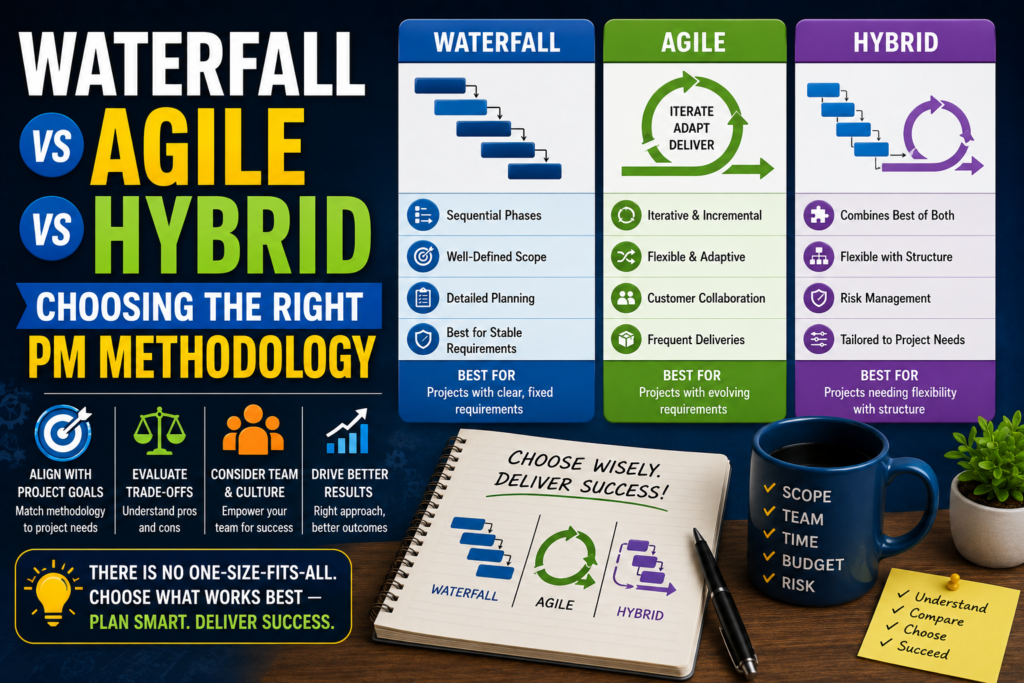
Before adopting Agile, it is important to understand precisely where it differs from — and where it complements — traditional manufacturing project management approaches such as waterfall scheduling, APQP, and stage-gate processes.
All requirements are defined upfront. A detailed schedule locks in every activity, resource, and milestone before work begins. Changes require formal change control. The plan is the master — deviation from it is treated as failure. This approach works well when requirements are stable and well understood, but it struggles severely when they change.
Requirements are defined progressively. Work is broken into short Sprints. Each Sprint delivers a working output that stakeholders can evaluate and provide feedback on. The plan adapts every Sprint based on real learning. Change is expected and welcomed — the process is specifically designed to accommodate it efficiently.
The Hybrid Approach in Manufacturing
In practice, most manufacturing organisations benefit from a hybrid approach. Regulatory requirements, quality system documentation, and capital expenditure approvals often require traditional waterfall planning and formal sign-off. However, the work within those frameworks — process development, tooling design, operator training, line commissioning — benefits enormously from Agile Sprint cycles. Therefore, the most effective manufacturers use stage-gate governance with Agile execution inside each gate.
| Dimension | Traditional / Waterfall | Agile Manufacturing |
|---|---|---|
| Planning Horizon | Full project upfront — 6–24 months | 2–4 week Sprints — rolling plan |
| Requirements | Fixed at project start | Refined progressively each Sprint |
| Change Response | Formal change control — slow | Backlog re-prioritisation — fast |
| Delivery | One large delivery at end | Working output every Sprint |
| Risk Management | Risk register — periodic review | Risks surfaced and resolved every Sprint |
| Team Structure | Functional — PM coordinates specialists | Cross-functional — self-organising team |
| Progress Measurement | % complete against Gantt chart | Working output delivered — velocity |
| Learning Cycle | Post-project lessons learned | Retrospective every Sprint |
The Core Agile Framework for Manufacturing — Scrum Adapted
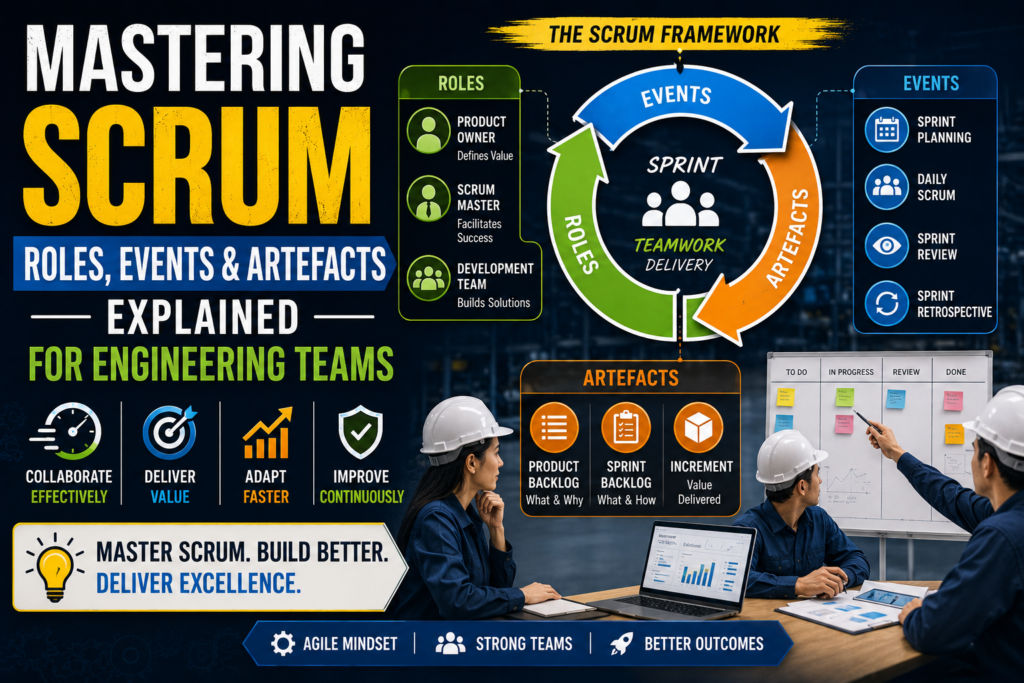
Scrum is the most widely used Agile framework, and it translates exceptionally well to manufacturing improvement teams, NPI projects, and shop-floor engineering teams. The Scrum framework defines specific roles, events, and artefacts that together create a disciplined, repeatable improvement cycle.
The Three Scrum Roles — Adapted for Manufacturing
The Product Owner defines and prioritises the Product Backlog — the ordered list of all work to be done. In manufacturing, this person is typically the engineering manager, process owner, or customer representative who understands the commercial and technical priorities. The Product Owner decides what to build and in what order. Consequently, they must be available to answer questions and make decisions rapidly — not disappear into meetings for weeks at a time.
The Scrum Master is not a project manager — they are a servant leader and facilitator who removes obstacles, protects the team from interruptions, coaches Agile practices, and ensures the Scrum process runs smoothly. In manufacturing, the Scrum Master role maps naturally to a Lean or Continuous Improvement engineer who is familiar with problem-solving tools, facilitation, and waste elimination. Furthermore, a good Scrum Master actively trains the team to be self-sufficient over time.
The Development Team (or Delivery Team in manufacturing) is a cross-functional group of 3–9 people who do the actual work each Sprint. In a manufacturing context, this team typically includes operators, engineers, quality technicians, maintenance staff, and a supervisor. The team is self-organising — they decide how to complete the Sprint Backlog items. As a result, team members develop broader skills and deeper ownership of outcomes than in traditional functionally siloed structures.
The Five Scrum Events — Adapted for Manufacturing
The Sprint is the fundamental unit of Agile work — a fixed-length cycle (2–4 weeks for manufacturing) during which the team completes a set of planned items from the Backlog. Each Sprint has a clear goal, a fixed end date, and produces a working, reviewable output. The Sprint is never extended — if work is not complete, it returns to the Backlog.
The team meets to select which Backlog items to commit to for the upcoming Sprint, define the Sprint Goal, and break selected items into specific daily tasks. However, only the team decides how much work to commit to — the Product Owner provides priority, not workload. Good Sprint Planning results in a clear, achievable Sprint Backlog that every team member understands.
A short, standing meeting every day at the same time and place. Each team member answers three questions: What did I complete yesterday? What will I complete today? What obstacles are blocking my progress? Consequently, the team stays aligned, problems surface immediately, and the Scrum Master can remove blockers before they grow. The stand-up is never a status report to management — it is the team coordinating with itself.
The team demonstrates the working output of the Sprint to stakeholders and the Product Owner. In manufacturing, this might mean showing a validated process running at target, a completed fixture design, or a tested training module. Stakeholders provide immediate feedback, which the Product Owner uses to update and re-prioritise the Backlog. Therefore, the Sprint Review closes the feedback loop between the team and the customer every two to four weeks.
The team reflects on how they worked — not what they built. Three questions drive the Retrospective: What went well this Sprint? What did not go well? What one improvement will we commit to in the next Sprint? As a result, the Retrospective is the continuous improvement engine of Agile — the equivalent of a Kaizen retrospective run every Sprint rather than once a year.
Product Backlog — the prioritised master list of all work. Sprint Backlog — the subset of Backlog items committed to for the current Sprint. Increment — the working, tested, reviewable output produced by each Sprint. All three artefacts are visible to all team members at all times.
The Product Backlog — Your Manufacturing Improvement Master List
The Product Backlog is the single, authoritative, ordered list of everything the team needs to do to achieve the project or improvement goal. In manufacturing, the Backlog replaces the traditional to-do list, issues log, and action register — but does so in a way that is continuously prioritised, collaboratively owned, and directly connected to customer and business value.
Writing Good Backlog Items — User Stories for Manufacturing
Agile teams write Backlog items as User Stories — short, simple descriptions of a feature or improvement written from the perspective of the person who benefits. The standard format is:
Backlog Refinement — Keeping the List Healthy
The Backlog is not a static document — it is a living list that grows, shrinks, and re-orders throughout the project. The Product Owner continuously refines the Backlog — adding new items as requirements emerge, removing items that are no longer valuable, splitting large items into smaller ones, and reordering items as priorities shift. Furthermore, the team participates in Backlog Refinement sessions (typically one hour per Sprint) to estimate effort, clarify requirements, and identify dependencies before items enter a Sprint.
Sprint Backlog — The Team's Commitment
At Sprint Planning, the team selects items from the top of the Product Backlog and creates the Sprint Backlog — the specific items the team commits to completing in the upcoming Sprint. Each item is broken into individual tasks of one to two days' effort. Consequently, progress is visible daily on the Sprint Board, and blockers surface within 24 hours rather than remaining hidden for weeks.
The Sprint Board — Visual Management on the Shop Floor
The Sprint Board is the visual heart of an Agile manufacturing team. It makes the Sprint Backlog visible at a glance — who is working on what, what is in progress, and what is done. In manufacturing, the Sprint Board is ideally a physical board in the team area — sticky notes, magnetic cards, or printed task cards. However, digital tools such as Jira, Trello, or Azure DevOps work equally well for engineering teams working across shifts or sites.
The board below shows a typical two-week Sprint Board for a manufacturing process improvement team working on a changeover reduction project:
The Sprint Board reveals the team's work-in-progress (WIP) at a glance. Moreover, it makes bottlenecks immediately visible — if the "In Progress" column has seven items and "Done" has none, the team is overloaded. As a result, the Daily Stand-up can immediately address the root cause and redistribute work before the Sprint is at risk.
The Burndown Chart
Alongside the Sprint Board, Agile teams use a Burndown Chart — a simple graph that shows the remaining work in the Sprint versus time. The ideal burndown is a straight diagonal line from the total Sprint commitment on Day 1 to zero on the last day. If the actual line is above the ideal, the team is behind. If it is below the ideal, they are ahead. Therefore, the Burndown Chart gives the Scrum Master and team a daily, visual, quantitative measure of Sprint health — without requiring a complex project management tool.
Agile on the Shop Floor — Real Manufacturing Applications
Agile is not a concept reserved for office-based engineering teams. Rather, it delivers its greatest manufacturing value when applied directly on the shop floor — in the physical spaces where production happens, quality problems occur, and operators have the deepest knowledge of what needs to improve.
Traditional NPI follows a sequential stage-gate process — design, prototype, test, and then manufacture. However, this approach frequently results in expensive last-minute design changes when the production process reveals problems the design team did not anticipate. Agile NPI runs short Sprints across all functions simultaneously — design, manufacturing engineering, quality, and supply chain collaborate in the same team. Consequently, problems surface during Sprint 2, not during production validation month 12.
Agile provides the missing structure that many Kaizen programmes lack. Instead of holding occasional Kaizen events and hoping improvements stick, an Agile CI programme runs two-week Sprints with clear goals, daily stand-ups, and Sprint Reviews that demonstrate actual results. Furthermore, the Sprint Retrospective replaces the annual lessons-learned review with a fortnightly improvement cycle. Teams therefore improve their improvement process — not just their production process.
Machine installations and line commissioning projects are notoriously difficult to plan upfront because new equipment always behaves differently than specifications predict. Agile handles this naturally — each Sprint targets a specific commissioning milestone (mechanical completion, electrical sign-off, first article, production trial), and the Sprint Retrospective captures lessons that improve the next commissioning Sprint. As a result, the team adapts to reality rather than chasing a plan that was obsolete within the first week.
Training programmes in manufacturing are often designed in full before delivery begins — and then fail because real operator needs diverge from the assumed training needs. Agile training runs short competency Sprints: identify the skill gap, design and deliver a focused training intervention, verify competency with a practical assessment, and capture what worked in the Retrospective. Therefore, training materials evolve through iteration rather than being discarded and rewritten when the first version proves inadequate.
Complex quality problems — recurring defects, customer complaints, process instability — often drag on for months because traditional corrective action processes lack urgency and accountability between reviews. Agile CAPA runs each corrective action as a series of Sprints: define the problem (Sprint 1), identify and test root cause countermeasures (Sprints 2–3), validate effectiveness and standardise (Sprint 4). Consequently, the average time from problem identification to verified closure reduces significantly.
Supplier improvement projects are notoriously difficult to manage because they involve two organisations with different priorities, systems, and cultures. Agile provides a shared framework — a joint Sprint Board, shared Backlog, and joint Sprint Reviews — that aligns the supplier's team with the customer's team around a common goal and a common sprint rhythm. Furthermore, joint Daily Stand-ups (even brief virtual check-ins) dramatically improve communication and accountability.
How to Implement Agile in Your Manufacturing Team — Step by Step
Introducing Agile to a manufacturing environment requires careful sequencing. Moving too fast creates resistance; moving too slowly loses momentum. Therefore, the following six-step implementation guide balances pace with durability — building Agile capability in a way that lasts beyond the first enthusiastic pilot.
Select a specific, bounded improvement project — not the most complex problem in the plant, but a real one where success will be visible and valued. Good first projects include a changeover time reduction, a recurring defect elimination, or a new operator training programme. The project should have a committed team of four to six people, a Product Owner who can make decisions quickly, and a timeframe of two to three months. As a result, the pilot produces results quickly enough to build confidence and organisational support for further adoption.
"Reduce changeover time on Line 4 from 22 to 10 minutes over 3 months using 2-week Sprints."
"Implement Agile across all 6 production lines simultaneously" — too broad, impossible to learn from, guaranteed confusion.
Run a two-day Agile foundation workshop — half theory, half practical. On Day 1, introduce the Scrum framework, roles, events, and artefacts. On Day 2, run a Sprint simulation using the actual pilot project — write user stories, estimate effort, plan the first Sprint, and build a physical Sprint Board in the team area. By doing this, team members experience Agile before they are asked to work it, which dramatically reduces resistance and confusion in the first real Sprint. Furthermore, practical simulations reveal team-specific questions that generic training never surfaces.
Run a half-day Backlog creation workshop with the Product Owner and team. Start by defining the Sprint Goal — the specific, measurable outcome you want to achieve. Then brainstorm all the work needed to reach that goal, write each item as a user story, and prioritise the list together. Do not attempt to identify every task at this stage — only the top fifteen to twenty items need sufficient detail to plan the first two or three Sprints. Everything else can be refined progressively. As a result, the team starts Sprint 1 with enough direction to work confidently without wasting time planning work that may never be needed.
Sprint 1 is the most critical Sprint because it establishes team habits and management expectations. Hold every ceremony on time — Sprint Planning, Daily Stand-up, Sprint Review, and Retrospective. The Scrum Master must actively protect the team from mid-Sprint scope changes and interruptions — if the Sprint Backlog changes constantly, the team learns that commitments are meaningless. However, do not expect Sprint 1 to be perfect. Instead, use the Retrospective to identify the single most important process improvement and implement it in Sprint 2. The team's ability to improve itself is the best leading indicator of Agile maturity.
Never cancel a Retrospective, even if the Sprint went well. The Retrospective is how the team gets better — skipping it communicates that improvement is optional.
Velocity = the number of story points (or user stories) completed per Sprint. Track it from Sprint 1 — it becomes the basis for reliable forecasting by Sprint 3.
After three Sprints (six to eight weeks), hold a formal pilot review — not just the Sprint Review, but a broader session that evaluates the Agile approach itself. Present results to senior management: what improved, by how much, and what the team learned about using Agile in this environment. Share the Sprint Board, the Backlog, and the velocity trend. Therefore, management sees concrete outcomes rather than abstract methodology promises. Use this review to secure support for expanding Agile to a second team or project area.
The most sustainable path to organisation-wide Agile adoption is developing internal coaches — people from the pilot team who can train and support new Agile teams. As a result, Agile capability grows organically rather than depending on expensive external consultants. Establish a monthly Community of Practice meeting where all Agile teams share experiences, tools, and solutions to common challenges. Furthermore, create a simple shared resource — a standard Sprint Board template, a user story guide, a Sprint ceremony agenda — that new teams can use immediately rather than reinventing from scratch.
Benefits, Challenges and the Manufacturing Agile Summary
- Faster response to customer specification changes and production problems
- Problems surface and are resolved within days — not weeks or months
- Cross-functional teams break down departmental silos naturally
- Operators develop ownership and problem-solving capability — not just compliance
- Sprint Reviews create a regular cadence of demonstrable, measurable results
- Retrospectives embed continuous improvement into the working rhythm — not as a separate activity
- Velocity data enables reliable forecasting after just two to three Sprints
- Backlog provides transparent, prioritised visibility of all improvement work — no hidden queues
- Reduces waste from over-planning work that never gets done or changes before it starts
- Builds team confidence and engagement — people see the impact of their work every Sprint
- Resistance from managers who prefer detailed long-term plans — show early Sprint results, not methodology arguments
- Operators on rotating shifts cannot attend Daily Stand-ups — use shift handover boards and async stand-up notes instead
- Sprint scope changes mid-Sprint from senior management — educate sponsors on the cost of interruption; protect Sprint commitments
- Undefined "Done" criteria for manufacturing tasks — invest time upfront in Sprint Planning to define testable acceptance criteria
- Velocity measurement is difficult when stories vary enormously in size — use relative estimation (story points) and split large stories
- Regulatory requirements conflict with Agile flexibility — run Agile inside stage-gates; use waterfall for governance, Agile for execution
- Team too large — Agile teams of more than nine people lose cohesion; split into two teams with a shared Backlog
- No dedicated Product Owner — without a empowered decision-maker, the Backlog stagnates and priorities conflict
Key Takeaway
Agile for manufacturing is not a technology — it is a way of organising people and work. At its core, it makes one powerful promise: rather than planning everything upfront and hoping reality matches the plan, Agile embraces the fact that manufacturing is complex, dynamic, and full of surprises — and builds a working rhythm that is specifically designed to learn from those surprises faster than they can cause damage.
The Sprint, the Backlog, the Daily Stand-up, and the Retrospective are simple tools. However, their power lies in their consistency — run every two weeks, in the same place, with the same people, focused on the same goal. Over time, that consistency builds something that no project plan can deliver: a team that improves itself continuously, solves problems before they escalate, and delivers measurable results at a pace that traditional management approaches simply cannot match.
Manufacturing organisations that combine Lean's waste elimination with Agile's iterative rhythm create a capability that is genuinely difficult for competitors to replicate. Therefore, start with one team, one project, and one Sprint. Run it properly. Show the results. Then expand — because in manufacturing, as in software, the best way to prove Agile works is simply to do it.
Never skip the Retrospective. The Daily Stand-up keeps the team aligned. The Sprint Review demonstrates value. However, the Retrospective is the only event that improves the team itself — and therefore every Sprint that follows. A team that cannot improve how it works will eventually stop improving what it builds. Protect the Retrospective as if the entire Agile programme depends on it — because it does.