Lean Manufacturing: Value-Added Activities, 3Ms & Seven Wastes
Understanding where value is created, where waste exists, and how Lean thinking improves manufacturing performance.
🎥 Lean Training Poster
📊 Lean Training Presentation
Table of Contents
1. Value-Added & Non-Value-Added Activities
One of the first things we need to understand in Lean Manufacturing is the difference between Value-Added (VA) and Non-Value-Added (NVA) activities.
Every manufacturing process contains many activities. Some activities actually transform the product and create value for the customer, while others consume time, manpower, space or resources without increasing the value of the product.
"Is the customer willing to pay for this activity?"
If the activity changes the product in a way that meets a customer requirement, it is generally considered Value-Added.
What is a Value-Added Activity?
A Value-Added activity is an activity that physically changes the product or service in a way that the customer requires and is willing to pay for.
Manufacturing Examples
| Process | Example | Value Added? |
|---|---|---|
| CNC Turning | Machining the shaft diameter to the specified drawing dimension | ✅ Yes |
| VMC Machining | Creating a required hole or slot according to customer specification | ✅ Yes |
| Grinding | Achieving required dimensional and surface-finish requirements | ✅ Yes |
| Painting | Applying a customer-required coating | ✅ Yes |
What is a Non-Value-Added Activity?
A Non-Value-Added activity consumes resources but does not transform the product in a way that the customer is willing to pay for.
| Activity | Example | Lean View |
|---|---|---|
| Waiting | Machine waiting for material | Waste |
| Movement | Operator walking to collect tools | Waste |
| Transportation | Moving WIP unnecessarily between departments | Waste |
| Searching | Searching for gauges or fixtures | Waste |
| Rework | Correcting a machining defect | Waste |
Necessary but Non-Value-Added Activities
An important point in Lean is that not every NVA activity can immediately be eliminated. For example, inspection may be required because of customer or regulatory requirements. The activity may not add value from the customer's transformation perspective, but it may currently be necessary.
Example: CNC Machining Process
Suppose a component requires 60 seconds of machining, but the operator spends another 120 seconds waiting, searching for tools and moving the component. The customer is effectively paying for the transformation, not the unnecessary waiting and searching.
2. 3Ms – Muri, Mura & Muda
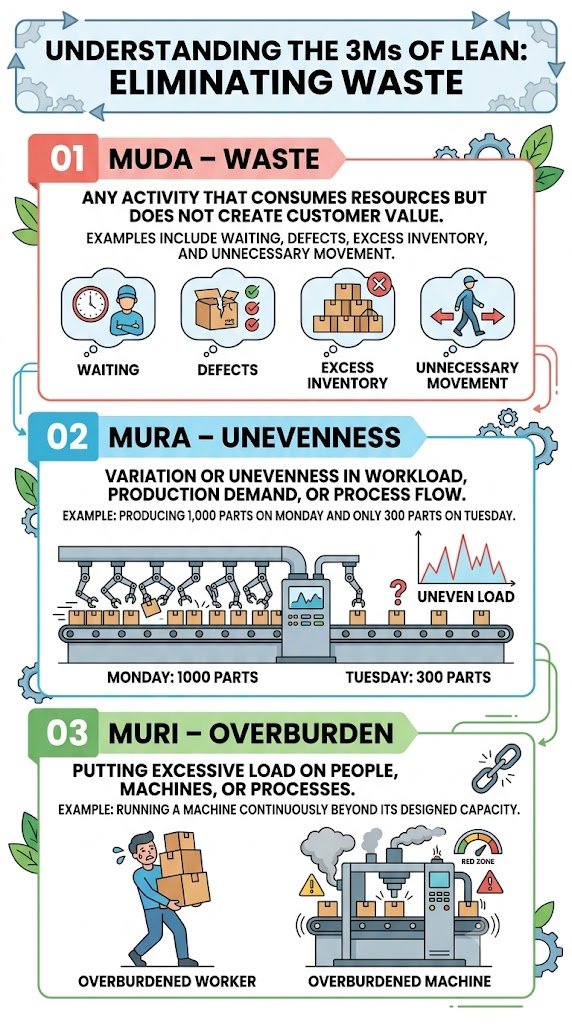
Lean Manufacturing does not focus only on visible waste. Japanese Lean thinking also identifies three conditions that create inefficiency: Muda, Mura and Muri.
Muda – Waste
Any activity that consumes resources but does not create customer value.
Examples include waiting, defects, excess inventory and unnecessary movement.
Mura – Unevenness
Variation or unevenness in workload, production demand or process flow.
Example: Producing 1,000 parts on Monday and only 300 parts on Tuesday.
Muri – Overburden
Putting excessive load on people, machines or processes.
Example: Running a machine continuously beyond its designed capacity.
Muda – Waste
Muda is probably the most familiar Lean concept. Waste can be found in material, manpower, machines, movement, information and time.
Mura – Unevenness
Mura occurs when work is not balanced. For example, imagine a machining line where one process receives 100 parts per hour while the next process can process only 60 parts. The result is increasing WIP and waiting.
Muri – Overburden
Muri occurs when employees or equipment are overloaded. For example:
- Operator working continuously without proper breaks
- Machine operated beyond recommended limits
- Maintenance team handling too many breakdowns without preventive planning
- Quality inspector checking excessive quantities because the process is unstable
Relationship Between 3Ms
Unevenness
Overburden
Waste
Uneven production can create overburden. Overburden can lead to breakdowns, defects and waiting. These conditions ultimately generate more waste. Therefore, Lean improvement should address all three.
Practical Manufacturing Example
| Condition | Example | Possible Lean Action |
|---|---|---|
| Mura | Large variation in daily production schedule | Level production / Heijunka |
| Muri | CNC machine overloaded continuously | Balance workload and capacity |
| Muda | Operator waiting for material | Improve material flow / Kanban |
3. Seven Wastes of Lean Manufacturing
The Seven Wastes are one of the most important concepts in Lean Manufacturing. The objective is not simply to memorize the seven wastes. The real objective is to learn how to see waste on the shop floor.
Overproduction
Producing more than required or producing earlier than required.
Example: Manufacturing 2,000 components when the customer currently requires only 1,000.
Waiting
People or machines remain idle because the next activity is not ready.
Example: CNC machine waiting for material, tooling or inspection clearance.
Transportation
Unnecessary movement of material or products.
Example: Moving WIP between distant machining departments multiple times.
Overprocessing
Doing more work than required by the customer or specification.
Example: Using unnecessarily tight process controls or additional machining that provides no customer value.
Inventory
Excess raw material, WIP, tooling or finished goods.
Example: Large quantities of WIP waiting between VMC and grinding.
Motion
Unnecessary movement of people.
Example: Maintenance technician repeatedly walking to collect tools or spares.
Defects
Errors that result in scrap, rework, additional inspection or customer complaints.
Example: Incorrect machining dimension requiring rework.
Seven Wastes – Quick Reference
| Waste | Manufacturing Example | Possible Lean Tool |
|---|---|---|
| Overproduction | Making more parts than required | JIT / Kanban |
| Waiting | Machine waiting for material | Flow / TPM |
| Transportation | Unnecessary WIP movement | VSM / Layout improvement |
| Overprocessing | Extra machining or inspection | Standard Work / VSM |
| Inventory | Excess WIP | Kanban / Pull System |
| Motion | Searching for tools | 5S / Visual Management |
| Defects | Scrap and rework | Poka-Yoke / RCA |
How to Identify Waste on the Shop Floor
When you walk through your manufacturing area, ask these simple questions:
- Where are people waiting?
- Where are machines waiting?
- Where is excess material stored?
- How many times does material move?
- How much walking is required?
- Where are defects and rework occurring?
- Are we producing according to actual demand?
- Are we doing any work that the customer does not require?
Putting It All Together
Let us consider a simple machining example. An operator loads a component into a CNC machine. The machine runs for 45 seconds. After machining, the operator walks 20 meters to collect a gauge, waits for inspection and then moves the part to another area.
The 45-second machining activity may be Value-Added. But the walking, waiting and unnecessary transportation are potential Lean wastes.
| Activity | Classification | Lean Opportunity |
|---|---|---|
| CNC machining | Value-Added | Optimize cycle time |
| Walking for gauge | Non-Value-Added / Motion | 5S / Point-of-use storage |
| Waiting for inspection | Non-Value-Added / Waiting | Flow / Quality at source |
| Moving parts unnecessarily | Non-Value-Added / Transportation | Layout improvement |
Key Takeaways
Value
Understand what the customer actually requires.
3Ms
Control Muda, Mura and Muri together.
Seven Wastes
Learn to identify waste during actual shopfloor observation.
Continuous Improvement
Measure the waste, find the root cause and improve the process.