
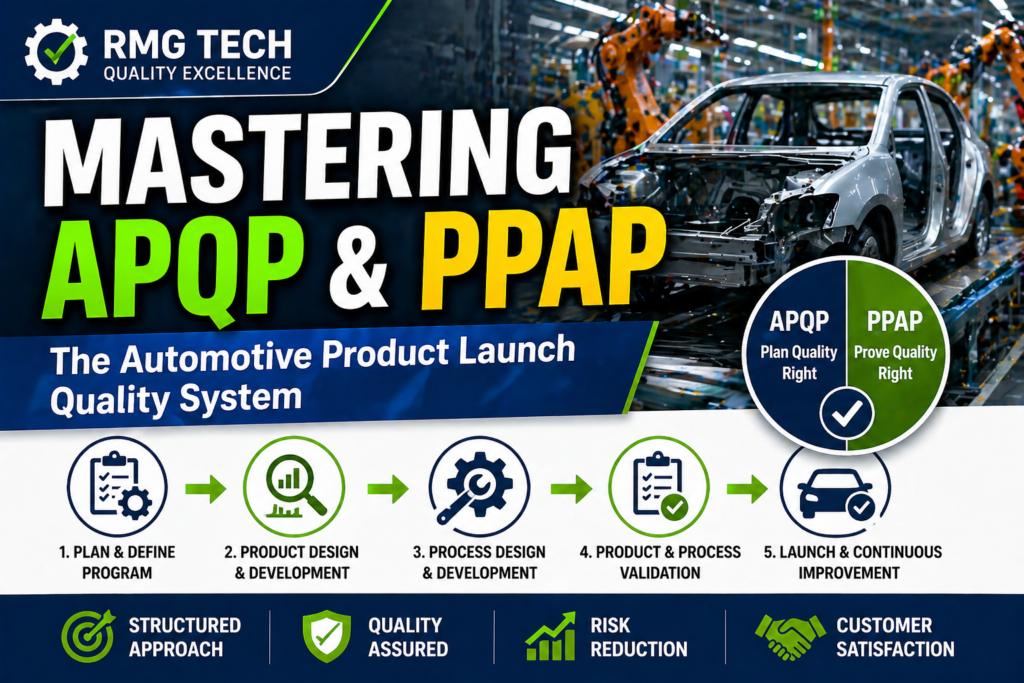
Mastering APQP & PPAP:
The Automotive Product Launch Quality System
A comprehensive guide to the two most important quality tools in the automotive supply chain — Advanced Product Quality Planning (APQP) and the Production Part Approval Process (PPAP). Covers the complete 5-phase APQP framework, all 18 PPAP elements, the 5 submission levels, the Control Plan, the Part Submission Warrant, APQP 3rd Edition (2023) updates, and a practical implementation roadmap for suppliers entering or advancing in the automotive supply chain.
What is APQP & PPAP?
Every new component that enters an automotive production line — a brake calliper, a fuel injector, a door hinge, an engine valve — must pass through two interconnected quality processes before a single production part is shipped to the vehicle assembler. The first is APQP (Advanced Product Quality Planning) — the structured framework that plans and manages every activity from the moment a supplier is nominated for a new programme through to production launch and beyond. The second is PPAP (Production Part Approval Process) — the formal evidence package assembled during APQP that proves to the OEM customer that the production process is capable, controlled, and ready for mass production. Together, they form the foundation of the automotive product launch quality system.
APQP is the road map; PPAP is the proof that the journey was completed correctly. APQP defines what must be done, by when, and by whom to ensure that a new or revised product meets all customer requirements before mass production begins. PPAP is the formal, documented evidence that all APQP activities were completed successfully — reviewed and approved by the customer before production shipments commence.
Both tools were developed by the Automotive Industry Action Group (AIAG) in collaboration with the US Big Three (Ford, GM, Chrysler) in the late 1980s and early 1990s as part of the QS-9000 framework, and are now mandated across the global automotive supply chain under IATF 16949:2016. They are applicable at every tier of the supply chain — Tier 1 suppliers use APQP and PPAP with their OEM customers; Tier 2 suppliers use them with their Tier 1 customers; and so on down the supply chain. No automotive production programme launches anywhere in the world without them.
The purpose of APQP is to produce a product quality plan which will support development of a product or service that will satisfy the customer. APQP provides a structured approach to communicate to suppliers and customers alike about requirements, specifications and risks at the earliest possible stage of the product development process.
— AIAG Advanced Product Quality Planning Manual, 3rd EditionHistory, Purpose & How APQP and PPAP Work Together
By the 1980s, the automotive industry had a pervasive and expensive problem: new model launches were plagued by quality failures, production disruptions, and field recalls — not because suppliers were incompetent, but because the system for planning, communicating, and validating new products before launch was fragmented, inconsistent, and reactive. Each OEM had its own requirements, its own timelines, and its own approval processes. Suppliers serving multiple OEMs maintained entirely separate quality planning systems for each customer relationship, duplicating enormous effort without improving outcomes.
The AIAG, Ford, GM, and Chrysler commissioned a cross-functional team of quality engineers in the late 1980s to create a standardised, prevention-focused framework that would: ensure all quality planning activities were completed in the right sequence, at the right time, with the right people, before production began. The result was APQP — and its companion, PPAP, which provided the formal customer approval gate at the end of the APQP process.
The relationship is sequential and cumulative: APQP begins when the supplier is nominated for a programme, and every phase of APQP generates specific deliverables. Many of these deliverables — the DFMEA, Process Flow Diagram, PFMEA, Control Plan, MSA studies, dimensional results, and capability studies — become elements of the PPAP package. PPAP is therefore not a separate parallel activity but the culmination and formalisation of APQP. When APQP is executed rigorously, PPAP assembly becomes a documentation exercise. When APQP is rushed or incomplete, PPAP assembly becomes a crisis.
Cross-Functional Team & APQP Timing Plan
APQP is fundamentally a team activity, not a quality department activity. One of the most common failures in APQP implementation is treating it as a documentation exercise managed by the quality engineer, with other functions involved only when they need to sign a form. This produces paperwork without prevention — the FMEA is completed retrospectively, the control plan is written after the process is already running, and the PPAP package is assembled under time pressure as the SOP date approaches. The purpose of the APQP Cross-Functional Team (CFT) is to ensure that quality decisions are made collectively and proactively — at the stage of the development process when they are still cheap and easy to implement.
A properly constituted APQP CFT includes representatives from: Engineering (product design, tolerancing, material specification, DVP&R ownership), Manufacturing Engineering (process design, tooling, fixtures, cycle time), Quality (DFMEA/PFMEA facilitation, control plan, MSA, SPC planning, PPAP coordination), Production / Operations (capacity, staffing, training requirements), Purchasing (sub-supplier qualification, PPAP requirements for sub-tiers), Logistics (packaging design, container specification), and critically — a direct line of communication to the customer (SQE / Supplier Quality Engineer from the OEM).
The CFT meets at defined intervals tied to the APQP timing plan — a Gantt chart that maps every APQP deliverable against the programme milestone dates. The timing plan starts with the SOP (Start Of Production) date specified by the OEM and works backwards: when must PPAP be submitted (typically 6–8 weeks before SOP to allow OEM review time), when must the production trial run be completed (before PPAP), when must the PFMEA and control plan be approved (before the trial run), when must tooling be in place (before the production trial), and so on back to programme award. This reverse-planning reveals which activities are on the critical path — and which are at risk of slipping and compressing the downstream activities that depend on them.
APQP 3rd Edition (2023) introduced a formal Gated Management approach — each phase has defined entry and exit criteria (gates) that must be reviewed and formally approved by the CFT before moving to the next phase. This gate structure prevents the most common APQP failure mode: moving forward with unresolved issues from a previous phase because the programme schedule is under pressure.
Phase 1 — Plan & Define: The Voice of the Customer
Phase 1 is triggered when the supplier receives formal notification of programme award or nomination. Its purpose is to deeply understand what the customer actually requires — not just what the drawing says, but the voice of the customer expressed through quality history, warranty data, field performance targets, customer satisfaction surveys, and future reliability goals. This understanding becomes the foundation on which all subsequent APQP activities are built.
The critical deliverables of Phase 1 are: a fully understood set of Design Goals and Reliability/Quality Goals (what failure rates and durability targets must the part achieve in service), a Preliminary Bill of Materials and Preliminary Process Flow Diagram (early thinking about how the part will be made), Preliminary Special Characteristics identification (which product and process characteristics could affect safety, function, or regulatory compliance if they deviate), a formal Team Feasibility Commitment (a documented statement that the team has reviewed the requirements and confirms they are achievable), and the all-important APQP Timing Plan — the programme management tool that makes APQP a discipline rather than a wish.
APQP 3rd Edition added a dedicated Sourcing Section and Sourcing Checklist to Phase 1, recognising that sub-supplier quality failures are one of the leading causes of launch disruptions. Phase 1 now formally requires the CFT to identify all sub-tier suppliers, assess their APQP and PPAP capability, and establish cascade requirements to ensure that Tier 2 and Tier 3 suppliers are executing their own APQP programmes in alignment with the Tier 1 APQP timing.
Phase 2 — Product Design & Development
Phase 2 covers all activities related to product design development and verification. Critical note: Phase 2 applies when the supplier is responsible for product design (Tier 1 design-responsible suppliers). When the OEM retains design responsibility (which is common for production parts to OEM drawings), Phase 2 is primarily the customer's APQP activity — the supplier focuses on understanding the design intent, identifying sub-supplier implications, and confirming manufacturing feasibility rather than generating design documents. In both cases, the supplier's APQP Phase 2 outputs must include evidence that the design has been reviewed from a manufacturing perspective.
The most important Phase 2 deliverable is the Design FMEA (DFMEA) — the systematic analysis of every product characteristic for potential failure modes, their effects on the customer, their causes, and the controls that prevent or detect them. The DFMEA identifies and refines the special characteristics that will require enhanced control in production. Using the AIAG & VDA FMEA Handbook (2019), DFMEA now uses the Action Priority (AP) system rather than the old RPN — ensuring that safety-critical failure modes (Severity 9/10) always receive High AP and are addressed regardless of their occurrence likelihood.
The Design Verification Plan & Report (DVP&R) defines every test that will be performed to verify the design meets all requirements — dimensional, material, functional, environmental, and regulatory. Prototype builds (Phase 2 gate requirement) are built and tested against the DVP&R. Design reviews at the end of Phase 2 confirm that all design issues are resolved before process design begins.
Phase 3 — Process Design & Development: The Heart of APQP
Phase 3 is the most consequential phase of APQP for production quality — it is where the production process is designed, its failure modes are analysed, and the control system is documented. The quality of Phase 3 execution directly determines whether the production process is capable and controlled, or unpredictable and dependent on operator heroics. Every automotive quality engineer will tell you: problems discovered in Phase 3 cost time and engineering effort to resolve; the same problems discovered after production launch cost production stoppages, scrap, customer complaints, and potentially recalls.
The three linked deliverables of Phase 3 form the backbone of the automotive quality system: the Process Flow Diagram (a graphical sequence of every manufacturing operation from raw material receipt to finished goods shipping — the foundation document that drives both PFMEA and Control Plan), the Process FMEA (PFMEA) (a systematic analysis of every manufacturing operation for potential failure modes, their effects on product quality and customer, their causes, and controls — specifically addressing special characteristics with enhanced prevention and detection measures), and the Control Plan (the master document that defines, for every characteristic that must be controlled in production, exactly what will be measured, with what gauge, at what frequency, with what sample size, with what reaction plan if out of control).
These three documents are not independent — they must be linked and consistent. Every operation in the process flow must appear in the PFMEA. Every special characteristic in the PFMEA must appear in the control plan. Every measurement in the control plan must be validated by an MSA study. The AIAG uses a powerful analogy: the process flow is the skeleton, the PFMEA is the risk analysis, and the control plan is the daily care instructions — all three are needed for a healthy production process.
Phase 3 also delivers the MSA Plan (which gauges will require Gauge R&R studies before production), the SPC Plan (which characteristics will be monitored by SPC), Work Instructions for every critical operation, the Operator Training Plan, a Packaging Specification, and a Measurement System & Test Equipment Plan including calibration requirements.
Phase 4 — Product & Process Validation: Proving Readiness
Phase 4 is the production validation phase — the moment of truth where everything planned in Phases 1–3 is put to the test on the actual production tooling, at the actual production facility, with actual production operators, at the actual planned production rate. This is not a prototype build or a pre-series trial — it is a genuine production run from which the PPAP parts and data are taken. Parts produced on engineering fixtures, pre-production tooling, or at a different facility than the one that will make production parts are not acceptable for PPAP — the PPAP represents the specific production process at the specific production location, not a surrogate.
The Production Trial Run (also called the Production Validation Run) requires a minimum of 300 consecutive pieces (or the AIAG/customer-specified quantity) produced under production conditions — same tooling, same operators, same setting parameters, same inspection methods as will be used in mass production. During and after this run, all measurement and capability data for the PPAP is collected: every drawing characteristic is measured on a representative sample of parts (typically 5–30 pieces depending on the characteristic), material test results are obtained from a certified laboratory, and initial process capability studies (Ppk and Cpk) are calculated for all special characteristics.
The Ppk requirement at PPAP submission is Ppk ≥ 1.67 for special characteristics and Ppk ≥ 1.33 for general characteristics. These are minimum values — many OEM customers impose higher requirements. When a characteristic fails to meet the Ppk requirement, the supplier must either improve the process before PPAP submission (preferred) or submit with a documented deviation plan showing how the characteristic will be brought to capability — both options require explicit OEM customer agreement.
Phase 4 also delivers the completed MSA studies (Gauge R&R for all measurement systems used to verify special characteristics), the Production Control Plan (updated from the pre-launch version to reflect what was actually learned during the trial run), the Qualified Laboratory Documentation (certifications for all test labs used), and the complete PPAP Package — all 18 elements assembled, checked, and ready for customer submission.
Phase 5 begins at SOP and continues throughout the production lifetime of the part. Once PPAP is approved and mass production begins, APQP transitions from a project management tool to an ongoing improvement system. Key Phase 5 activities: Layered Process Audits (LPA) — structured on-floor audits verifying that production is being executed as the Control Plan defines; Customer Satisfaction monitoring (warranty data, OEM scorecard performance, customer complaints); Lessons Learned capture and deployment to future APQP programmes; FMEA and Control Plan updates when field failures or process changes occur; and implementation of corrective actions using 8D methodology when quality issues arise.
PPAP — All 18 Elements Explained
The PPAP package is the formal evidence package assembled by the supplier that collectively demonstrates process readiness for mass production. It is reviewed and approved by the customer's Supplier Quality Engineer (SQE) before any production parts are shipped for use in a vehicle. The package contains 18 defined elements specified by the AIAG PPAP Manual (4th Edition). Not all 18 elements are required for every submission — the required elements depend on the submission level agreed with the customer.
Complete engineering drawing (customer and/or supplier), including all notes, tolerances, and specifications. Every dimension "ballooned" (numbered) to correspond with dimensional results. The baseline document for everything else.
Any Engineering Change Notices (ECN) or engineering deviation approvals that modify the baseline design. Must be customer-authorised before inclusion in the PPAP. Provides traceability of all design changes from the original specification.
Evidence of customer engineering department approval of the part design — typically the engineering release documentation or a formal signed approval. Required when the part is engineering-approved but full PPAP has not yet been completed.
Complete or summary of the Design Failure Mode and Effects Analysis. Shows systematic analysis of all product failure modes, their severity, occurrence, detection, and Action Priority. Identifies all design-level special characteristics.
Graphical representation of every manufacturing step from raw material receipt to finished goods shipping. Identifies all operations, inspection points, rework loops, and sub-supplier operations. The master reference for PFMEA and Control Plan development.
Complete Process Failure Mode and Effects Analysis — analyzes every manufacturing operation for potential failure modes affecting product quality. Must link directly to the Control Plan. Action Priority (AP) ratings per AIAG & VDA 2019 Handbook.
The master production quality document — defines every controlled characteristic, its specification, the measurement method and gauge, sampling frequency, control method (SPC, 100% inspection, attributes), and reaction plan when out of control. Must be the final Production Control Plan (not pre-launch version).
Gauge R&R studies for all measurement systems used to verify special characteristics. Must demonstrate Gauge R&R < 10% of tolerance (or process variation) for the measurement system to be acceptable. Variable and attribute MSA per AIAG MSA Manual 4th Edition.
Measurement results for every dimension and specification on the drawing, measured on parts produced from the production trial run. Every drawing characteristic must be measured — typically on 5 pieces per cavity (for multi-cavity tooling). All dimensions must be to nominal with actual measured values recorded.
Summary of all material test results (hardness, tensile, chemical composition, microstructure per material specification) and performance test results (functional tests per DVP&R) confirming the part meets all engineering requirements. Must be from a certified laboratory.
Statistical capability studies for all special characteristics. The minimum acceptable Ppk at PPAP submission is 1.67 for special characteristics and 1.33 for general characteristics. Must be calculated from the production trial run data (minimum 25 subgroups / 100 data points recommended).
Accreditation certificates (ISO/IEC 17025 or equivalent) for all external test laboratories used in the PPAP. Internal test facilities may also require documented scope of approval. Ensures that all test data in the PPAP was generated by a qualified, calibrated, traceable facility.
Required for parts with appearance specifications (colour, texture, gloss, grain, feel). The AAR documents customer visual approval of the production-representative sample against all appearance criteria. Typically requires physical sample submission to the OEM's design studio.
Physical sample parts produced from the production trial run — typically 5 to 30 pieces depending on customer requirement, built with production tooling, at the production facility, by production operators. These are the parts against which all dimensional and material results were taken.
A representative production part signed off and retained jointly by the supplier and customer as the agreed reference standard. Used for colour and appearance comparisons, incoming inspection reference, and as the reference if a design or process dispute arises. Clearly labelled and stored in controlled conditions.
List and description of all gauges, fixtures, templates, and inspection aids used to measure the part. Includes part-specific checking fixtures (attribute gauges, go/no-go gauges, CMM fixtures) with their calibration status and R&R results if applicable. Checking aids must be available for customer review.
Documentation confirming that all customer-specific requirements (CSRs) applicable to this part and process have been reviewed, understood, and implemented. This element captures the OEM-specific additions to the base PPAP requirements — including unique formats, additional submission elements, or different capability thresholds.
The cover document and formal declaration that summarises the entire PPAP submission. Signed by an authorised supplier representative confirming that all 18 elements are complete and the production process is capable of consistently producing conforming parts. The customer's SQE signature on the PSW constitutes PPAP approval. Without an approved PSW, no production parts may ship.
PPAP Submission Levels & the Part Submission Warrant
Not every PPAP submission requires all 18 elements to be physically submitted to the customer — the required documentation set is defined by the PPAP Submission Level, agreed between supplier and customer at the start of the programme. There are 5 levels, each representing a different depth of documentation evidence. The default level for new parts in the automotive supply chain is Level 3.
Part Submission Warrant submitted to the customer with no supporting documentation. Used for minor changes or very low-risk parts where the customer has strong existing knowledge of the supplier's process. Documents retained at supplier.
PSW with product samples, material test results, and an Appearance Approval Report (if required). Limited documentation — some elements retained at supplier. Used for less complex parts or where customer has good process knowledge.
Full documentation package submitted to customer — PSW, production samples, and all applicable PPAP elements. The default level for new parts and significant changes. Customer reviews all documentation before issuing approval.
Default LevelPSW and any other requirements specifically defined by the customer. Level 4 requirements are unique to each customer and are stated in the customer's purchase order or CSR documentation. No standard definition — purely customer-specified.
PSW with complete supporting data and production samples — but reviewed at the supplier's manufacturing location rather than submitted to the customer. The customer (SQE) visits the supplier's plant to review all documentation and the production process in situ. Used for complex, high-value, or safety-critical parts.
The Part Submission Warrant (PSW) is the cover document that accompanies every PPAP submission. It is a formal, legal declaration by an authorised supplier representative that: all design requirements are understood and met; all applicable PPAP elements have been completed; the production process is capable of producing conforming parts at the stated production rate; and the submission is based on parts produced using production tooling, at the production facility, by production operators.
The PSW records: part number, part name, customer name, supplier name and location, engineering change level, drawing date, production location, submission reason (new product, engineering change, process change, etc.), annual production volume, material declaration (IMDS/REACH compliance), and the supplier's authorised signature. The customer's SQE signs the PSW to issue the approval status:
PPAP Approved: All elements meet requirements — supplier may ship production parts. Interim PPAP Approval: The part may be shipped temporarily (with specific quantity and/or time limit), but documented open items must be resolved by a specific date. Interim approval should not be treated as routine — it is an exception that requires a documented corrective action plan with committed closure dates. PPAP Rejected: Significant issues prevent approval — the supplier must address non-conformances and resubmit. Production shipments are not permitted.
A critical implication: PPAP approval is process-specific and location-specific. A new or revised PPAP is required whenever the production process changes — new or modified tooling, change of production facility, change of sub-supplier, new material source, change of process parameters for a special characteristic, or interruption of production for more than 12 months. The PPAP reflects the approved process; any change to that process invalidates the existing PPAP.
APQP 3rd Edition, Control Plan 1st Edition & Key Updates
In 2023, AIAG published the APQP 3rd Edition and the Control Plan 1st Edition — the first major update to these core tools since 2008. The revision was driven by significant changes in the automotive industry: the rise of electric vehicles and their new quality challenges (battery systems, high-voltage architecture, embedded software), the increasing use of agile programme management, greater supply chain complexity, and the need to address the recurring root causes of launch quality failures identified over 15 years of IATF audit data.
Gated Management
Formal phase gates with defined entry/exit criteria and CFT sign-off requirements — prevents advancing with unresolved issues.
Sourcing Section
Dedicated sourcing checklist in Phase 1 for sub-tier supplier qualification and cascade APQP requirements management.
Change Management
New dedicated change management section and checklist — addresses engineering changes, process changes, and supplier changes during programme execution.
Agile Integration
Agile programme management concepts incorporated — recognises that EV and software-intensive programmes require iterative development approaches within the APQP structure.
APQP Programme Metrics
New metrics framework for measuring APQP programme health — enables early identification of at-risk deliverables before they impact the launch timeline.
Control Plan Standalone
Control Plan content removed from APQP and published as a separate 1st Edition manual — recognising its importance as an ongoing production document, not just a launch deliverable.
The Control Plan is the most used and most audited document in any automotive supplier's quality system — more so than even the PFMEA. Where the PFMEA is a risk analysis performed once (and updated when needed), the Control Plan is the daily operating instruction for every production operator and quality inspector. It defines, for every characteristic that must be controlled in production: the operation name and number (linked to the Process Flow), the machine/fixture/tool, the characteristic specification (nominal, upper and lower limits), the measurement gauge or method, the measurement frequency (every part, every hour, every batch), the sample size, the reaction plan if the characteristic is found out of specification, and whether the control method is SPC, 100% inspection, attributes, or error-proofing.
There are three versions of the Control Plan developed across the APQP phases: the Prototype Control Plan (Phase 2 — covers prototype build and test activities), the Pre-Launch Control Plan (Phase 3 — for the production trial run), and the Production Control Plan (Phase 4/5 — the final document used in ongoing mass production). The Production Control Plan is the PPAP Element #7 and must reflect what is actually being done in production — it is a living document that must be updated whenever the process changes. The Control Plan 1st Edition (2023) introduced enhanced guidance on linkages between the Control Plan and PFMEA, clearer requirements for inspection point definition, and new examples aligned with EV and high-voltage product applications.
Summary & Implementation Roadmap
APQP and PPAP, executed together as an integrated system, represent the most powerful quality engineering methodology available for new product launches. When implemented genuinely — with a committed cross-functional team, rigorous phase gate reviews, honest risk assessment in the FMEA, and a production trial run that truly represents mass production conditions — they consistently deliver launch quality that prevents the customer complaints, production disruptions, and field returns that destroy supplier relationships and profitability.
- Quality problems are resolved during design and process planning — not during production
- All customer requirements are understood and verified before a single production part ships
- The production process is proven capable (Ppk ≥ 1.67) before mass production begins
- All measurement systems are validated — data-driven decisions, not measurement noise
- The Control Plan ensures every operator knows what to measure, how often, and what to do if out of control
- Sub-supplier risks are identified and managed — not discovered at the production trial run
- Lessons Learned from each programme improve the next launch — a compounding quality advantage
- APQP treated as a documentation exercise by the quality department rather than a team discipline
- Timing plan not created or not maintained — APQP becomes reactive as the SOP date approaches
- PFMEA and Control Plan written after the process is already designed, not during process design
- Production trial run performed with pre-production tooling or at a different facility than production
- Ppk data taken from a few parts at tool tryout, not 300 consecutive production pieces
- PPAP assembled under SOP time pressure with elements copied from previous programmes
- Interim PPAP approvals treated as normal — used routinely rather than as an emergency exception
The Central Principle of APQP & PPAP
The cost to fix a quality problem multiplies tenfold at every stage of the product development process. A design issue identified in Phase 1 costs an engineer an afternoon. The same issue identified during Phase 2 design review costs a week of redesign. Identified during Phase 3 process design, it costs tooling changes. Identified during the Phase 4 production trial, it costs a delayed SOP. Identified after SOP — in production — it costs scrap, rework, customer delivery disruptions, and expedited corrective actions. Identified in the field, it costs recalls, warranty claims, and potentially lives.
APQP is the systematic programme discipline that forces quality decisions to be made early — when they are still cheap, fast, and reversible. PPAP is the formal evidence that the programme was executed rigorously enough that mass production can begin with confidence. Together, they represent the automotive industry's answer to the most fundamental challenge in manufacturing: how do you ensure that a product produced for the first time at the production facility, with production tooling, by production operators, will consistently meet all customer requirements — before any customer vehicle is built?
If you are a supplier entering the automotive supply chain for the first time, or re-energising your APQP programme: start with the timing plan, build the cross-functional team immediately after programme award, and treat the Control Plan and PFMEA as living production documents — not one-time launch deliverables. The PPAP package is only as good as the APQP programme that produced it. A PPAP submitted under time pressure, assembled from previous-programme templates, with a production trial run of 50 pieces on pre-production tooling, will fail — either at the customer's SQE review, or in production when the problems that APQP was designed to prevent instead reveal themselves as warranty claims and customer disruptions.
APQP & PPAP · Automotive Product Launch Quality System · AIAG APQP 3rd Edition · AIAG PPAP 4th Edition · IATF 16949 Core Tools · RMG Tech
I have been surfing online more than 3 hours these days, yet I by
no means found any interesting article like yours. It is beautiful worth sufficient for me.
In my opinion, if all site owners and bloggers made good
content as you probably did, the web will probably be
much more helpful than ever before.