Lean Manufacturing Training
Improve Efficiency | Eliminate Waste | Deliver Customer Value
Training Video on Lean Manufacturing
Presentation on Lean Manufacturing for Support Functions
What is Lean Manufacturing?
Lean Manufacturing is a systematic approach to improve productivity by eliminating waste and focusing on activities that add value for the customer. The concept originated from the Toyota Production System and is now widely used in manufacturing industries across the world.
The primary goal of Lean is to produce high quality products while using fewer resources such as time, labor, space, and materials.
Five Principles of Lean
1. Define Value
Value is defined from the customer's perspective. Companies must understand what the customer truly needs and focus on delivering that value.
2. Map the Value Stream
Identify every step involved in producing a product. This helps distinguish value-added activities from non-value-added activities.
3. Create Flow
Ensure that the production process flows smoothly without interruptions, delays, or bottlenecks.
4. Establish Pull
Production should be based on actual customer demand instead of forecasting large quantities in advance.
5. Pursue Perfection
Continuous improvement should be practiced to eliminate waste and achieve operational excellence.
The 7 Wastes of Lean Manufacturing
Overproduction
Producing more products than required or before they are needed.
Waiting
Idle time when workers or machines wait for materials or information.
Transportation
Unnecessary movement of materials between processes.
Overprocessing
Performing more work than what the customer requires.
Inventory
Excess raw materials, work in progress, or finished goods.
Motion
Unnecessary movement of workers that does not add value.
Defects
Production errors that require rework or scrap.
The 3M Concept
Lean also focuses on eliminating three major sources of inefficiency:
- Muda (Waste) – Activities that do not add value.
- Mura (Unevenness) – Variations in workload that cause inefficiency.
- Muri (Overburden) – Overloading people or machines beyond capacity.
Common Lean Tools
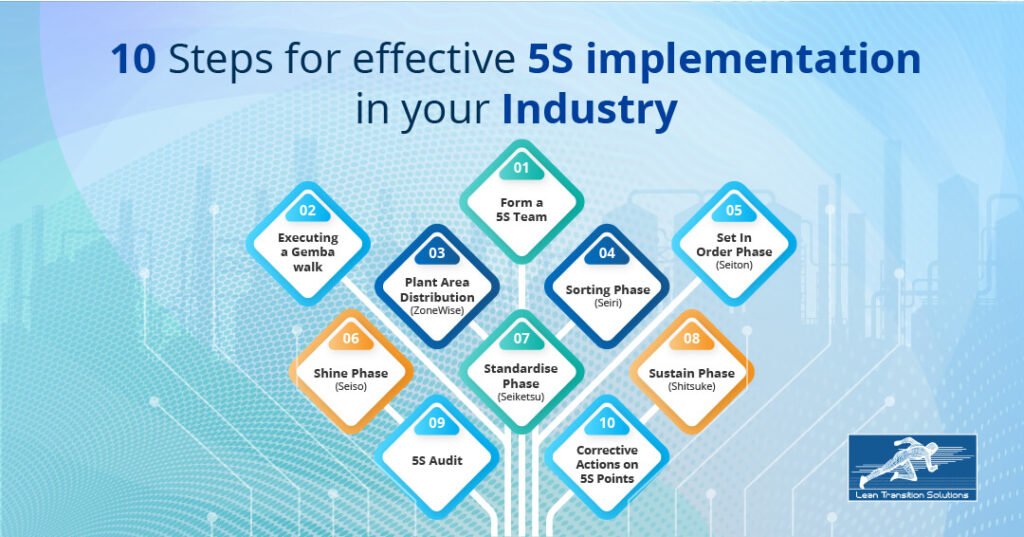
5S
Workplace organization technique that improves efficiency and safety.
Kaizen
Continuous improvement through small incremental changes.
Value Stream Mapping
Visual tool used to analyze material and information flow.
Kanban
Visual system used to control production and inventory.
Poka-Yoke
Error-proofing techniques that prevent defects.
TPM
Total Productive Maintenance improves equipment reliability.