Mastering Value Stream Mapping:
Current State to Future State
A comprehensive step-by-step guide to Value Stream Mapping (VSM) — the most powerful visual tool in the Lean practitioner's arsenal. Covers the complete methodology from product family selection and current state mapping through waste identification, future state design using lean principles, and the implementation roadmap that converts a map on the wall into measurable improvements on the factory floor.
What is Value Stream Mapping?
Value Stream Mapping (VSM) is a lean management technique that creates a visual representation — a "map" — of every step involved in delivering a product or service to a customer, including both the material flow (physical movement of product from raw material to finished goods) and the information flow (the signals, schedules, and communications that tell each process what to make and when). Crucially, VSM captures not only the value-adding steps — the operations that transform the product into something the customer wants — but also all the waiting, storing, reworking, and transporting steps that consume time and resources without adding any value whatsoever.
A value stream is all the actions — both value-creating and non-value-creating — required to bring a product from raw material to the customer's hands. Value Stream Mapping makes the entire value stream visible so that a team can distinguish value-adding work from waste, quantify the gap between them, and design a specific, achievable improvement plan to close that gap.
The power of VSM lies in what it reveals. In most manufacturing and service organisations, the time a product is actually being processed — transformed, assembled, machined, tested — represents a tiny fraction of the total time it spends in the production system. The remainder is waiting: waiting in inventory between operations, waiting in a queue for a machine to become available, waiting for an approval, waiting for a batch to be completed before moving to the next step. Studies consistently show that in most production systems, less than 5% of lead time is value-adding. VSM makes this waste visible — not as an abstract percentage, but as specific inventory triangles, time bars, and push arrows on a map that everyone can see, understand, and act on.
If you cannot see it, you cannot improve it. Value stream mapping gives the entire organisation a common language and a shared picture of how work actually flows — not how we think it flows, or how we wish it flowed, but how it actually flows today. From that shared picture, improvement becomes possible.
— Mike Rother & John Shook, Learning to See, Lean Enterprise Institute (1999)History — From Toyota to the World
VSM's origins are inseparable from the Toyota Production System (TPS). Toyota called the underlying technique "material and information flow mapping" — a practice developed through decades of production system refinement under Taiichi Ohno and Shigeo Shingo from the 1950s onwards. The technique was central to how Toyota engineers understood and improved production systems: by walking the entire flow from raw material to finished vehicle, observing what actually happened (not what the standard operating procedures said should happen), and drawing the flow by hand to make it discussable.
The tool was introduced to Western audiences in two landmark publications. James P. Womack and Daniel T. Jones described the underlying concept in Lean Thinking (1996), coining the term "value stream" and articulating the five lean principles (Value, Value Stream, Flow, Pull, Perfection). Three years later, Mike Rother and John Shook of the Lean Enterprise Institute published Learning to See: Value-Stream Mapping to Create Value and Eliminate Muda (1999) — the practical workbook that standardised the VSM symbols, methodology, and step-by-step approach that is used globally today. The book won the Shingo Research and Professional Publication Prize and has since sold over 300,000 copies, making it the most widely read lean manufacturing text after The Machine That Changed the World.
VSM is now used across every sector of industry — automotive, aerospace, electronics, food and beverage, pharmaceuticals, healthcare, financial services, software development, and logistics. Beau Keyte and Drew Locher extended VSM explicitly to service and administrative processes in The Complete Lean Enterprise (2004), recognising that information flows in offices and service centres are fundamentally the same kind of system as material flows on factory floors — with the same categories of waste, the same opportunity for flow improvement, and the same need for visual management.
VSM Symbols — The Standard Language of Flow
VSM uses a standardised set of symbols drawn from Toyota's original material and information flow diagrams. Learning these symbols is the first practical step in VSM literacy — they are the vocabulary of a common language that makes flow visible and discussable across engineering, operations, quality, and management.
The map is always drawn with the customer at the top right, the supplier at the top left, and the production processes in the middle row from left (upstream) to right (downstream). Information flows run horizontally across the top. Material flows horizontally along the middle. The timeline runs along the bottom, alternating between processing time (time actually worked on the product) and lead time (time the product spends waiting in inventory between processes). This structure makes the proportion of value-adding to non-value-adding time immediately and viscerally visible to every viewer.
Step 1 — Select the Product Family
The first and most critical decision in any VSM project is choosing which product family to map. A product family is a group of products that share the same or similar manufacturing operations and equipment — they pass through the same sequence of process steps. Products that share processes can be mapped together; products that follow fundamentally different routes through the factory belong to different value streams and should be mapped separately.
The tool for selecting the product family is the Product Family Matrix — a simple grid with products (or part numbers) on the rows and manufacturing processes on the columns. A tick marks where each product passes through each process. Products with the same (or very similar) tick pattern in the same sequence form a product family. Select the product family that represents the highest revenue volume, the highest strategic importance, or the most significant customer delivery problem — the one where improvement will have the greatest impact on the business.
Once the product family is selected, define the VSM scope boundaries: where does the value stream start (typically at raw material receipt from the first external supplier) and where does it end (typically at finished goods shipment to the customer). A written scope statement — one clear sentence — prevents scope creep during the mapping event. Post it at the top of every map sheet throughout the project.
Assemble the cross-functional team: VSM is not a solo activity or a quality department exercise. The ideal team includes representation from production operations (the people who actually run the processes), engineering, quality, logistics, and ideally a customer or supply chain representative. The ASQ recommends an ideal team size of approximately 10 members — small enough to be agile, large enough to capture all perspectives. The team lead is the Value Stream Manager — ideally a senior operations or engineering leader who has the authority to implement changes across functional boundaries.
Step 2 — Map the Current State
The current state map is built by walking the actual production flow from shipping dock back to the receiving dock — in reverse order, starting from the customer end. This counter-intuitive direction is deliberate: it keeps the team focused on what the customer needs (pull) rather than what the supplier provides (push). The team physically walks to each process step with a clipboard, a stopwatch, and the VSM symbols. They observe the actual process, measure actual cycle times, count actual inventory, and record what is actually happening — not what the standard operating procedure says should be happening, and not what the ERP system thinks is happening.
For each process box, measure and record: Cycle Time (C/T) — the actual time to complete one cycle of work, including manual time and auto time; Changeover Time (C/O) — actual setup time between product families; Number of Operators (N/O); Machine Uptime (% availability); Batch Size (if applicable); and % Complete and Accurate (%C&A) — the percentage of work passing to the next step without requiring rework, correction, or additional information. These metrics populate the data box below each process box and are the raw material for the waste analysis in Step 3.
Between each process box, draw an inventory triangle labelled with the actual inventory count (in pieces) and the equivalent number of days of inventory it represents (pieces ÷ daily demand). Count the actual pieces in the actual pile or shelf — do not use the ERP system's number, which is frequently wrong. The inventory triangle is the single most revealing element of the current state map: it makes visible what every supervisor and manager knows intellectually but rarely confronts visually — that the factory floor is full of parts waiting, not parts being processed.
Step 3 — Identify Waste: The 8 Wastes (TIMWOODS)
With the current state map complete and the timeline calculated, the team applies systematic waste analysis. Lean manufacturing recognises 8 categories of waste (Muda) — activities that consume time, space, and resources without adding value that the customer would be willing to pay for. These are identified by examining each element of the current state map against the 8-waste framework. Every waste identified is marked directly on the current state map — creating a visual record that drives the future state design.
Moving materials or products that doesn't add value. Forklift trips between storage and production, inter-building moves, excessive conveyors. On the VSM, visible as physical distance between operations and as transport symbols.
The most visible waste on a VSM — every inventory triangle between process boxes. Raw materials, WIP, and finished goods held beyond what is immediately needed. Hides quality problems, masks demand variation, ties up cash, and occupies space.
Operator movement that doesn't add value — reaching, bending, walking to fetch tools or materials. Different from transport (which moves product); motion wastes the operator's body. Identified through time studies and spaghetti diagrams of operator movement patterns.
The dominant waste in most VSMs — visible as the red bars on the timeline. Operators waiting for machines, machines waiting for operators, products waiting between operations in inventory queues. Every inventory triangle represents waiting time.
Making more than the customer needs, sooner than needed, or faster than needed. Taiichi Ohno called it the worst of all wastes because it generates all other wastes: excess inventory, unnecessary transport, extra motion, quality defects hidden in stockpiles. Visible on VSM as push arrows and large inventory triangles.
Doing more work on a product than the customer requires — tighter tolerances than specified, extra finishing, redundant inspections, multiple sign-offs. Often invisible because it looks like value-adding work. Identified by asking "does the customer actually need this step to this standard?"
Non-conforming parts that must be reworked, scrapped, or replaced — including warranty returns. Every defect represents double the work: once to make the part wrong, once to correct it. On the VSM, visible in the %C&A metric in data boxes and in rework loops.
The 8th waste — not in Toyota's original 7 but added as Lean spread to knowledge work. Failing to use the skills, creativity, ideas, and experience of the workforce. Operators who could solve problems but are never asked. Teams with improvement ideas that are never implemented. The hardest waste to see on a VSM.
All we are doing is looking at the time line, from the moment the customer gives us an order to the point when we collect the cash. And we are reducing that time line by removing the non-value-added wastes.
— Taiichi Ohno, Toyota Production SystemStep 4 — Design the Future State
The future state map is not a wish list or a theoretical ideal — it is a specific, achievable target condition for the value stream within a defined timeframe (typically 6–12 months). It uses the same VSM symbols as the current state map so that the before-and-after comparison is clear and consistent. Every improvement shown on the future state map is flagged with a kaizen burst — the starburst symbol that identifies exactly where, and what type of, improvement must occur.
Mike Rother and John Shook's Learning to See provides the 8 key questions that guide future state design:
1. What is the takt time? 2. Will you build to a finished goods supermarket or directly to shipping? 3. Where can you use continuous flow processing? 4. Where will you need to use supermarket pull systems? 5. At what single point in the production chain (the pacemaker process) will you schedule production? 6. How will you level the production mix at the pacemaker? 7. What increment of work will you consistently release and take away at the pacemaker? 8. What process improvements will be necessary for the value stream to flow as your future state design specifies?
The future state design principles — takt time, continuous flow, pull systems, and the pacemaker concept — are covered in depth in Section 08. The output of this step is a completed future state map with all kaizen bursts identified and labelled, and a clear lead time improvement target (e.g. "reduce from 17.8 days to 4.2 days") confirmed as achievable given the planned improvements.
Takt Time, Continuous Flow & Pull Systems
Three lean design principles form the structural backbone of every future state VSM. Understanding them deeply is what separates a future state map that drives genuine transformation from one that simply rearranges the same waste in a slightly different order.
Takt Time = Available Time ÷ Customer Demand. If customers want 500 units/day and you have 27,000 seconds of available production time, your Takt Time is 54 seconds. Every process must be capable of producing one unit every 54 seconds. Takt time sets the rhythm the entire future state must achieve.
Continuous flow means making and moving one piece at a time between processes — eliminating batches and queues within a cell. Each operation's output immediately becomes the next operation's input. Eliminates waiting inventory, reveals quality defects immediately, and makes lead time approach the sum of processing times only.
Pull means no process produces anything until the downstream process requests it via a signal (kanban card, empty container, electronic signal). Pull eliminates overproduction — the root cause of all other wastes. Between cells or where continuous flow is impractical, a supermarket with controlled inventory serves as the pull trigger point.
In a lean future state, production is scheduled at only ONE point in the value stream — the pacemaker process. All upstream processes run as pull. All downstream processes run as flow from the pacemaker. This single scheduling point replaces the multiple independent schedules that create the push-and-accumulate pattern of the current state.
Heijunka means levelling the production mix and volume at the pacemaker — spreading different product types evenly across the schedule rather than running batches of one type. Level loading reduces the peak demand on upstream processes and enables smaller, more frequent batches that match takt time more closely to customer demand patterns.
With Takt Time calculated, compare each process's Cycle Time (from the current state data boxes) to the Takt Time. Processes where Cycle Time exceeds Takt Time are bottlenecks — they cannot meet customer demand at the current rate and must be improved. Processes where Cycle Time is far below Takt Time are overproducing — they have excess capacity that is currently being used to build inventory rather than being redeployed. The future state design eliminates both conditions: bottlenecks are improved, and over-capacity is rebalanced through operator cross-training, cell design changes, or reduced machine speed.
Step 5 — Implementation Roadmap: From Map to Reality
The most important truth about VSM is one that practitioners learn the hard way: a map on the wall is not an improvement. The value of VSM lies entirely in what happens after the mapping event — in the structured, disciplined implementation programme that converts kaizen bursts into concrete actions with named owners, committed completion dates, and regular review cadences. Organisations that treat the VSM as an event rather than a programme typically see beautiful maps and minimal improvement.
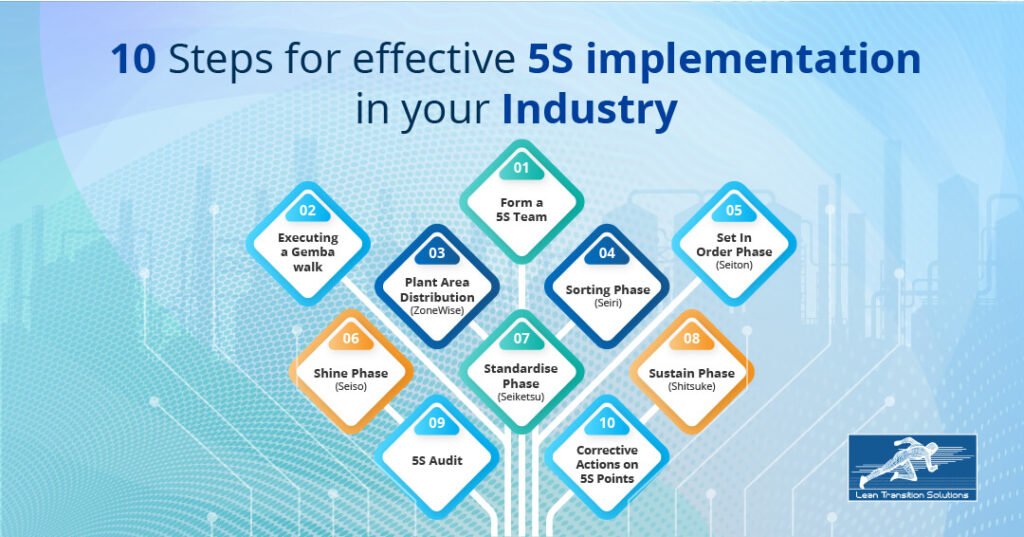
Begin with improvements that require no capital and can be implemented immediately: 5S workplace organisation (Sort, Set in order, Shine, Standardise, Sustain) to eliminate the physical chaos that hides problems; visual management boards at each process displaying production status, quality metrics, and day-by-day performance against takt; and correction of the data inaccuracies discovered during the current state walk (inventory counts, BOM accuracy, ERP data). These immediate actions demonstrate team commitment, create the foundation for flow, and begin building the discipline that all subsequent improvements require.
Redesign the physical layout to enable continuous flow within cells — grouping the process steps identified for continuous flow in the future state into U-shaped or linear cells where one-piece flow between operations is physically possible. Resize and rebalance operator work content to match Takt Time. Eliminate the walking distance that currently forces operators to leave their workstations. This phase typically requires the most cross-functional coordination — manufacturing engineering for the layout redesign, facilities for physical moves, HR for operator cross-training — and delivers the most visible lead time reduction of any phase.
Between cells where continuous flow is not yet practical, implement kanban (pull) systems to replace the MRP-driven push schedules that are generating overproduction. Calculate the required kanban quantity (supermarket size) using the formula: Kanban Size = (Daily Demand × Replenishment Lead Time × Safety Factor) ÷ Container Size. Initially, use physical kanban cards or containers — visible, tangible signals that operators can see and understand immediately. Electronic kanban is appropriate after the physical system is working reliably and the team understands the pull logic.
Large batch sizes on the current state map are almost always caused by long changeover times — the logic being "if setup takes 2 hours, we had better run a large batch to amortise it." Applying SMED (Single-Minute Exchange of Die) — separating internal setup (done with machine stopped) from external setup (done while machine is running), and converting internal to external — typically reduces changeover time by 50–80%. Shorter changeovers enable smaller batches, which reduce inventory, lead time, and the risk of producing large quantities of defective product before the error is detected.
At the 6–12 month mark, re-walk the value stream and draw a new current state map. Compare it directly to the future state target. Calculate the new lead time, WIP inventory, and process efficiency. Were the targets achieved? What new wastes have become visible now that the previous wastes have been eliminated? The new current state becomes the starting point for the next future state map — and the cycle of improvement continues. The Lean Enterprise Institute describes this as the "continuous loop of value stream management" — VSM is not a one-time project but the recurring process by which lean organisations continuously improve.
VSM Metrics & VSM Beyond Manufacturing
| VSM Metric | Definition | Current State Typical | Future State Target | How to Improve |
|---|---|---|---|---|
| Total Lead Time (L/T) | Time from raw material receipt to finished goods shipment — the full dock-to-dock time | Days to weeks | Hours to days (30–80% reduction) | Reduce inventory, implement pull, achieve flow |
| Value-Added Time (VA) | Total processing time across all operations — the time actually spent transforming the product | Minutes to hours | Remains similar — focus is on reducing NVA, not VA | Improve cycle times only where they exceed takt time |
| Process Efficiency (%) | VA Time ÷ Total Lead Time × 100%. Reveals the proportion of the timeline that adds value | 0.1%–5% | 5%–30% (dramatic increase) | Reduce NVA waste — primarily inventory and waiting |
| WIP Inventory (days) | Total work-in-process inventory between processes expressed in days of demand coverage | 5–30 days | 0.5–3 days | Reduce batch sizes, implement pull, improve flow |
| Takt Time Adherence | Percentage of production intervals where each process meets its takt time target | <60% | >90% | Balance workload, reduce cycle time variation, error-proof |
| % Complete & Accurate (%C&A) | Percentage of work passing to the next process correctly the first time, without rework or correction | 60–85% | >95% | Error-proofing (poka-yoke), standardised work, jidoka |
VSM in Service and Knowledge Work: The transfer of value stream mapping to services began in the 2000s, with a key insight: in service processes, the "material" flow is often an information flow — an application, a claim, a credit request — and waste manifests not in physical inventory but in digital queues, redundant data entry, and approval loops. A hospital emergency department maps the patient journey from arrival to discharge; an insurance company maps the claims process from first notice of loss to settlement; a software team maps a feature request from backlog to deployment. In every case, the same structure applies: map the actual flow, identify the wastes (primarily waiting — inbox queues, approval delays, re-work loops), calculate the process efficiency, and design a future state that replaces the wastes with flow. Process efficiency in service processes is almost always less than 1% of lead time — 99% or more of the time is waiting.
- A shared visual understanding of the entire value stream — not just the local view each person normally sees
- Quantified waste: specific inventory counts, cycle times, and lead times that make the improvement opportunity concrete
- A prioritised improvement plan focused on the highest-impact wastes, not random kaizen activity
- Cross-functional alignment — when everyone sees the same map, functional silos lose their excuse to optimise locally at the expense of the whole stream
- 30–80% lead time reduction achievable in the first future state cycle with focused implementation
- The foundation for all subsequent lean tools: flow, pull, standard work, and total productive maintenance all emerge naturally from VSM-driven improvement
- Using ERP data instead of walking and measuring — produces a map of the theoretical process, not the actual one
- Mapping too broadly (the entire factory) instead of selecting one product family — produces a complex diagram without actionable insight
- Completing the future state map and filing it — no implementation, no results
- Assigning kaizen bursts without named owners and deadline dates — collective responsibility is no responsibility
- Optimising individual processes (local) rather than the flow (global) — improving machine efficiency at a non-bottleneck helps no one
- Skipping the team walkthrough — a map drawn from memory or from meeting room discussion is inaccurate; only the floor reveals the truth
- Not repeating the cycle — VSM is a continuous improvement loop, not a one-time event
Summary
Value Stream Mapping is the foundational tool of lean manufacturing — the one capability that makes every other lean technique more effective, because it provides the system-level view that tells you where to apply those techniques for maximum impact. Without VSM, lean improvement is fragmented: 5S in one corner, SMED on one machine, kanban on one line, with no coherent understanding of how these individual improvements connect to reducing the lead time and improving the flow that the customer actually experiences. With VSM, every improvement is placed precisely where the value stream needs it most.
The Central Truth of Value Stream Mapping
The current state map is not the problem — it is the mirror. It shows, with unsparing clarity, the difference between what an organisation believes its production system looks like and what it actually looks like. The 17.8-day lead time. The 9,000 units of WIP. The 0.09% process efficiency. These numbers exist in every current state map of every production system that has not been systematically improved — they are not unique failures but the natural outcome of push scheduling, batch thinking, and local optimisation that characterise traditional manufacturing management.
The future state map is not a diagram — it is a commitment. A commitment that the organisation will change the physical layout, the scheduling logic, the batch sizes, and the management practices needed to achieve a specific, measurable reduction in lead time and waste by a specific date. The kaizen bursts are not decorations — they are promises, each with a named owner and a deadline. The implementation roadmap is not a wish list — it is a project plan, reviewed weekly, with progress tracked against targets and problems escalated when owners fall behind. That is how VSM transforms an organisation — not through the act of mapping, but through the discipline of implementing what the map reveals.
Draw the current state map the way the value stream actually is, not the way you think it should be. Design the future state the way it needs to be, not the way it would be easiest to achieve. Implement the future state with the rigour and urgency the improvement opportunity deserves. Then do it again. The best time to draw your current state map was last year. The second-best time is today.
Value Stream Mapping · Lean Manufacturing · Toyota Production System · Mike Rother & John Shook · Learning to See · Takt Time · Pull · Kanban · Kaizen · RMG Tech