How to Improve Cycle Time
in Manufacturing
A comprehensive guide to understanding, measuring, and systematically reducing cycle time in manufacturing — covering every key strategy from bottleneck elimination and SMED to automation and Industry 4.0 digital tools.
What is Cycle Time?
Cycle Time (CT) is the total elapsed time from the moment work begins on a unit to the moment that unit is completed and ready to move to the next process step — or to the customer. It is the most fundamental measure of manufacturing speed and one of the most powerful levers for improving productivity, cost, delivery, and customer satisfaction simultaneously.
Cycle Time is the average time between the completion of successive units in a production process. It encompasses all value-adding, non-value-adding, and waiting time that a product or process experiences from start to finish — making it a comprehensive mirror of how efficiently a manufacturing operation truly performs.
Cycle time is not the same as Lead Time (the total time from customer order to delivery, including queue and wait time) or Takt Time (the rate at which products must be completed to meet customer demand). Understanding these distinctions is fundamental — because the goal of cycle time improvement is always to bring Cycle Time below or equal to Takt Time, which is the pace set by the customer.
Speed is the essence of war. In manufacturing, speed is the essence of competitiveness. Cycle time reduction is not an efficiency exercise — it is a survival strategy.
— Taiichi Ohno, Father of the Toyota Production SystemUnderstanding the Components of Time
Before you can reduce cycle time, you must understand what it is made of. Every second spent in a manufacturing process belongs to one of four time categories. Improvement strategy depends entirely on which category dominates your cycle time.
Time during which the product is physically transformed in a way the customer values — machining, welding, assembly. Typically only 5–15% of total lead time in most factories.
Pure waste — rework, over-inspection, unnecessary transport, excess motion, overproduction. The customer pays nothing for these activities. Eliminate them completely.
Necessary but non-value-adding activities — regulatory compliance, safety checks, changeovers, preventive maintenance. Cannot be eliminated but must be minimised and optimised.
Time product spends waiting for the next process step — the single largest component of cycle time in most factories. Driven by batching, imbalanced lines, and poor flow.
How to Measure Cycle Time Accurately
You cannot improve what you cannot measure accurately. Many factories have never properly measured their actual cycle times — they rely on planned standards that bear little resemblance to reality. Establishing a true, data-based cycle time baseline is the essential first step of any improvement programme.
Go to the actual process (Gemba) with a stopwatch or video camera. Observe and time minimum 30 consecutive cycles for each process step. Record the actual time for every element — machine cycle, operator walk, load/unload, waiting, inspection, changeover. Do not rely on planned times or operator estimates — they are almost always wrong.
From your time study data, calculate: Average Cycle Time (mean of all observed cycles), Minimum Achievable Cycle Time (best observed cycle — your short-term target), Takt Time (Available time ÷ Customer demand rate), and Process Cycle Efficiency (PCE) = Value-Adding Time ÷ Total Cycle Time × 100%. A PCE below 25% is typical in most factories — and represents the scale of the opportunity.
Extend measurement beyond individual stations to the full end-to-end value stream using Value Stream Mapping (VSM). Record process time (work time at each station), inventory levels (queue waiting time), push/pull signals, and information flows. The gap between total process time and total lead time reveals the true scale of waste — in most factories, product is being actively worked on for less than 5% of the total time it spends in the facility.
Root Causes of Excessive Cycle Time
Cycle time inflation has consistent root causes across manufacturing environments. Understanding which are dominant in your operation is essential before selecting improvement strategies.
| Root Cause Category | Specific Causes | Primary Waste | Impact |
|---|---|---|---|
| Bottlenecks | One station slower than all others, creating upstream queues | Waiting, Inventory | Very High |
| Long Changeovers | Machine stopped for hours during product changeover | Downtime, Wait | Very High |
| Unplanned Downtime | Breakdowns, tool failures, material shortages stopping production | Downtime | Very High |
| Large Batch Sizes | Processing in large batches forces long queues between stations | Inventory, Wait | High |
| Rework & Defects | Defective parts requiring re-inspection, repair, or scrapping | Defects | High |
| Excess Motion | Operators walking to fetch tools, parts, documentation | Motion, Transport | Medium |
| Poor Layout | Long material travel distances due to inefficient plant layout | Transport | Medium |
| Slow Machine Speed | Equipment running below ideal cycle time due to wear or settings | Under-utilisation | Medium |
| Operator Waiting | Operator waiting for machine, material, or information | Waiting | Low–Med |
| Over-Processing | Doing more than the customer requires — extra checks, finishes, features | Over-processing | Low–Med |
10 Proven Strategies to Reduce Cycle Time
Cycle time reduction is not a single-tool problem — it requires a co-ordinated set of strategies, prioritised by the root causes dominant in your specific operation. The following ten strategies cover the full range of interventions available, from immediate low-cost wins to longer-term structural improvements.
Map the entire flow to see all waste, queue time, and non-value-adding steps. Creates the roadmap for all other improvements.
Identify and relieve the constraint — the single slowest process step. Every other improvement is secondary until the bottleneck is resolved.
Reduce changeover time from hours to minutes using Single-Minute Exchange of Die — enabling smaller batches and faster response.
Organised, visual workplaces eliminate time lost to searching, retrieving, and sorting — delivering immediate cycle time savings with minimal investment.
Distribute work evenly across all process stations so every step runs at Takt Time — eliminating idle time at fast stations and queues at slow ones.
Move from batch processing to single-piece flow — eliminating queue time between stations and reducing work-in-progress inventory dramatically.
Eliminate unplanned downtime through systematic preventive and predictive maintenance — restoring machine availability and consistent cycle time performance.
Automate repetitive, time-critical, or bottleneck operations — reducing human cycle time variation and enabling 24/7 consistent throughput.
Eliminate rework and re-inspection time by preventing defects at source — every defect eliminated removes the entire rework cycle from the flow.
Deploy sensors and live dashboards to detect cycle time deviations instantly — enabling immediate corrective action before losses compound across the shift.
Value Stream Mapping is the essential starting point for any serious cycle time improvement programme. It maps the complete flow of materials and information from raw material to customer delivery — making all process times, inventory levels, wait times, push/pull signals, and non-value-adding activities simultaneously visible on a single page.
The Current State Map reveals where time is truly being consumed. The Future State Map redesigns the flow to eliminate the dominant waste categories — typically by reducing batch sizes, pulling rather than pushing, and eliminating the process steps that contribute wait time without adding value. The gap between current and future state becomes the improvement roadmap. Most Current State VSMs reveal that value-adding time represents less than 5–10% of total lead time — meaning 90%+ of cycle time is theoretically reducible.
In any production system, the bottleneck — the slowest process step — controls the output rate of the entire system. This is the core insight of Eliyahu Goldratt's Theory of Constraints. No matter how fast every other station runs, the system can only produce as fast as its bottleneck allows. This means that any improvement effort on non-bottleneck processes delivers zero increase in throughput.
To identify the bottleneck: look for the station with the longest cycle time relative to Takt Time, the largest queue of work-in-progress waiting upstream, and the lowest utilisation just downstream. Once identified, apply the Five Focusing Steps: (1) Identify the constraint. (2) Exploit it — maximise its output with existing resources. (3) Subordinate everything else to support it. (4) Elevate it — invest to increase its capacity. (5) Repeat for the next bottleneck. The constraint must always be the focus of improvement until it moves elsewhere.
SMED is Shigeo Shingo's systematic methodology for reducing changeover time from hours to minutes. Long changeovers force factories into large batch production — which inflates cycle time through massive queue build-up between stations. When changeovers are reduced below 10 minutes, factories can run smaller batches, respond to customer mix changes faster, and dramatically reduce both cycle time and inventory simultaneously.
The SMED process classifies all changeover activities as Internal (machine must be stopped) or External (can be done while machine runs). Most factories find 30–50% of "internal" activities are actually external — they only stop the machine out of habit. Converting these immediately reduces downtime without any hardware changes. Further reduction comes from standardising tooling heights, using quick-release clamps instead of bolts, and parallelising tasks across two operators.
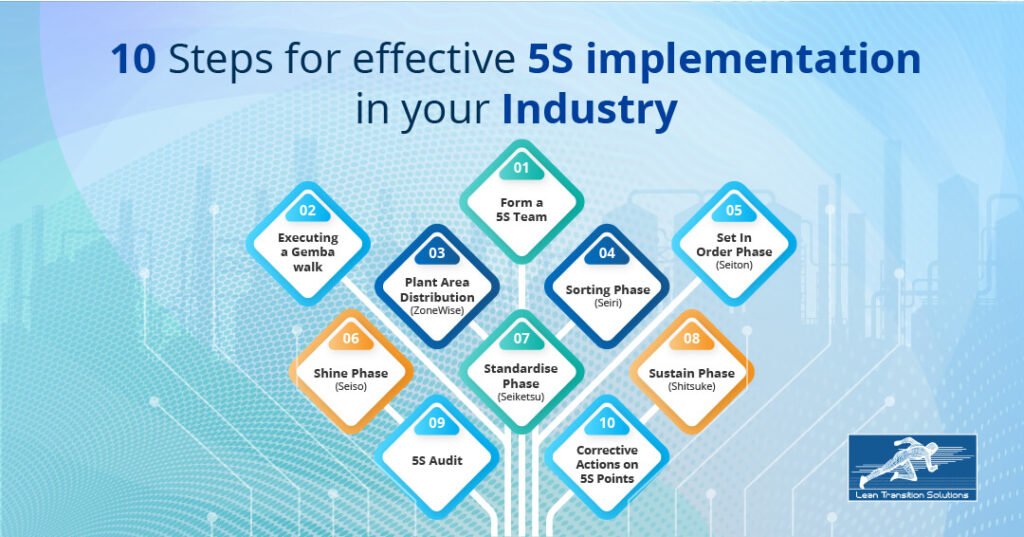
5S (Sort, Set in Order, Shine, Standardise, Sustain) creates the organised, visual workplace that is the foundation of fast, efficient operations. An un-5S'd workspace inflates cycle time invisibly — operators spend minutes per cycle searching for tools, walking to retrieve materials, waiting for information, and navigating clutter. These losses are individually small but collectively enormous across thousands of cycles per day.
Visual management extends 5S principles — shadow boards place every tool at its point of use, floor markings define material locations and traffic paths, andon lights signal abnormalities instantly, and visual SOPs guide operators without reference to paper documents. In a well-implemented visual workplace, any abnormality becomes immediately obvious to any person — enabling instant corrective action rather than hours of loss before anyone notices the problem.
Line Balancing redistributes work content across stations so every step runs at the same Takt Time — eliminating the idle time at fast stations and queue build-up at slow ones. When lines are unbalanced, the fastest station wastes capacity while the slowest creates the constraint. Rebalancing often requires only reallocating tasks between operators — no capital investment.
One-Piece Flow — moving single units between stations rather than batches — is the most powerful cycle time lever in the Lean toolkit. Every unit in a batch except the last one is waiting, not moving. Reducing batch size from 50 to 1 reduces the queue component of cycle time by up to 98%. Combined with cellular manufacturing layouts where stations are arranged in a U-shape close together, one-piece flow dramatically shrinks both cycle time and floor space simultaneously.
TPM (Total Productive Maintenance) eliminates unplanned downtime — the most disruptive cause of cycle time inflation — through systematic preventive maintenance, autonomous maintenance by operators, and predictive maintenance using sensor data. A machine that breaks down twice per shift inflates average cycle time far beyond its rated performance.
Automation and IoT attack cycle time from two directions: automation removes human variability from the cycle (ensuring every cycle runs at the minimum achievable time), while IoT real-time monitoring instantly flags cycle time deviations — enabling supervisors to react to losses as they happen rather than discovering them in the next day's report.
Implementation Roadmap
Cycle time improvement is most effective when pursued as a structured programme rather than a series of disconnected projects. The following six-phase roadmap reflects proven best practice for delivering sustainable results.
Conduct time studies on all critical process steps. Build the Current State VSM. Calculate current cycle time, takt time, process cycle efficiency, and identify the top 3 cycle time contributors. Establish the financial value of the improvement opportunity.
Implement 5S in the target area. Create visual SOPs, shadow boards, and floor markings. Reclassify external changeover activities and update the changeover sequence. These changes cost almost nothing and typically deliver 10–20% cycle time reduction within weeks.
Exploit and elevate the identified bottleneck. Rebalance the line to Takt Time. Reduce batch sizes progressively toward one-piece flow. Design the Future State VSM and begin implementing cellular layout changes.
Run SMED Kaizen events on the highest-changeover machines. Deploy autonomous maintenance for operators. Install poka-yoke devices on top defect sources to eliminate rework from the cycle. Install process control and SPC where cycle time variation is highest.
Install live cycle time monitoring dashboards on the shop floor. Automate bottleneck or highly variable process steps. Connect machine data to MES for automatic OEE and cycle time tracking. Link results to daily management meetings.
Update SOPs and control plans. Conduct monthly cycle time audits against standard. Track Takt Time compliance and PCE as permanent KPIs. Run quarterly Kaizen events to continue improving. Celebrate results and share learnings across the plant.
- Higher throughput without additional capital
- Lower work-in-progress inventory and carrying costs
- Faster delivery to customers — improved service level
- Improved OEE and overall plant efficiency
- Reduced cost per unit through better utilisation
- Greater flexibility to respond to demand changes
- Defects identified and corrected faster (smaller batches)
- Improved employee engagement through cleaner flow
- Improving non-bottleneck stations first — no throughput gain
- Reducing CT at one station without balancing the line
- Pursuing automation before eliminating waste first
- Measuring average CT without tracking variation
- Ignoring the queue time between stations
- Failing to maintain 5S — improvements decay within weeks
- No CT target linked to Takt Time — no clear goal
Key Performance Indicators to Track
Cycle time improvement must be measured, trended, and reviewed as part of the plant's daily management system. These are the essential KPIs for a cycle time improvement programme.
The primary metric — is each process step running at or below Takt Time? Any station above Takt Time is a problem that requires immediate action.
OEE = Availability × Performance × Quality. The Performance component directly reflects cycle time vs. ideal cycle time — any Performance below 95% signals cycle time losses.
Value-Adding Time ÷ Total Lead Time × 100. Tracks the ratio of truly productive time to total elapsed time. Target: above 25% for most manufacturing environments.
WIP between stations is queued cycle time made visible. High WIP = long queue time = long cycle time. Reducing WIP is both a symptom and a driver of CT improvement.
The ultimate customer measure of cycle time performance. If cycle time is consistently below Takt Time, OTD should be above 95%. Falling OTD signals hidden cycle time inflation.
Average and maximum changeover times per machine — tracked daily, trended weekly. Target is single-digit minutes for all critical changeovers after SMED implementation.
Frequency of unplanned stoppages — each stoppage inflates average cycle time significantly. Improving MTBF through TPM directly reduces cycle time variability and average.
Percentage of units completing the process without rework or scrap. Every unit that requires rework adds a full extra cycle to the flow — eliminating defects cuts average cycle time directly.
Industry Applications
Cycle time improvement is universally applicable — wherever a repeatable process produces an output, cycle time can be measured, analysed, and reduced. These industries represent the breadth of real-world application.
Takt-driven assembly lines, body shop welding robots, and engine transfer lines all target cycle times measured in seconds — any variation stops the entire line.
Cycle time reduction through optimal cutting parameters, reduced setup time, in-process gauging, and lights-out unmanned running can double throughput from the same machines.
Tablet press, capsule fill, and packaging line cycle times are monitored in real time. CT reduction must be balanced with GMP compliance documentation requirements.
High-speed filling and packing lines measure cycle time in milliseconds. Changeover reduction between SKUs is the dominant cycle time improvement lever.
Operating theatre turnaround, patient discharge processes, and lab test turnaround time all respond to Lean cycle time analysis — with life-affecting outcomes.
SMT placement, reflow soldering, and test cycle times on high-mix PCB lines are managed through flexible automation, rapid changeovers, and in-line AOI inspection.
Summary
Cycle time is the pulse of a manufacturing operation. It reveals, in a single number, how well a factory converts resources into customer value. Most manufacturers find — when they measure honestly for the first time — that 60–90% of their cycle time is waste. That is not a discouraging finding. It is an extraordinary opportunity.
Key Takeaway
Improving cycle time in manufacturing is not fundamentally about working faster or buying faster machines. It is about ruthlessly eliminating the waste, waiting, and variation that inflate time without adding value. Start by measuring accurately. Map the full value stream. Attack the bottleneck first. Implement 5S and SMED for immediate wins. Reduce batch sizes toward one-piece flow. Then lock gains in with TPM, poka-yoke, and real-time monitoring. Done with discipline and sustained with daily management, a systematic cycle time improvement programme can double throughput, halve inventory, and improve delivery performance — all from the same footprint, with the same people, and at a fraction of the cost of any new capital investment.
Presentation embedded from Google Slides · Cycle Time Improvement in Manufacturing · docs.google.com