🎯 Top 25 Lean Tools: Your Complete Guide to Manufacturing Excellence
Master the essential lean manufacturing tools and techniques to eliminate waste, optimize processes, and achieve operational excellence
What Are Lean Tools?
Lean manufacturing tools are systematic methods and techniques designed to identify and eliminate waste, improve efficiency, and maximize value in production processes. Originally developed by Toyota as part of the Toyota Production System (TPS), these tools have become fundamental practices in manufacturing and service industries worldwide.
The primary goal of lean tools is to create more value for customers with fewer resources by continuously identifying and removing non-value-adding activities (waste) from processes.
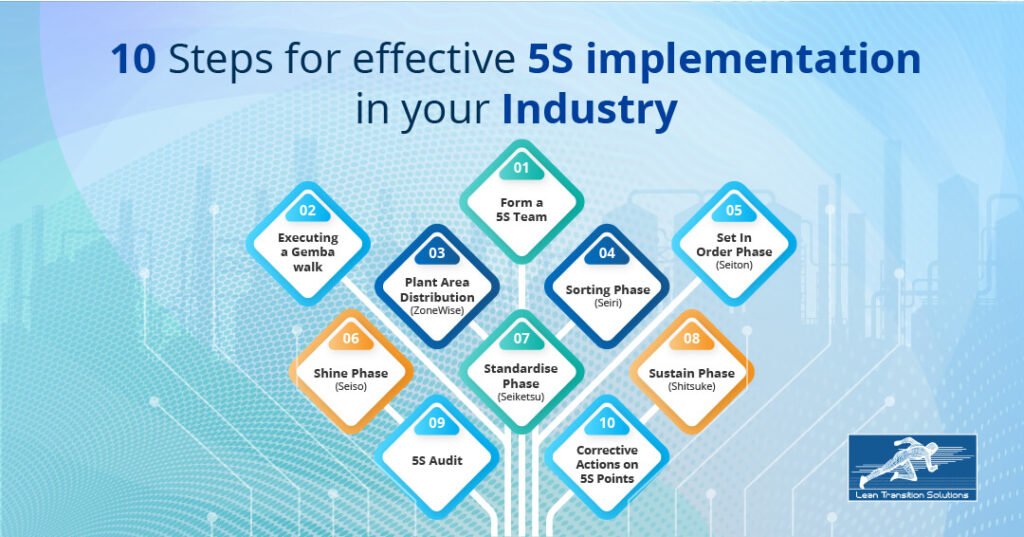
15S System
The 5S system is a fundamental lean tool focused on workplace organization and standardization. It creates a clean, organized, and efficient work environment.
The Five Steps:
- Sort (Seiri): Remove unnecessary items from the workplace
- Set in Order (Seiton): Organize remaining items for easy access
- Shine (Seiso): Clean and inspect the workplace regularly
- Standardize (Seiketsu): Establish standards and procedures
- Sustain (Shitsuke): Maintain and continuously improve the system
2Kaizen (Continuous Improvement)
Kaizen is a philosophy and practice of continuous improvement involving all employees, from management to frontline workers. It emphasizes making small, incremental changes regularly rather than large, radical transformations.
Core Principles:
- Everyone participates in improvement activities
- Focus on small, manageable changes
- Improvements are ongoing and never-ending
- Eliminate waste in all forms
- Respect for people and teamwork
3Value Stream Mapping (VSM)
Value Stream Mapping is a visual tool that displays all critical steps in a specific process and quantifies the time and volume taken at each stage. It helps identify waste and opportunities for improvement.
Steps in VSM:
- Identify the product or service family to map
- Create a current state map showing all process steps
- Analyze the map to identify waste and bottlenecks
- Design a future state map with improvements
- Develop an implementation plan
Common Wastes Identified:
- Waiting time between processes
- Unnecessary transportation
- Excess inventory
- Overprocessing
- Defects and rework
4Kanban
Kanban is a visual scheduling system that controls the flow of materials through production. It uses cards or electronic signals to trigger movement, production, or supply of products in a pull-based system.
Key Elements:
- Visual signals: Cards, bins, or electronic displays
- Pull system: Production based on actual demand
- WIP limits: Control work-in-progress quantities
- Just-in-time delivery: Materials arrive when needed
5PDCA (Plan-Do-Check-Act)
The PDCA cycle, also known as the Deming Cycle, is an iterative four-step management method for continuous improvement of processes and products.
The Four Stages:
- Plan: Identify a problem or opportunity and develop a hypothesis
- Do: Implement the plan on a small scale as a test
- Check: Analyze results and compare to expected outcomes
- Act: If successful, standardize; if not, revise and repeat
6Six Sigma
Six Sigma is a data-driven methodology aimed at reducing process variation and defects to achieve near-perfect quality (3.4 defects per million opportunities).
DMAIC Framework:
- Define: Identify the problem and project goals
- Measure: Collect data on current performance
- Analyze: Identify root causes of defects
- Improve: Develop and implement solutions
- Control: Sustain the improvements
Key Tools Used:
- Statistical Process Control (SPC)
- Control charts
- Pareto analysis
- Fishbone diagrams
- Design of Experiments (DOE)
7Poka-Yoke (Error Proofing)
Poka-Yoke is a Japanese term meaning "mistake-proofing" or "error-proofing." It involves designing processes and tools to prevent errors from occurring or to make errors immediately obvious.
Types of Poka-Yoke:
- Prevention: Design that makes errors impossible
- Detection: Identifies errors when they occur
- Warning: Alerts operators to potential errors
8SMED (Single Minute Exchange of Die)
SMED is a methodology for reducing equipment changeover time to less than 10 minutes (single-digit minutes). It enables faster response to customer demands and smaller batch sizes.
SMED Steps:
- Identify and separate internal and external setup activities
- Convert internal setup to external setup where possible
- Streamline all aspects of setup operations
- Eliminate adjustments and improve procedures
Benefits:
- Reduced changeover time
- Increased equipment availability
- Smaller lot sizes possible
- Improved flexibility and responsiveness
- Lower inventory levels
9Total Productive Maintenance (TPM)
TPM is a holistic approach to equipment maintenance that strives to achieve perfect production: no breakdowns, no small stops, no defects, and no accidents.
Eight Pillars of TPM:
- Autonomous Maintenance
- Focused Improvement
- Planned Maintenance
- Quality Maintenance
- Early Equipment Management
- Education and Training
- Safety, Health, and Environment
- TPM in Administration
10Gemba Walk
Gemba is a Japanese term meaning "the real place" – where value is created. A Gemba Walk involves going to the actual workplace to observe processes, ask questions, and learn.
Purpose of Gemba Walks:
- Observe actual work processes
- Engage with employees doing the work
- Identify improvement opportunities
- Build relationships and trust
- Understand problems firsthand
11Andon
Andon is a visual feedback system that alerts workers and management to problems in the production line, enabling quick response and resolution.
Components:
- Visual signals: Lights, displays, or boards showing status
- Audible alerts: Sounds that indicate problems
- Pull cords/buttons: Allow workers to stop the line
- Status indicators: Show normal operation, warnings, or stops
Benefits:
- Immediate problem notification
- Faster response time
- Empowers workers to stop production for quality
- Prevents defects from moving downstream
- Improves communication
12Just-In-Time (JIT)
Just-In-Time is a production strategy that aims to improve business return on investment by reducing in-process inventory and associated carrying costs.
Core Principles:
- Produce only what is needed
- Produce only when it is needed
- Produce only in the quantity needed
- Minimize inventory at all stages
- Eliminate waste in all forms
13Heijunka (Production Leveling)
Heijunka is the practice of leveling production by volume and variety to create a smooth, predictable production flow and reduce variability.
Benefits of Production Leveling:
- Reduced inventory levels
- More consistent resource utilization
- Better ability to respond to demand changes
- Reduced stress on workers and equipment
- Improved quality and efficiency
14Jidoka (Automation with Human Touch)
Jidoka is one of the two pillars of the Toyota Production System. It means giving machines or processes the ability to detect abnormalities and stop automatically.
Four Principles of Jidoka:
- Detect abnormalities
- Stop production when problems occur
- Fix immediate problems
- Investigate root causes and prevent recurrence
Advantages:
- Prevents defective products from advancing
- Reduces the need for inspection
- Allows one operator to handle multiple machines
- Separates human work from machine work
- Builds quality into the process
15Root Cause Analysis (5 Whys)
The 5 Whys is a simple but powerful tool for root cause analysis. By asking "Why?" five times, you can peel away layers of symptoms to reveal the root cause of a problem.
How It Works:
- State the problem clearly
- Ask "Why did this happen?"
- For each answer, ask "Why?" again
- Continue until you reach the root cause
- Develop countermeasures for the root cause
Problem: Machine stopped
Why? Overload, fuse blew
Why? Bearing not lubricated
Why? Lubrication pump not working
Why? Pump shaft worn out
Why? No strainer, metal shavings got in
Root Cause: No strainer on pump
16Standard Work
Standard Work is the documented current best practice for performing a task safely, with the highest quality, and most efficiently. It establishes a baseline for continuous improvement.
Three Elements:
- Takt time: The pace of customer demand
- Work sequence: The precise order of operations
- Standard WIP: Minimum inventory needed for smooth flow
Benefits:
- Consistent quality and output
- Easier training for new employees
- Baseline for measuring improvements
- Reduced variation in processes
- Foundation for kaizen activities
17Visual Management
Visual Management uses visual signals to communicate information quickly and clearly about the status of operations, making abnormalities immediately apparent.
Common Visual Tools:
- Color coding systems
- Performance boards and metrics
- Shadow boards for tools
- Floor marking and labels
- Status lights and displays
- Visual work instructions
18Cellular Manufacturing
Cellular Manufacturing arranges equipment and workstations in a sequence that supports a smooth flow of materials and components through the process with minimal transport or delay.
Characteristics of Manufacturing Cells:
- U-shaped or linear layout
- Multiple processes in close proximity
- One-piece flow or small batch sizes
- Cross-trained operators
- Quick changeover capability
Advantages:
- Reduced material handling and transport
- Shorter lead times
- Lower work-in-progress inventory
- Easier communication and teamwork
- Better quality control
- Improved space utilization
19Overall Equipment Effectiveness (OEE)
OEE is a metric that measures the percentage of manufacturing time that is truly productive. It identifies the percentage of planned production time that is genuinely productive.
OEE Formula:
OEE = Availability × Performance × Quality
- Availability: Actual operating time / Planned production time
- Performance: Actual output / Theoretical maximum output
- Quality: Good units / Total units produced
20Takt Time
Takt Time is the rate at which you need to produce to meet customer demand. It's calculated by dividing available production time by customer demand.
Formula:
Takt Time = Available Production Time / Customer Demand
Applications:
- Pace production to match demand
- Balance workload across stations
- Identify bottlenecks
- Determine number of operators needed
- Design efficient production lines
21A3 Problem Solving
A3 Problem Solving is a structured approach to problem-solving and continuous improvement that fits on a single A3-sized sheet of paper (11" × 17").
A3 Format Sections:
- Background: Context and importance of the problem
- Current Condition: Data showing the current state
- Goal/Target: Desired future state
- Root Cause Analysis: Why the problem exists
- Countermeasures: Proposed solutions
- Implementation Plan: Who, what, when
- Follow-up: Check results and adjust
22Hoshin Kanri (Policy Deployment)
Hoshin Kanri is a strategic planning method that ensures organizational goals are communicated throughout the company and that progress toward goals is tracked.
Key Elements:
- Catchball: Interactive dialogue between management levels
- Alignment: Ensuring all activities support strategic objectives
- X-Matrix: Visual tool showing relationships between goals, strategies, tactics, and metrics
- PDCA cycles: Regular review and adjustment
Benefits:
- Strategic alignment across the organization
- Clear priorities and focus
- Better resource allocation
- Improved communication
- Faster achievement of goals
23Pull System
A Pull System is a production approach where work is "pulled" based on actual customer demand rather than "pushed" based on forecasts or schedules.
Characteristics:
- Production triggered by downstream demand
- Limited work-in-progress inventory
- Visual signals (often Kanban cards)
- Just-in-time material flow
- Reduced overproduction
24Bottleneck Analysis
Bottleneck Analysis identifies the constraint in a process that limits overall throughput. According to the Theory of Constraints, improving the bottleneck improves the entire system.
Steps to Identify and Address Bottlenecks:
- Map the entire process flow
- Measure cycle times at each step
- Identify the slowest process (bottleneck)
- Analyze why this step is constrained
- Implement improvements at the bottleneck
- Re-evaluate to find the next bottleneck
Common Solutions:
- Add capacity at the bottleneck
- Offload work to other resources
- Improve efficiency of the bottleneck process
- Reduce changeover time
- Eliminate defects that waste bottleneck capacity
25Yamazumi Chart
A Yamazumi Chart (also called an operator balance chart) is a visual tool that shows the distribution of work elements and cycle times across different operators or workstations.
Purpose:
- Visualize workload distribution
- Identify imbalances between operators
- Show value-added vs. non-value-added time
- Support line balancing efforts
- Highlight improvement opportunities
✓Conclusion: Building Your Lean Journey
These 25 lean tools form a comprehensive toolkit for eliminating waste, improving efficiency, and creating value. However, successful lean implementation is not about using all tools at once, but rather:
Keys to Success:
- Start Small: Begin with one or two tools that address your most pressing problems
- Respect for People: Involve employees at all levels in improvement activities
- Continuous Learning: Lean is a journey, not a destination
- Systematic Approach: Use PDCA to test, learn, and refine
- Visual Management: Make progress and problems visible
- Leadership Commitment: Ensure management support and participation
- Long-term Perspective: Build a culture of continuous improvement
By mastering these lean tools and embedding them into your organization's culture, you'll be well-positioned to achieve operational excellence, improve quality, reduce costs, and deliver greater value to your customers.