Mastering Total Productive Maintenance
A comprehensive guide to TPM — the holistic equipment management philosophy pioneered by Seiichi Nakajima that transforms reactive maintenance into a proactive, people-driven system for eliminating losses, maximising equipment effectiveness, and building a zero-breakdown, zero-defect workplace.
What is Total Productive Maintenance?
Total Productive Maintenance (TPM) is a holistic approach to equipment care that engages every employee — from operators on the shop floor to senior managers — in maintaining and improving machinery, processes, and the workplace environment. The word Total has three meanings: total effectiveness (targeting zero breakdowns, zero defects, zero accidents), total participation (involving all departments and all personnel), and total maintenance (encompassing the full equipment lifecycle from design to decommissioning).
TPM fundamentally rejects the traditional division between production (people who run machines) and maintenance (people who fix them). Instead, it creates a shared ownership culture where operators perform routine care and inspection — Autonomous Maintenance — while maintenance technicians focus on improving equipment reliability, precision, and lifecycle. The result is equipment that runs consistently, cleanly, and at its design capability.
TPM is not a maintenance programme. It is a companywide equipment management philosophy whose goal is to maximise equipment effectiveness through the total participation of all employees. — Seiichi Nakajima, Introduction to TPM, 1988
History & Origins of TPM
TPM evolved in Japan through four distinct generations of maintenance thinking, each building on the lessons of the previous era. Its roots lie in American Preventive Maintenance concepts introduced to Japan after World War II, which were then progressively enriched by Japanese manufacturing culture, Lean thinking, and the quality revolution of the 1960s–1980s.
Early Japanese factories operated on pure reactive maintenance — fix it when it breaks. High downtime, unpredictable production, and dangerous conditions were accepted as the cost of doing business. American Preventive Maintenance (PM) concepts were introduced to Japan in the early 1950s and began to change this mindset.
Japanese companies adopted time-based Preventive Maintenance — performing routine overhauls and parts replacement on a fixed schedule regardless of actual machine condition. While more disciplined than breakdown maintenance, this approach was expensive, wasteful, and still kept operators and maintainers in separate silos.
Seiichi Nakajima of JIPM formalised TPM at Nippondenso (a Toyota supplier), which received the first PM Excellence Award in 1971. The key innovation: operators would maintain their own machines — Autonomous Maintenance was born. TPM became a systematic, companywide programme rather than a maintenance department initiative.
TPM spread globally through the 1980s and 1990s, adopted by automotive, semiconductor, chemical, food, pharmaceutical, and process industries worldwide. The framework expanded from 5 to 8 pillars, OEE became the universal TPM metric, and the approach was integrated with Lean, Six Sigma, and Industry 4.0 predictive maintenance technologies.
The 8 Pillars of TPM
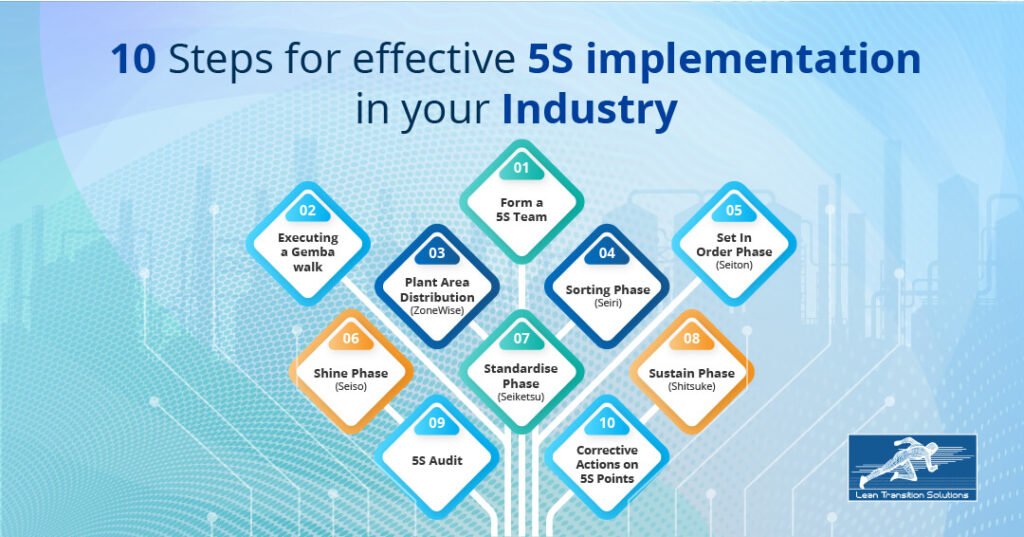
The eight pillars of TPM are the structural activities that together create a comprehensive, sustainable equipment management system. They are built on a foundation of 5S — without a clean, organised, standard workplace, no TPM pillar can function effectively.
Operators take ownership of their machines — cleaning, inspecting, lubricating, and detecting abnormalities daily. Transfers routine care from maintenance to production, freeing technicians for higher-value work.
Maintenance technicians move from reactive firefighting to proactive, scheduled, and condition-based maintenance — driven by equipment data, failure history, and risk analysis to achieve zero breakdowns.
Designs maintenance activities to guarantee zero defects. Identifies and controls machine conditions that cause quality problems — eliminating defects at source rather than detecting them downstream.
Small cross-functional teams systematically identify and eliminate equipment losses using structured problem-solving tools. Directly targets the 6 Big Losses through data-driven Kaizen activities.
Applies maintenance knowledge and OEE learning to the design of new equipment — building reliability, maintainability, and operability in from the start to achieve rapid, trouble-free production ramp-up.
Develops the skills and knowledge of operators and maintenance teams — from basic machine literacy (operators) to advanced diagnostic and precision maintenance skills (technicians) through structured competency programmes.
Ensures all TPM activities are conducted safely. Targets zero accidents, zero health incidents, and zero environmental violations — treating safety as non-negotiable in every maintenance and operational activity.
Extends TPM principles beyond the shop floor to office and administrative functions — eliminating waste in information flows, order processing, procurement, and planning that create indirect losses for the factory.
The 8 pillars are not independent activities — they form an integrated system. Implementing one or two pillars in isolation produces limited results. True TPM requires all eight, built on the foundation of 5S discipline.
OEE — Overall Equipment Effectiveness
OEE (Overall Equipment Effectiveness) is the primary metric of TPM — the single number that captures how well a piece of equipment is actually performing relative to its full potential during planned production time. OEE is the product of three factors: Availability, Performance, and Quality.
A typical factory without a structured TPM programme runs at 40–60% OEE — meaning 40–60% of its potential productive capacity is being lost to breakdowns, speed losses, and quality failures. The gap between current and world-class OEE represents the hidden factory — productive capacity available without capital investment.
The 6 Big Losses
TPM's Focused Improvement pillar targets the 6 Big Losses — the six categories of production loss that destroy OEE. Each loss maps to one of the three OEE components. Understanding, measuring, and systematically eliminating these losses is the engine of OEE improvement.
Unplanned stoppages due to equipment failure. The most visible and dramatic loss — and often the easiest to start measuring. Every minute of unplanned downtime is a breakdown loss.
Time lost during product changeovers, tooling changes, and subsequent adjustments until the first good part is produced. Reduced through SMED (Single Minute Exchange of Die) methodology.
Brief stoppages (typically under 5 minutes) caused by jams, sensor trips, parts misfeeds, and other transient problems. High frequency makes this loss significant — often invisible because each event is so brief.
Equipment running below its design speed due to vibration, wear, quality concerns, or operator habit. Often the largest loss in mature factories — and the hardest to see because the machine appears to be running.
Scrap and rework produced during steady-state production due to process instability, worn tooling, incorrect settings, or contamination. Every defective part represents wasted time, material, and energy.
Scrap and rework produced during startup after a changeover, breakdown repair, or shift start — before the process reaches stable, capable conditions. Reduced by precision maintenance and standardised startup procedures.
| # | Big Loss | OEE Component | Root Cause Category | Primary TPM Pillar |
|---|---|---|---|---|
| 1 | Breakdown Loss | Availability | Equipment failure, lack of PM | Planned Maintenance, AM |
| 2 | Setup & Adjustment | Availability | Changeover inefficiency | Focused Improvement (SMED) |
| 3 | Minor Stoppage | Performance | Process instability, contamination | AM, Quality Maintenance |
| 4 | Reduced Speed | Performance | Wear, degradation, no standard | Planned Maintenance, Training |
| 5 | Process Defects | Quality | Unstable process, worn tooling | Quality Maintenance, Kaizen |
| 6 | Startup / Yield Loss | Quality | Non-standard startup, poor PM | Planned Maintenance, Training |
Autonomous Maintenance (AM) — Jishu Hozen
Autonomous Maintenance is the heart and soul of TPM — the pillar that most fundamentally shifts the culture of a manufacturing organisation. It is a structured, seven-step process through which operators progressively develop the knowledge and skills to care for their own equipment, detect abnormalities early, and prevent deterioration before it causes breakdowns or quality problems.
The operator cleans the machine thoroughly — removing all dirt, oil, dust, and contamination. Crucially, cleaning is inspection: during this deep clean, operators discover abnormalities (leaks, loose bolts, worn parts, missing guards, cracked hoses) that would otherwise remain hidden. Every abnormality found is tagged with an orange tag for immediate action.
Teams identify and eliminate or reduce the sources of contamination discovered in AM1 — designing drip trays, splash guards, improved covers, and access panels. Areas that are difficult to clean, inspect, or lubricate are redesigned or retrofitted to make the right actions easy and the wrong actions hard.
Operators, with maintenance support, develop written and visual standards for cleaning, inspection, and lubrication — specifying what to clean, what to inspect, how to lubricate, what type and quantity of lubricant to use, and how frequently. These standards become the Autonomous Maintenance schedule posted at the machine.
Operators receive structured training in the fundamental mechanisms and subsystems of their machines — hydraulics, pneumatics, electrical systems, drives, fasteners, and so on. This knowledge enables operators to detect subtle abnormalities (unusual vibration, smell, noise, temperature, visual changes) that signal impending failure.
Operators now conduct their own systematic inspection — consolidating the cleaning, lubrication, and inspection checklists into a single, efficient daily/weekly routine. Maintenance technicians verify operator proficiency and revise the maintenance schedule to eliminate overlapping activities and avoid over-maintenance.
AM standards are extended to include workplace organisation — tooling, materials, and consumables storage; visual management controls; and standardised workflows. The goal is a workplace where any abnormality is immediately obvious and where the correct action is clearly indicated.
At the highest level of AM maturity, operators independently manage their own work area — identifying improvement opportunities, conducting Kaizen activities, analysing failure data, and continuously improving their own standards. The operator becomes a guardian of the equipment and a driver of improvement, not merely a button-pusher.
Planned Maintenance — Keikaku Hozen
Planned Maintenance transforms the maintenance function from reactive firefighting into a proactive, data-driven discipline. Its goal is simple but demanding: zero unplanned breakdowns — achieved by maintaining equipment in its optimal condition through scheduled, condition-based, and predictive strategies.
Replace parts, perform overhauls, and conduct inspections on a fixed time or cycle-count schedule — regardless of actual condition. Simple to plan and communicate. Risk of over-maintenance (replacing good parts) and failure between scheduled intervals.
Monitor equipment condition (vibration, temperature, oil analysis, ultrasound, thermal imaging) and perform maintenance only when indicators show approaching failure. Maximises part life and minimises unnecessary interventions.
Allow non-critical, easily replaceable components to run until failure, then repair quickly. Appropriate only for low-criticality items where failure has no safety, quality, or downstream impact and repair is quick and inexpensive.
In a mature Planned Maintenance programme, maintenance technicians spend less than 10% of their time on reactive (breakdown) work — the rest is planned, scheduled, and performed at a time that minimises production impact.
TPM vs Traditional Maintenance Approach
The shift to TPM represents a fundamental change in how organisations think about equipment, maintenance, and people — not just a new set of procedures. Understanding the contrast makes clear why TPM is a culture change, not a technical programme.
| Dimension | Traditional Maintenance | TPM Approach | Impact |
|---|---|---|---|
| Ownership | Maintenance department owns all equipment care | Operators own daily care; maintenance owns reliability | Shared |
| Response Mode | Reactive — fix when broken, respond to calls | Proactive — prevent failures, detect abnormalities early | Prevention |
| Cleanliness | Cleaning done when convenient or before audits | Daily systematic cleaning is inspection — non-negotiable | Daily Standard |
| Abnormality Detection | Operator calls maintenance only when machine stops | Operator detects & tags abnormalities during daily checks | Early Warning |
| Skill Development | Operators operate; technicians maintain — separate skills | Structured multi-skilling — operators learn machine mechanisms | Competency |
| Performance Measure | Mean Time To Repair (MTTR), maintenance cost | OEE — Availability × Performance × Quality | Holistic |
| Improvement Focus | Repair speed — how fast can we fix it? | Loss elimination — why did it break? How do we prevent it? | Root Cause |
Implementing TPM — Phase by Phase
A successful TPM implementation follows a structured, multi-year journey. JIPM recommends a minimum of 3–5 years to achieve genuine TPM maturity. Rushing the programme or skipping foundations consistently produces superficial results that regress when management attention moves elsewhere.
Secure genuine senior leadership commitment — not just sponsorship, but active participation. Educate all levels on TPM philosophy, goals, and expected roles. Implement 5S throughout the pilot area until standards are sustained. Measure and baseline current OEE and 6 Big Losses. Select a pilot machine or line that is representative of the factory's challenges.
Conduct the AM Step 1 Initial Cleaning on the pilot machine — a full-day or multi-day deep clean event with all operators and maintenance technicians working together. Tag every abnormality found. Simultaneously, a cross-functional Focused Improvement team begins the analysis of the pilot machine's top losses using OEE data, Pareto analysis, and Why-Why (5 Why) root cause tools.
With maintenance support, operators develop the AM cleaning, inspection, and lubrication standard for the pilot machine (AM Steps 2–3). Maintenance simultaneously develops the Planned Maintenance schedule for the machine — based on failure history, manufacturer data, and risk assessment. Both plans are posted visually at the machine and reviewed monthly for improvement.
Formalise operator competency assessment using skill matrices — what does each operator know about their machine? Develop training modules for each machine type. As pilot results are demonstrated (improved OEE, fewer breakdowns), expand the programme to adjacent machines and work areas. Each expansion uses the pilot's experience to improve the deployment approach.
TPM maturity is measured through regular internal audits against the JIPM assessment criteria. World-class organisations pursue the JIPM TPM Excellence Award — a rigorous external audit that validates genuine, sustained implementation across all eight pillars. The award process itself drives disciplined programme management and honest self-assessment.
Applications & Benefits
TPM has been successfully implemented across virtually every industry where equipment plays a significant role in the production of goods or services. Its core principles — zero losses, total participation, disciplined prevention — are universal.
Birthplace of TPM — Toyota, Denso, and their supply chain achieve OEE levels exceeding 85% through deeply embedded AM and Planned Maintenance programmes integrated with Just-In-Time production systems.
TPM's Quality Maintenance pillar is critical in regulated industries — ensuring equipment condition directly controls product quality and GMP compliance. Validated maintenance procedures prevent batch failures and regulatory violations.
Hygiene and food safety requirements make thorough cleaning and contamination control essential. TPM's AM cleaning standards align naturally with food safety management systems (HACCP, BRC), while OEE improvement drives yield and capacity.
High-value, precision equipment in cleanroom environments demands exceptional maintenance discipline. TPM's predictive maintenance and contamination control pillars are critical in an industry where a single breakdown can scrap millions in product.
- Dramatic reduction in unplanned breakdowns and downtime
- OEE improvement — unlocking the hidden factory without capital
- Improved product quality through stable, consistent equipment
- Reduced maintenance costs — less reactive work, better parts life
- Safer workplace — equipment in good condition has fewer hazards
- Increased operator engagement and equipment ownership
- Extended equipment lifespan through proactive care
- Foundation for Industry 4.0 and predictive maintenance technologies
- Requires genuine, sustained senior management commitment (3–5 years)
- Operators and maintenance teams must overcome silo mentality
- Initial cleaning events are physically demanding and time-intensive
- Difficult to sustain AM standards under production pressure
- Training investment is significant — especially for multi-skilling
- Results take 12–24 months to become clearly visible in OEE data
- Risk of superficial compliance — doing the forms without the thinking
Summary
Key Takeaway
Total Productive Maintenance is one of the most powerful and proven frameworks in manufacturing management — but it is consistently misunderstood. It is not a maintenance department initiative. It is not a cleaning programme. It is not a set of forms and checklists. TPM is a culture transformation — a fundamental shift in how every person in an organisation relates to the equipment they work with, how leaders develop their people's capability, and how organisations measure and eliminate the hidden losses that drain productive capacity every day.
The eight pillars, the OEE metric, the Autonomous Maintenance steps, and the 6 Big Loss framework are all tools in service of a single goal: zero losses from equipment — zero breakdowns, zero defects, zero accidents. When implemented with discipline, patience, and genuine participation at every level, TPM consistently delivers OEE improvements of 15–30 percentage points, dramatic reductions in maintenance cost, and the kind of workplace pride and equipment ownership that sustains improvement long after the initial programme energy has faded.
A machine that is clean is a machine that is known. A machine that is known is a machine that can be maintained. A machine that is maintained is a machine that does not break down. And a machine that does not break down is the most powerful competitive asset a factory can possess — because it delivers capacity, quality, and reliability without additional capital investment. Start with 5S. Start with the Initial Clean. Start with one machine. The journey of a thousand OEE points begins with a single cleaning cloth.