Mastering Lean
Manufacturing
A complete guide to Lean Manufacturing — the revolutionary production philosophy born in Toyota's factories that transformed global industry by relentlessly eliminating waste, creating continuous flow, and delivering maximum value with minimum resources.
What is Lean Manufacturing?
Lean Manufacturing is a systematic production philosophy and operational methodology that focuses on maximising customer value while minimising waste — any activity that consumes resources but creates no value for the customer. Rooted in the Toyota Production System (TPS), Lean is not a set of tools but a fundamental way of thinking about work, waste, and value that transforms how organisations design, operate, and improve their processes.
Lean Manufacturing is the relentless pursuit of perfection through the systematic identification and elimination of all forms of waste in every process — creating smooth, continuous flow of value from raw material to customer, pulled by actual demand, and improved continuously by every person in the organisation.
The word "Lean" was coined by researchers John Krafcik, James Womack, and Daniel Jones in their landmark 1990 book The Machine That Changed the World, based on their MIT study of global automotive manufacturing. They observed that Toyota's production system consistently achieved twice the productivity, half the defects, half the inventory, and half the development time of Western competitors — using fundamentally different principles, not just better technology.
All we are doing is looking at the time line, from the moment the customer gives us an order to the point when we collect the cash. And we are reducing that time line by removing the non-value-added wastes.
— Taiichi Ohno, Chief Engineer Toyota, Father of the Toyota Production SystemHistory & Origins
Lean Manufacturing's story is inseparable from Toyota's remarkable post-war transformation from a small, resource-constrained Japanese automaker into the world's most efficient and eventually most profitable car company.
Sakichi Toyoda invented an automatic loom that stopped instantly when a thread broke — refusing to produce defective cloth. This principle of Jidoka (automation with a human touch) — that machines should detect problems and stop rather than continue producing defects — became one of the two foundational pillars of TPS and Lean thinking. Kiichiro Toyoda used the proceeds from selling the loom patent to found Toyota Motor Corporation in 1937.
Taiichi Ohno, studying Ford's system and supermarkets, developed the Toyota Production System — built on Just-in-Time (produce only what is needed, when needed, in the amount needed) and Jidoka. Working with Shigeo Shingo, Ohno developed Kanban pull systems, SMED for rapid changeover, and heijunka (production levelling) — creating the world's first truly flow-based, waste-free manufacturing system.
The MIT International Motor Vehicle Programme published its landmark study comparing automotive manufacturing worldwide. Womack, Jones, and Roos named Toyota's approach "Lean Production" and quantified the performance gap between Toyota and Western manufacturers. The book triggered a global wave of Lean adoption that extended far beyond automotive into every industry sector.
Womack & Jones codified the 5 Lean Principles in their 1996 book Lean Thinking. Lean expanded beyond manufacturing into healthcare (Lean hospitals), software development (Lean IT/Agile), construction (Lean construction), financial services, government, and retail. Today, Lean is the world's most widely deployed operational excellence philosophy.
The 5 Lean Principles
Womack and Jones distilled TPS into five fundamental principles that provide a universal framework for Lean implementation in any industry. These principles are sequential and mutually reinforcing — they form a continuous improvement cycle, not a one-time project.
Define value from the customer's perspective — what they are willing to pay for. Everything else is waste. Most organisations define value from their own operational convenience rather than the customer's view.
Identify every step in the value stream for each product family. Ruthlessly eliminate steps that do not create value. The Value Stream Map makes all waste visible for the first time.
Make the remaining value-creating steps flow smoothly and continuously — eliminating batching, queuing, and departmental barriers. Flow exposes problems that batching was hiding.
Let the customer pull value from the producer — make nothing until the customer requests it. Pull systems replace push production schedules with Kanban signals, eliminating overproduction.
As waste is removed and flow and pull become established, keep going. Lean is never "done" — the pursuit of perfection is perpetual. Every improvement creates the conditions to see the next layer of waste.
The 8 Wastes — TIMWOODS
In Lean thinking, waste (muda) is any activity that consumes time, resources, or space but adds no value that the customer is willing to pay for. Taiichi Ohno originally identified 7 wastes of production; a modern addition — the 8th waste of unused human talent — broadened the framework to encompass knowledge work. The acronym TIMWOODS makes all eight memorable.
Unnecessary movement of materials, parts, or products between locations. Every transfer is a chance for damage, delay, or loss — and adds no value to the product.
Excess raw material, WIP, or finished goods beyond immediate need. Inventory hides problems, consumes cash, occupies space, and carries the risk of obsolescence and damage.
Unnecessary movement of people — reaching, bending, walking, turning. Poor workstation design forces operators to waste time and physical effort on every cycle without adding value.
Time spent waiting for the next process step, material, information, approval, or machine. In most factories, products spend over 80% of their time simply waiting — creating zero value.
Producing more than the customer needs, sooner than needed, or faster than needed. Ohno called overproduction the "worst waste" — it generates all other wastes: inventory, transport, waiting, motion.
Doing more work than the customer requires or values — extra finishing steps, tighter tolerances than needed, redundant inspections, or approvals that add cost without adding value.
Products or services that do not meet requirements — generating rework, scrap, warranty costs, and customer dissatisfaction. Every defect represents wasted material, time, capacity, and customer trust.
The 8th waste — not utilising people's full knowledge, creativity, and skills. Treating workers as pairs of hands rather than thinkers wastes the most valuable resource in any organisation.
The Lean House — Toyota Production System Architecture
The Lean House (or TPS House) is the most widely used visual framework for explaining how all Lean concepts fit together. Like an architectural structure, every element supports and depends on the others — the entire house collapses if any component is weak.
The two main pillars — JIT and Jidoka — represent the operational and quality dimensions of Lean. JIT ensures the right product flows to the right place at the right time with zero waste. Jidoka ensures that quality problems are immediately detected, production stops, and root cause is found — so defects never propagate downstream. Both rest on a foundation of operational stability: standardised work, Heijunka (level scheduling), 5S, and TPM. Without stability, JIT and Jidoka cannot function reliably. The entire house rests on the bedrock of Respect for People — the recognition that sustainable Lean improvement comes from the creativity and commitment of every worker, not just management decisions.
Core Lean Tools & Techniques
Lean Manufacturing has developed a rich toolkit over seven decades. Each tool addresses a specific type of waste or flow problem. The key is selecting and combining the right tools for the specific waste pattern in your operation — not deploying all tools at once.
Maps every step, delay, and information flow from raw material to customer. The primary diagnostic tool — makes all waste visible before selecting improvement priorities.
Sort, Set in Order, Shine, Standardise, Sustain. Creates the organised, visual workplace that is the foundation of all other Lean improvements — Lean cannot be sustained without 5S.
Visual pull signal system — cards, bins, or electronic signals that authorise the upstream process to produce or replenish only when downstream consumption has created space. Prevents overproduction.
Moves single units between stations rather than batches, eliminating queue time and dramatically reducing lead time, WIP, and the distance between defect creation and detection.
Single-Minute Exchange of Die — reduces changeover time from hours to minutes, enabling smaller batches, greater flexibility, and the ability to respond to mixed customer demand.
Engages operators in daily equipment care, eliminating unplanned breakdowns, minor stoppages, and speed losses — the three availability-stealing sources that inflate cycle time.
Continuous incremental improvement — involving everyone, every day. Kaizen events (Kaizen Blitz) focus cross-functional teams on specific waste areas for rapid, hands-on improvement over 3–5 days.
Visual signal system that makes abnormalities immediately visible to the entire team. When any operator encounters a problem, they signal with Andon — production stops until the problem is resolved at root.
Documented best method for each operation — combining Takt Time, work sequence, and standard WIP. Creates the baseline for consistent quality, the foundation for Kaizen, and the platform for operator training.
Error-proofing devices or methods that make it impossible to produce a defect or pass a defective product forward — physically eliminating the possibility of human error rather than relying on inspection.
Value Stream Mapping is the strategic starting point of any Lean implementation. It maps the complete flow of materials and information — from supplier to customer — making all process times, inventory levels, wait times, push/pull signals, and non-value-adding steps simultaneously visible on a single A3 sheet. VSM answers the most important question in Lean: "Where exactly is our time and money being wasted?"
The Current State Map is drawn first — capturing reality as it is, not as it should be. The Future State Map redesigns the flow to eliminate the dominant waste categories. The gap between current and future state is transformed into a prioritised improvement plan. Most Current State maps reveal that value-adding time represents less than 5–10% of total lead time — the other 90%+ is waste waiting to be eliminated.
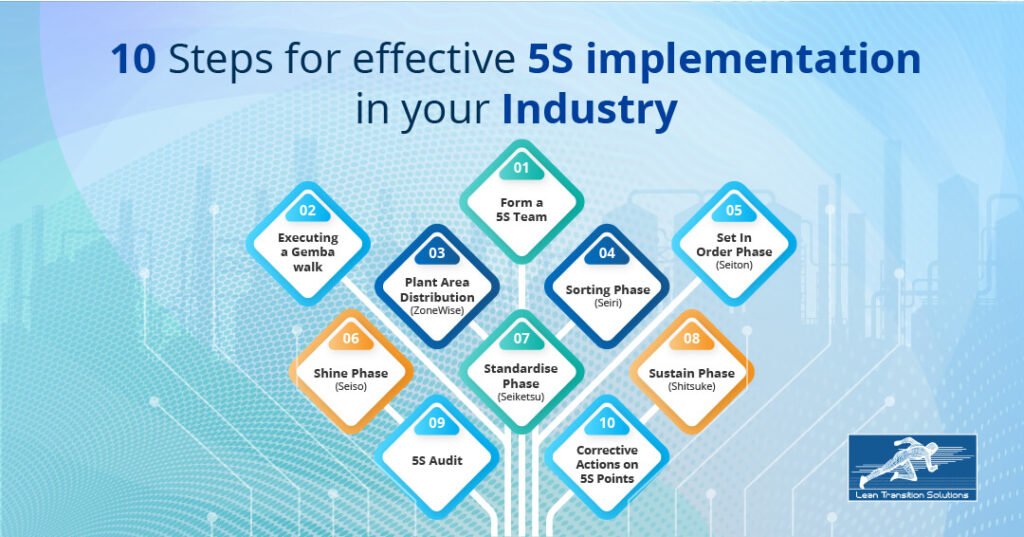
5S is the systematic method for creating and maintaining an organised, clean, safe, and visual workplace. It is typically the first Lean tool deployed because without a stable, standardised workplace, no other Lean improvement can be sustained. 5S is not a housekeeping programme — it is the physical expression of Lean thinking in the workspace.
The five Japanese S words — Seiri (Sort), Seiton (Set in Order), Seiso (Shine), Seiketsu (Standardise), Shitsuke (Sustain) — each address a different layer of workplace organisation. The 5th S (Sustain) is the hardest and most important — without discipline, all 5S gains decay within weeks. Regular audits, visual standards, and daily discipline by operators are essential for sustaining the gains.
Just-in-Time (JIT) means producing and delivering exactly what is needed, exactly when it is needed, in exactly the quantity needed. JIT is the operational embodiment of the Lean principle of Pull — the upstream process makes nothing until the downstream process signals its need. Kanban is the visual signal system that makes JIT work in practice.
In a Kanban system, every container or pallet of parts travels with a card (Kanban) that authorises production or replenishment. When the downstream station takes a container and sends the Kanban card back upstream, that is the signal to produce exactly one more container — no more, no less. This simple mechanism eliminates overproduction (the worst waste) by ensuring that production is always driven by actual consumption, never by a forecast or a supervisor's estimate of what "should" be needed.
Kaizen (改善) means "change for better" in Japanese — the philosophy that every process can and should be continuously improved by the people who work in it, through small, incremental steps rather than large, infrequent overhauls. Kaizen is the engine of Lean — without it, even the best Lean implementation gradually decays back to the old ways.
Two forms of Kaizen operate in a Lean organisation: Daily Kaizen — small, immediate improvements made by operators as part of their normal work, typically tracked on an idea board; and Kaizen Events (Kaizen Blitz) — focused 3–5 day workshops where a cross-functional team attacks a specific waste area, implements changes immediately, and measures the results before leaving. Kaizen Events are particularly effective for rapid improvement of specific processes, layouts, or workflows.
Lean Implementation Roadmap
Lean transformation is a journey, not a project. Organisations that treat it as a one-time tools deployment achieve temporary improvements. Those that treat it as a cultural transformation achieve lasting competitive advantage. The following roadmap reflects proven best practice.
Secure genuine leadership commitment — not just approval, but active participation. Train all leaders and key practitioners on Lean principles and philosophy. Select 1–2 pilot value streams for initial transformation. Conduct senior management VSM walk-throughs to build shared understanding of the current state waste level.
Map the Current State VSM for the selected value streams. Measure actual cycle times, changeover times, inventory levels, and defect rates. Calculate current PCE (Process Cycle Efficiency) and lead time. Identify the top 3–5 waste categories by magnitude. Quantify the financial opportunity in each.
Implement 5S in the pilot area. Create visual workplace standards — shadow boards, floor markings, visual SOPs. Document current best method as Standardised Work. These changes deliver 10–20% improvement in operator productivity within weeks at near-zero cost — and build the stable platform for deeper tools.
Run Kaizen events targeting the priority waste areas identified in VSM. Implement cellular layout for one-piece flow where feasible. Install Kanban loops to replace push scheduling. Conduct SMED on highest-changeover operations. Implement Andon for abnormality detection at process.
Install daily management system: Tier 1 stand-up meetings at each process, Tier 2 value stream reviews, Tier 3 site leadership reviews. Track KPIs daily. Roll out Lean to additional value streams. Launch daily Kaizen idea system. Develop internal Lean trainers and coaches. Lean becomes the way of working, not a project.
- 50–90% reduction in lead time
- 40–60% reduction in WIP and finished goods inventory
- 30–50% improvement in productivity from same resources
- Significant defect and rework reduction
- Improved on-time delivery and customer satisfaction
- Reduced floor space requirement (typically 30–40%)
- Higher employee engagement and problem-solving capability
- Lower cost per unit and improved operating margins
- Tool deployment without cultural change — gains don't stick
- Leadership not walking the gemba — Lean becomes abstract
- 5S as a one-time clean-up, not a sustained discipline
- Implementing tools out of sequence — Kanban before stability
- Using Lean to cut headcount rather than grow capacity
- No daily management system to sustain improvements
- Ignoring the 8th waste — not involving all workers
- Declaring Lean "complete" rather than treating it as endless
Industry Applications
Lean has proven its power in every sector where processes can be mapped, waste can be identified, and people can be engaged in improvement. These applications represent the remarkable breadth of Lean thinking beyond its automotive origins.
The birthplace of Lean. TPS principles drive every Toyota, and have been adopted across Ford, BMW, Honda, Hyundai, and their global supply chains — making automotive the world's Lean benchmark sector.
Boeing's 737 and 787 assembly lines, GE Aviation's engine plants, and Airbus's final assembly lines all use Lean to manage the extraordinary complexity of aircraft manufacturing at competitive cost.
Lean hospitals reduce patient wait times, medication errors, operating theatre turnaround, and discharge process waste — Virginia Mason Medical Centre's pioneering work proved Lean's power in clinical settings.
Lean batch manufacturing, cleanroom 5S, and value stream mapping of drug development and regulatory approval processes drive both cost reduction and compliance improvement simultaneously.
Amazon, Walmart, and major 3PLs apply Lean principles to warehouse picking, inventory replenishment, and last-mile delivery — treating logistics as a value stream to be mapped and continuously improved.
Agile development, Scrum, and DevOps all draw directly on Lean principles — pull systems (Kanban boards), small batches (sprints), visual management (burndown charts), and waste elimination (removing friction from deployment).
Summary
Lean Manufacturing is one of the most profound and transformative management philosophies of the 20th century. Born in Toyota's resource-constrained post-war factories and validated across seven decades of global deployment, it has demonstrated consistently that the path to exceptional performance lies not in more capital, more people, or more technology — but in the relentless, disciplined elimination of waste from every process by every person.
Key Takeaway
Mastering Lean Manufacturing means understanding that it is not a toolbox — it is a way of seeing. When you see a factory through Lean eyes, you see not what is there, but what should not be there: the inventory that is waiting, the motion that adds no value, the defect that slipped through, the operator whose knowledge is never asked for. The 5 Lean Principles give you the direction. The 8 Wastes give you the target. The Lean House gives you the architecture. The tools give you the means. But the transformation itself — the one that delivers lasting results — comes only when every person in the organisation understands that their job is not just to do the work, but to continuously improve the work. That is the true inheritance of Taiichi Ohno, Shigeo Shingo, and the Toyota Production System — and it remains the most powerful competitive advantage available to any manufacturer on earth.
Presentation embedded from Google Slides · Lean Manufacturing Mastery Deck · docs.google.com