Mastering Kaizen
改善
A complete guide to Kaizen — the Japanese philosophy of continuous, incremental improvement that transforms organisations from the inside out, one small change at a time.
Replace the src attribute of the <iframe> above with your Google Slides embed URL to display your presentation here.
What is Kaizen?
Kaizen (改善) is a Japanese term composed of two characters: kai (改) meaning "change" and zen (善) meaning "good" or "for the better." Together they define a philosophy of continuous, incremental improvement applied to all aspects of life — and, in a business context, to every process, every workflow, and every person in an organisation.
Kaizen is the practice of making small, consistent, everyday improvements rather than seeking large, infrequent transformations. It is a mindset before it is a method — the belief that nothing is so good it cannot be made better.
Unlike large-scale transformation programmes, Kaizen operates at the level of daily habits. Every employee, at every level, is empowered to identify waste, suggest improvements, and implement small changes in their own work area. Compounded over time, these small gains produce dramatic results.
Improvement usually means doing something that we have never done before.
— Shigeo Shingo, Co-creator of the Toyota Production System- Many small changes over time
- Low investment per improvement
- Driven by frontline employees
- Reduces risk of disruption
- Builds a lasting improvement culture
- Major transformation in one move
- High investment and resource commitment
- Driven by leadership or consultants
- Higher disruption and risk
- Needs Kaizen to sustain the gains
History & Origins
Kaizen was not invented in a boardroom. It emerged from the factory floors of post-war Japan — shaped by necessity, guided by visionary thinkers, and proven through decades of practice at Toyota and beyond.
After World War II, American quality experts — including W. Edwards Deming and Joseph Juran — were invited to Japan to help rebuild its devastated industry. Their teachings on quality and statistical methods planted the seeds of what would become Kaizen.
Taiichi Ohno and Shigeo Shingo developed the Toyota Production System (TPS), which embedded Kaizen as a daily operating principle. Every worker was expected to continuously identify waste (muda) and suggest improvements. TPS became the template for Lean manufacturing worldwide.
Masaaki Imai's landmark book Kaizen: The Key to Japan's Competitive Success introduced the concept formally to the Western world. He later founded the Kaizen Institute to help organisations globally adopt the philosophy. His work is the most definitive articulation of Kaizen in print.
Kaizen became embedded in Lean, Six Sigma, and Agile frameworks worldwide. Today it is practised in manufacturing, healthcare, software development, education, and government — anywhere people seek to work smarter, reduce waste, and improve outcomes continuously.
Core Principles of Kaizen
Kaizen is not a checklist — it is a set of deeply held beliefs about people, work, and improvement. These eight principles underpin every successful Kaizen culture.
Improvement is never finished. Every standard reached is the new starting point for the next improvement.
Challenge every assumption. "We've always done it this way" is the enemy of Kaizen thinking.
A good idea implemented today beats a perfect idea debated for months. Small actions generate learning faster than planning.
Kaizen prioritises creative, low-cost solutions over expensive capital investment. Ingenuity first, budget second.
Everyone from CEO to frontline worker contributes ideas and improvements. Kaizen respects every person's insight.
Fix the process, not the person. When something goes wrong, the process is the suspect — not the individual.
Go to the Gemba (actual workplace). Observe reality, collect data, and make decisions based on facts — not opinions.
Every improvement must be standardised and documented before moving on, or the gains will erode over time.
The Kaizen Cycle
Kaizen operates through a structured improvement cycle — most commonly aligned with the PDCA (Plan–Do–Check–Act) model developed by Deming, adapted into the Kaizen context as four repeating stages. The cycle is never closed; each rotation raises the performance baseline.
Go to the Gemba — the actual workplace. Observe the process and identify the eight wastes: overproduction, waiting, transport, over-processing, inventory, motion, defects, and underutilised talent.
Use tools like the 5-Why technique or Fishbone diagram to trace the problem to its true root cause. Never address symptoms alone — eliminate the source.
Develop a simple, low-cost improvement idea with the team. Implement it quickly on a small scale. Track results immediately using defined metrics.
If the improvement works, document the new standard, update SOPs, and train the team. Then start the cycle again — the new standard is the next starting point.
A powerful application of the Kaizen cycle is the Kaizen Blitz (or Kaizen Event) — an intensive 3–5 day workshop where a cross-functional team focuses entirely on improving one specific process, producing measurable results within the event itself.
The 5S Framework
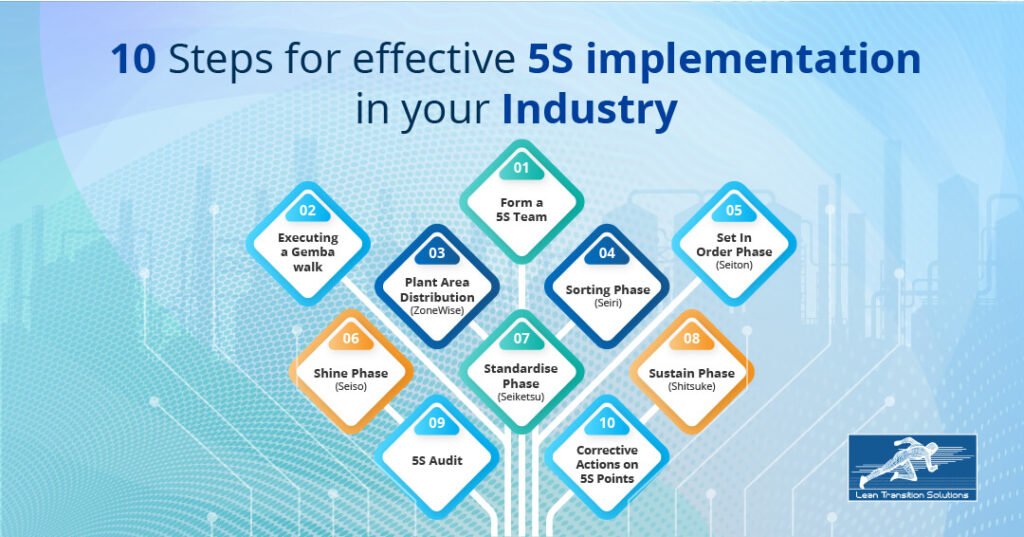
5S is the foundational workplace organisation system of Kaizen. Named after five Japanese words, it creates the stable, visual, and waste-free environment in which continuous improvement can flourish. Without 5S, Kaizen has no ground to stand on.
Remove everything from the workspace that is not needed. If in doubt, it goes out. Eliminate clutter at the root.
Assign a place for everything and put everything in its place. Arrange items so they are easy to find, use, and return.
Clean the workspace daily. Cleaning is also inspection — dirt reveals leaks, wear, and equipment problems before they escalate.
Create visual standards, colour codes, and schedules so the first three S's are maintained consistently without relying on memory.
Make 5S a habit through discipline, audits, and leadership modelling. The fifth S is where most organisations fail — and where culture is truly tested.
A sixth S — Safety — is often added in Western adaptations, making it 6S. Safety is embedded into every step of workplace organisation rather than treated as a separate programme.
Key Kaizen Tools & Techniques
Kaizen is supported by a rich toolkit of proven methods. These tools help teams observe, analyse, and improve work with rigour and precision — turning good intentions into measurable results.
Go to the actual workplace (Gemba) to observe the real process. Leaders who walk the Gemba regularly understand what is actually happening vs. what is reported.
Ask "Why?" five times in succession to drill past symptoms and surface the true root cause of a problem. Simple yet devastatingly effective.
Ishikawa's cause-and-effect diagram maps all potential causes of a problem across six categories: Man, Machine, Method, Material, Measurement, Environment.
Visualises the entire flow of materials and information to deliver a product or service — exposing bottlenecks, delays, and non-value-adding steps at a glance.
A structured process for collecting improvement ideas from all employees daily. Toyota receives millions of suggestions per year — and implements the vast majority.
Small groups of employees who meet regularly to identify, analyse, and solve quality and efficiency problems in their own work area. Driven bottom-up.
Design processes or devices so that mistakes are physically impossible or immediately visible — removing the possibility of human error entirely.
Visual management boards that make work-in-progress visible, limit overproduction, and signal when replenishment or action is needed in a process.
Senior leaders must understand, model, and actively champion Kaizen. Introduce the philosophy through training — not just posters. Walk the Gemba visibly and regularly.
Begin with a 5S implementation in one pilot area. Create visual standards, run a 5S audit, and use the results to build momentum before expanding.
Open formal channels for all employees to contribute improvement ideas. Respond to every suggestion — even if not implemented. Recognition fuels participation.
Target high-impact problem areas with focused 3–5 day Kaizen events. Cross-functional teams observe, analyse, and implement improvements within the event itself.
Document every improvement as the new standard. Track KPIs to verify sustained gains. Feed results back into the next improvement cycle. Celebrate wins publicly.
Industry Applications
Kaizen began on the manufacturing floor but has since spread into every sector where people do repeated work and seek to do it better. Its universality is its greatest strength.
Toyota's legendary quality and efficiency is the direct product of 70+ years of daily Kaizen practice across all plants globally.
Hospitals use Kaizen to reduce patient wait times, medication errors, and unnecessary process steps — improving both safety and experience.
Agile retrospectives are a form of Kaizen. Teams reflect on each sprint to identify what to improve in the next cycle.
Amazon, Zara, and others use Kaizen-driven lean processes to optimise fulfilment, reduce waste, and shorten lead times.
Schools apply Kaizen to curriculum delivery, administrative processes, and student engagement — building a culture of continuous learning at institutional level.
Lean construction uses Kaizen to cut rework, improve safety records, and streamline project scheduling and handoffs.
- Reduces waste across all eight Lean waste types
- Builds a proactive, improvement-minded culture
- High employee engagement and ownership
- Low cost — relies on people, not capital
- Sustainable — gains are standardised and locked in
- Applies at any scale — individual to enterprise
- Leadership says Kaizen but doesn't model it
- Improvements not standardised — gains slip back
- Treated as a project, not an ongoing culture
- Employee ideas ignored — participation drops fast
- Focus on tools only, neglecting mindset shift
- Measuring activity (events) not outcomes (results)
Summary
Kaizen is more than a quality tool or a management technique — it is a philosophy of life applied to work. When an entire organisation internalises the belief that every process can always be a little better, and that every person has the wisdom to contribute to that improvement, transformation becomes inevitable.
Key Takeaway
Mastering Kaizen is not about running a workshop or deploying a tool — it is about changing how people think about their work. The organisations that sustain Kaizen are those where leaders walk the Gemba, employees feel safe to raise problems, and every small improvement is celebrated as a step forward. In a world obsessed with disruption, Kaizen is a quiet revolution — one small, relentless, compounding improvement at a time.