🏭 Mastering 5S: The Complete Guide to Workplace Excellence
Transform Your Workplace Through Sort, Set in Order, Shine, Standardize, and Sustain
📊 5S Training Presentation
What is 5S?
5S is a systematic methodology for workplace organization and standardization that originated in Japan. The term "5S" refers to five Japanese words that represent the five steps of this lean manufacturing technique: Seiri (Sort), Seiton (Set in Order), Seiso (Shine), Seiketsu (Standardize), and Shitsuke (Sustain).
5S is the foundation of lean manufacturing and continuous improvement. It creates a clean, organized, safe, and efficient work environment where waste is eliminated, productivity is maximized, and quality is built into every process.
History & Origins of 5S
The 5S methodology has deep roots in Japanese manufacturing culture and played a crucial role in Japan's post-World War II industrial transformation.
Post-War Japan: The Beginning
In the aftermath of World War II, Japanese manufacturers faced severe resource shortages and needed to maximize efficiency with minimal waste. This economic pressure led to the development of systematic workplace organization methods.
Toyota Motor Corporation formalized the 5S system as part of the Toyota Production System (TPS). Engineers Taiichi Ohno and Shigeo Shingo recognized that workplace organization was fundamental to quality and efficiency. They observed that a cluttered, disorganized workspace led to:
- Wasted time searching for tools and materials
- Higher defect rates due to contamination
- Safety hazards from poor housekeeping
- Difficulty identifying problems and abnormalities
Global Expansion
The success of Japanese manufacturing in the 1970s and 1980s attracted worldwide attention. Companies from around the globe studied the Toyota Production System and adopted 5S as a foundational practice.
Key Milestones in 5S History
| Era | Development | Impact |
|---|---|---|
| 1950s | Toyota formalizes 5S methodology | Foundation of TPS established |
| 1970s | 5S spreads across Japanese manufacturing | National quality movement in Japan |
| 1980s | Western companies begin adopting 5S | Global lean manufacturing revolution |
| 1990s-2000s | 5S expands beyond manufacturing | Applied in healthcare, offices, services |
| 2010s-Present | Digital 5S and integration with Industry 4.0 | Smart factories and visual management |
Cultural Foundation
5S reflects deep-rooted Japanese cultural values:
- Mottainai: Regret over waste – a mindset that values resources and abhors wastefulness
- Kaizen: Continuous improvement through small, incremental changes
- Respect for People: Creating safe, pleasant work environments shows respect for workers
- Gemba: The actual workplace where value is created deserves careful attention
Benefits of 5S Implementation
Organizations that successfully implement 5S experience transformative improvements across safety, quality, productivity, and employee engagement:
Operational Benefits
🚀 Increased Productivity
Eliminate time wasted searching for tools, materials, and information. Studies show 5S can improve productivity by 15-30%.
🎯 Improved Quality
Clean, organized workplaces reduce contamination, errors, and defects. Abnormalities become immediately visible.
💰 Reduced Costs
Less waste, fewer defects, reduced inventory, and lower equipment maintenance costs directly impact the bottom line.
⚡ Shorter Lead Times
Streamlined workflows and visual management enable faster production cycles and quicker response to customer demands.
🛡️ Enhanced Safety
Organized workspaces with clear pathways reduce accidents, injuries, and near-misses by 40-60%.
📊 Better Space Utilization
Eliminating unnecessary items and optimizing layout can free up 20-50% of floor space.
Strategic Benefits
- Foundation for Lean: 5S creates the discipline and visual management necessary for advanced lean techniques
- Culture of Improvement: Engages employees in continuous improvement and problem-solving
- Visual Management: Makes problems, standards, and status immediately apparent
- Employee Engagement: Workers take pride in clean, organized workspaces and participate actively in improvements
- Customer Confidence: Clean, organized facilities impress customers and auditors
- Competitive Advantage: Systematic workplace excellence becomes a differentiator
Sort (Seiri - 整理)
Seiri: "To organize, arrange, put in order"Definition: Sort means separating needed items from unneeded items and removing the unneeded items from the workplace.
Purpose of Sort
The first step in 5S addresses the clutter problem that plagues most workplaces. By removing unnecessary items, you:
- Free up valuable space
- Reduce visual noise and confusion
- Eliminate safety hazards from clutter
- Make it easier to find what you need
- Reduce inventory carrying costs
- Identify what's truly necessary for work
How to Implement Sort
Identify the Target Area
Define the specific workspace, department, or area where you'll conduct the Sort activity. Set clear boundaries and schedule dedicated time.
Remove Everything
Take everything out of the workspace – tools, materials, equipment, furniture, documents. This forces you to make conscious decisions about each item.
Sort Items into Categories
Use the red tag strategy to classify items:
- Needed Daily/Weekly: Essential items used regularly
- Needed Occasionally: Used monthly or less frequently
- Broken/Obsolete: Damaged or no longer functional
- Unknown/Undecided: Items requiring further investigation
- Clearly Unnecessary: Items with no work-related purpose
Apply Red Tag Strategy
Attach red tags to questionable items with information about what it is, who owns it, and why it might be unnecessary. Place red-tagged items in a designated holding area for 30 days.
Dispose of Unnecessary Items
After the waiting period, permanently remove unclaimed red-tagged items through:
- Disposal (trash/recycling)
- Return to supplier
- Transfer to another department
- Donation or sale
- Central storage for rarely used items
Sort Checklist
- Are all items in the workspace necessary for current operations?
- Have all broken, obsolete, or excess items been removed?
- Is there a red tag system in place for questionable items?
- Have criteria been established for what belongs in the workspace?
- Are personal items limited to designated areas?
- Has unnecessary furniture been removed?
- Are only current job instructions and documents present?
- Has excess inventory been eliminated?
⚠️ Common Sort Mistakes
Hoarding "Just in Case": Keeping items because they "might be useful someday" defeats the purpose. Be ruthless – if it's not needed now, it goes.
Moving, Not Removing: Shifting clutter from one location to another isn't sorting. Items must leave the workspace entirely.
Skipping the Red Tag Period: The 30-day holding area prevents hasty decisions you might regret and builds confidence in the process.
Set in Order (Seiton - 整頓)
Seiton: "To arrange, put in order"Definition: Set in Order means arranging needed items so they are easy to find, use, and return. Everything has a designated place, and everything is in its place.
Purpose of Set in Order
After removing unnecessary items through Sort, Set in Order creates an efficient, logical arrangement of what remains:
- Minimize time wasted searching for items
- Reduce motion and movement waste
- Make abnormalities immediately visible
- Enable anyone to find and return items quickly
- Support standardized work sequences
- Improve safety through clear organization
Core Principles
Every item must have a specific, designated location. No exceptions. When an item is not in use, it should be in its designated spot.
The location and proper state of items should be obvious at a glance. Use labels, color coding, shadow boards, floor markings, and other visual cues.
Place items based on frequency of use and work sequence. Most-used items should be most accessible. Eliminate bending, reaching, and unnecessary movement.
Implementation Steps
Analyze Workflow
Understand the sequence of work activities. Map out how materials, tools, and information flow through the workspace. Identify frequency of use for each item.
Design Layout
Create an optimal arrangement based on:
- Frequency: Daily items within arm's reach, weekly items nearby, monthly items in storage
- Sequence: Arrange items in order of use in the work process
- Function: Group related items together
- Ergonomics: Place items to minimize bending, reaching, and movement
Establish Locations
Designate specific spots for every item using:
- Shadow boards with tool outlines
- Labeled storage bins and shelves
- Floor marking tape for equipment placement
- Color coding by category or area
- Height and depth indicators on shelves
Create Visual Controls
Make it impossible to put things in the wrong place and easy to see when things are missing or out of place:
- Outline shapes of tools on shadow boards
- Label everything clearly with large, easy-to-read text
- Use color coding consistently throughout the workspace
- Mark minimum and maximum inventory levels
- Create visual work instructions at point of use
Implement Address System
Create a logical addressing system for storage locations (similar to street addresses) so anyone can find items quickly. Example: Area-Row-Shelf-Position (A-3-2-5).
Set in Order Techniques
| Technique | Application | Benefit |
|---|---|---|
| Shadow Boards | Tool storage with outlined shapes | Missing tools immediately obvious |
| Color Coding | Group items by category or area | Quick visual identification |
| Floor Marking | Equipment, walkways, storage zones | Clear boundaries and organization |
| Label Everything | Shelves, bins, cabinets, equipment | Anyone can find and return items |
| Point-of-Use Storage | Keep items where they're used | Eliminates travel and search time |
| Visual Instructions | Procedures, standards, references | Support standardized work |
Set in Order Checklist
- Does everything have a designated location?
- Are locations clearly marked and labeled?
- Can anyone find items within 30 seconds?
- Are most frequently used items most accessible?
- Is there visual management (shadow boards, color coding, labels)?
- Are walkways, work areas, and storage zones clearly marked?
- Are items arranged to support work sequence?
- Can you tell at a glance if something is missing or misplaced?
- Are safety equipment and emergency items easily accessible?
Shine (Seiso - 清掃)
Seiso: "To clean, polish, purify"Definition: Shine means cleaning the workplace thoroughly and keeping it clean. But it's more than just cleaning – it's about inspection, maintenance, and creating a workplace you're proud of.
Purpose of Shine
Shine goes beyond basic housekeeping to become a tool for problem identification and prevention:
- Create a safe, pleasant work environment
- Identify equipment problems early through cleaning as inspection
- Prevent contamination that causes quality defects
- Extend equipment life through regular maintenance
- Build pride and ownership in the workplace
- Make abnormalities immediately visible
Cleaning as Inspection
In 5S, cleaning isn't just about making things look good – it's an inspection activity:
- Check for oil leaks, loose bolts, worn parts
- Identify sources of contamination (dust, oil, debris)
- Notice unusual sounds, vibrations, or heat
- Spot developing problems before they cause failures
- Verify that guards and safety features are intact
Implementation Steps
Establish Cleaning Standards
Define what "clean" means for each area and piece of equipment. Create visual standards with photos showing acceptable cleanliness. Specify cleaning frequency and methods.
Identify Contamination Sources
Find the root causes of dirt, dust, leaks, and debris. Don't just clean up symptoms – eliminate sources. Ask: "Why does this get dirty?" and address the underlying problem.
Assign Cleaning Responsibilities
Every area and piece of equipment should have an owner responsible for its cleanliness. Create cleaning assignment maps showing who cleans what. Operators should clean their own equipment.
Develop Cleaning Procedures
Document step-by-step cleaning procedures including:
- What to clean and how to clean it
- Cleaning frequency (daily, weekly, monthly)
- Required cleaning materials and tools
- Safety precautions
- Inspection points to check while cleaning
- Estimated time required
Conduct Initial Deep Clean
Perform a thorough, intensive cleaning to establish the baseline standard. This may require shutting down equipment and using specialized cleaning methods. Document the "before" and "after" with photos.
Make Cleaning Easy
Reduce the effort required to maintain cleanliness:
- Store cleaning supplies at point of use
- Install guards and covers to prevent contamination
- Design equipment for easy cleaning access
- Eliminate hard-to-reach areas where dirt accumulates
- Use quick-release fasteners on covers and panels
Cleaning Schedule Example
| Frequency | Activities | Responsibility |
|---|---|---|
| Daily (5 min) | Wipe down equipment, sweep floor, empty trash, return tools | Equipment Operator |
| Weekly (30 min) | Deep clean equipment, mop floors, clean windows, organize storage | Team |
| Monthly (2 hrs) | Clean hard-to-reach areas, detailed inspection, repaint markings | Team + Maintenance |
| Quarterly (4 hrs) | Comprehensive facility cleaning, update visual management | All Departments |
In Total Productive Maintenance (TPM), cleaning is the first step of autonomous maintenance. Operators who clean their own equipment develop deeper understanding of how it works, notice problems early, and take ownership of equipment condition.
Shine Checklist
- Are all work areas, equipment, and tools clean?
- Are cleaning standards defined with visual examples?
- Is cleaning responsibility assigned for every area?
- Are cleaning supplies readily available at point of use?
- Is equipment inspected while being cleaned?
- Have sources of contamination been identified and eliminated?
- Are cleaning procedures documented and followed?
- Is cleaning integrated into daily work routines?
- Are floors, walls, windows, and ceilings clean?
- Would you be proud to show this workspace to a customer?
⚠️ Common Shine Mistakes
Treating Cleaning as Punishment: Cleaning should be built into daily work, not saved for when things get really bad or used to discipline employees.
Cleaning Around Problems: If oil keeps leaking, fix the leak – don't just keep wiping it up. Address root causes.
Expecting Maintenance to Clean: Operators should clean their own equipment. This builds ownership and enables early problem detection.
Standardize (Seiketsu - 清潔)
Seiketsu: "To standardize, make pure, clean"Definition: Standardize means creating rules and procedures to maintain Sort, Set in Order, and Shine. It establishes standards and makes them visual, systematic, and easy to follow.
Purpose of Standardize
The first three S's create an organized, clean workplace. Standardize ensures it stays that way:
- Prevent backsliding to old habits
- Make expectations clear and consistent
- Enable anyone to maintain standards
- Support training and onboarding
- Create foundation for continuous improvement
- Build organizational discipline
What to Standardize
Create visual representations of the ideal state:
- Photos of properly organized areas (before/after)
- Diagrams showing correct tool placement
- Color-coded floor markings and labels
- Visual work instructions
- Standard operating procedures (SOPs) with pictures
Clearly define who does what:
- 5S responsibility maps showing ownership by area
- Daily, weekly, monthly task assignments
- Cleaning checklists for each area/equipment
- Escalation procedures for problems found during 5S
Establish when 5S activities occur:
- Daily 5S time (e.g., last 5 minutes of shift)
- Weekly deep clean schedule
- Monthly 5S audit calendar
- Quarterly comprehensive reviews
Document the "right way" to perform 5S activities:
- Standard procedures for sorting (red tag process)
- Equipment cleaning procedures
- Floor marking standards (colors, widths, patterns)
- Labeling conventions (format, size, placement)
- Visual management standards (signs, boards, displays)
Implementation Steps
Document Best Practices
Identify the most effective methods discovered during Sort, Set in Order, and Shine. Photograph ideal states. Create visual standards showing the "right way."
Create Standard Work
Develop step-by-step procedures for maintaining 5S:
- One-page visual work instructions
- Checklists for daily/weekly/monthly tasks
- Quick reference guides posted at point of use
- Video demonstrations of proper techniques
Implement Visual Controls
Make standards self-enforcing through visual management:
- Shadow boards make missing tools obvious
- Floor markings show correct placement
- Color coding enables quick identification
- Min/max lines show proper inventory levels
- Status boards display current condition
Develop 5S Schedules
Integrate 5S activities into daily, weekly, and monthly routines. Build 5S time into production schedules. Create visible schedules showing who does what when.
Train Everyone
Ensure all employees understand 5S standards and their role in maintaining them. Use visual standards as training materials. Conduct hands-on training in actual workspaces.
Establish Audit System
Create a formal process to check compliance with 5S standards:
- Develop detailed audit checklists
- Schedule regular audits (weekly/monthly)
- Assign audit responsibilities (peer audits, management audits)
- Score and track audit results
- Post audit scores publicly
- Follow up on identified issues
Visual Management Examples
| Visual Tool | Purpose | Example |
|---|---|---|
| Shadow Boards | Show where tools belong | Tool outlines on pegboard |
| Floor Marking | Define zones and pathways | Yellow lines for walkways, blue for work areas |
| Color Coding | Categorize and identify | Red tools for Team A, blue for Team B |
| Labels & Signs | Identify locations and contents | Shelf labels with item names and photos |
| Min/Max Lines | Show proper inventory levels | Lines on bins showing reorder points |
| Status Boards | Display current conditions | 5S audit scores by area |
Standardize Checklist
- Are 5S standards documented with visual examples?
- Is responsibility clearly assigned for each area?
- Are 5S activities integrated into daily schedules?
- Are visual controls in place to make standards obvious?
- Have all employees been trained on 5S standards?
- Is there a regular audit system to check compliance?
- Are audit results posted publicly?
- Is there a process to address non-conformances?
- Are standards reviewed and updated regularly?
- Can anyone easily understand and follow the standards?
Sustain (Shitsuke - 躾)
Shitsuke: "To discipline, train, sustain"Definition: Sustain means maintaining and continuously improving 5S standards through discipline, habit formation, and making 5S part of the organizational culture.
Purpose of Sustain
Sustain is the most challenging S because it requires changing behavior and culture:
- Make 5S a habit, not a special event
- Prevent backsliding to old ways
- Continuously improve 5S practices
- Build organizational discipline
- Create pride in workplace excellence
- Develop improvement mindset at all levels
Why Organizations Struggle to Sustain
Many companies successfully implement the first four S's only to see them deteriorate over time. Common reasons include:
⚠️ Sustain Challenges
- Lack of Leadership Commitment: Management treats 5S as a one-time project rather than ongoing practice
- No Accountability: Standards exist but violations have no consequences
- Competing Priorities: 5S gets deprioritized when production pressures increase
- Insufficient Resources: Time not allocated for 5S maintenance
- Poor Communication: New employees not trained, standards not reinforced
- Lack of Recognition: Good 5S performance goes unnoticed
Sustain Strategies
Leaders must visibly participate in and support 5S:
- Conduct regular gemba walks to observe 5S conditions
- Participate in 5S audits personally
- Discuss 5S in staff meetings and reviews
- Allocate resources (time, budget) for 5S
- Model the behavior expected of others
- Make 5S performance a leadership responsibility
Systematic assessment maintains focus and identifies issues:
- Weekly team self-audits using standardized checklists
- Monthly cross-functional audits (teams audit each other)
- Quarterly management audits with scoring
- Public posting of audit results
- Trend analysis to identify improvement opportunities
- Action plans for addressing deficiencies
5S must be part of normal work, not extra work:
- Build 5S time into production schedules (e.g., last 5 minutes of shift)
- Include 5S in daily team meetings/huddles
- Make 5S part of equipment operator responsibilities
- Link 5S to performance reviews and compensation
- Embed 5S in standard operating procedures
Continuous education reinforces 5S culture:
- Include 5S in new employee orientation
- Conduct refresher training quarterly
- Train employees to conduct audits
- Share best practices across departments
- Send teams to visit excellent 5S facilities
- Develop internal 5S experts/champions
Acknowledge and reward 5S excellence:
- Monthly 5S awards for best area
- Public recognition in meetings and communications
- Photos of excellent 5S examples on displays
- Team celebrations for achieving 5S milestones
- Link 5S performance to incentives
- Share improvement stories throughout organization
Use PDCA to continually raise 5S standards:
- Regularly review and update 5S procedures
- Benchmark against best-in-class organizations
- Implement employee suggestions for improvement
- Set increasingly challenging 5S targets
- Expand 5S to new areas (offices, warehouses, etc.)
- Integrate 5S with other improvement initiatives
Sustain Success Factors
| Factor | Key Actions | Expected Outcome |
|---|---|---|
| Leadership Commitment | Visible participation, resource allocation | 5S becomes organizational priority |
| Systematic Auditing | Regular, structured assessments | Early detection of backsliding |
| Daily Integration | 5S time in schedule, part of routines | 5S becomes habitual |
| Training & Communication | Ongoing education, sharing successes | Knowledge and motivation maintained |
| Recognition | Celebrate excellence, share examples | Positive reinforcement of desired behavior |
| Continuous Improvement | PDCA cycles, raising standards | 5S evolves and improves over time |
Sustain Checklist
- Do leaders visibly support and participate in 5S?
- Are regular audits conducted and results posted?
- Is 5S time built into daily schedules?
- Are all employees trained in 5S standards?
- Is there accountability for 5S performance?
- Are 5S achievements recognized and celebrated?
- Is 5S discussed in regular management reviews?
- Do new employees receive 5S orientation?
- Are 5S improvements continuously implemented?
- Has 5S become part of organizational culture?
5S Implementation Guide
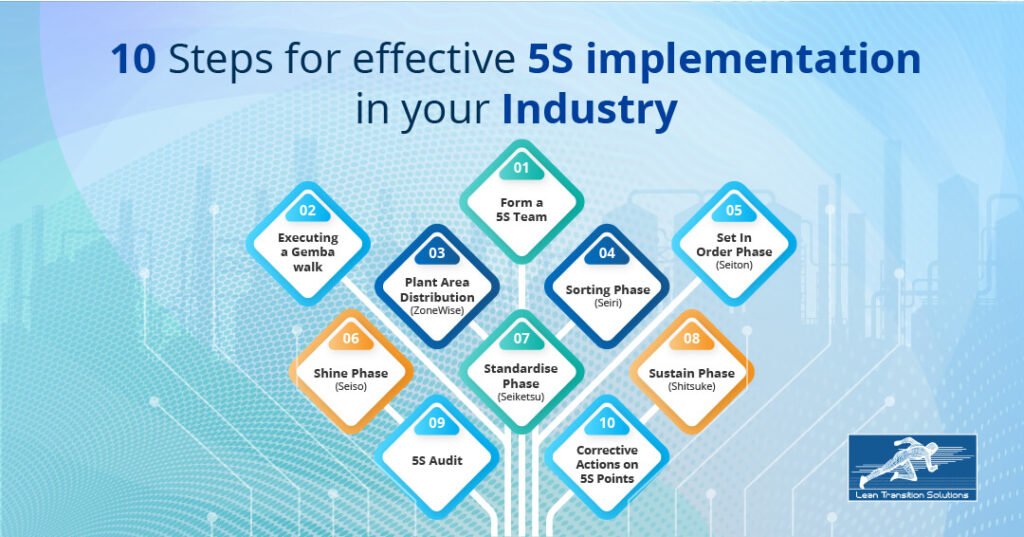
Successfully implementing 5S requires careful planning, strong leadership, and systematic execution. Here's a comprehensive roadmap:
Phase 1: Preparation (Weeks 1-2)
Secure Leadership Commitment
Present business case for 5S to senior management. Secure commitment of resources (time, budget, people). Establish 5S as strategic priority, not optional initiative.
Form Steering Committee
Create cross-functional team to guide implementation. Include representatives from all areas. Assign roles: champion, facilitator, area coordinators.
Develop Implementation Plan
Define scope (pilot area vs. full facility). Set timeline and milestones. Allocate resources. Identify potential obstacles and mitigation strategies.
Educate and Train
Train leadership team on 5S principles and methods. Develop training materials tailored to your organization. Plan cascade training for all employees.
Phase 2: Pilot Implementation (Weeks 3-8)
Select Pilot Area
Choose visible, high-impact area. Look for supportive supervisor and engaged team. Ensure manageable size for initial effort.
Conduct Before Assessment
Document current state with photos and measurements. Conduct baseline audit using standard 5S checklist. Identify major issues and opportunities.
Execute 5S Steps
Week 1: Sort – red tag event, remove unnecessary items
Week 2: Set in Order – design layout, create visual management
Week 3: Shine – deep clean, identify contamination sources
Week 4: Standardize – document standards, create procedures
Weeks 5-8: Sustain – practice, audit, refine
Learn and Refine
Capture lessons learned from pilot. Refine approach based on what worked and what didn't. Document best practices for rollout.
Phase 3: Rollout (Months 3-6)
Expand to Additional Areas
Use phased approach, implementing in waves. Leverage pilot team members as coaches. Maintain momentum with regular kick-offs and celebrations.
Establish Support Systems
Create 5S audit schedule and process. Develop recognition and reward program. Set up communication channels (newsletters, displays, meetings). Provide ongoing training and coaching.
Phase 4: Sustain and Improve (Ongoing)
Monitor and Audit
Conduct regular audits at all levels. Track and trend audit scores. Address deficiencies promptly. Share results transparently.
Continuous Improvement
Implement employee suggestions. Benchmark against best practices. Raise standards progressively. Integrate 5S with other lean initiatives.
- Start Small: Pilot before full rollout to learn and build credibility
- Make it Visual: Communicate through photos, displays, examples
- Involve Everyone: 5S is not a top-down mandate but collaborative effort
- Celebrate Wins: Recognize progress and successes along the way
- Be Patient: Culture change takes time – sustain requires years, not months
- Lead by Example: Management must walk the talk
5S Tools & Techniques
Effective 5S implementation leverages specific tools and techniques that make standards visual, problems obvious, and maintenance easy:
1. Red Tag Strategy
Core tool for the Sort phase:
- Purpose: Identify questionable items for evaluation
- Process: Attach red tags to items that may be unnecessary, documenting what it is, who uses it, and why it might not be needed
- Red Tag Area: Designated holding zone for tagged items (30-day waiting period)
- Disposition: After waiting period, unclaimed items are disposed, donated, or moved to storage
2. Shadow Boards
Visual tool storage system:
- Outline or shadow of each tool shows exactly where it belongs
- Missing tools immediately obvious
- Supports quick retrieval and return
- Can use foam cutouts, painted outlines, or photos
3. Floor Marking and Labeling
Define zones and boundaries visually:
- Color Standards: Yellow for walkways, blue for work areas, red for safety/fire equipment
- Footprints: Show exact equipment placement
- Arrows: Indicate flow direction
- Zone Labels: Identify area purpose and ownership
4. Visual Work Instructions
Picture-based procedures at point of use:
- Step-by-step photos showing how to perform tasks
- Minimal text, emphasis on visuals
- Laminated for durability
- Posted where work is performed
5. 5S Checklist and Audit Forms
Standardized assessment tools:
- Detailed questions for each of the 5S's
- Scoring system (e.g., 1-5 scale)
- Space for comments and improvement actions
- Photos of non-conformances
6. Before/After Photo Boards
Visual documentation of improvement:
- Side-by-side comparison of before/after states
- Show tangible results of 5S efforts
- Motivate continued improvement
- Useful for training and communication
7. 5S Maps
Facility layouts showing 5S responsibility:
- Floor plan with areas color-coded by owner
- Names and photos of responsible persons
- Audit schedule indicated on map
- Posted publicly for accountability
8. Point of Use Storage (POUS)
Keep items where they're used:
- Eliminates walking to get tools/materials
- Mobile carts with organized drawers
- Wall-mounted storage at workstations
- Reduces search and transport time
5S Tool Selection Guide
| 5S Phase | Primary Tools | Supporting Tools |
|---|---|---|
| Sort | Red tags, Red tag area | Disposal plan, Before photos |
| Set in Order | Shadow boards, Floor marking, Labels | Layout diagrams, Color coding standards |
| Shine | Cleaning checklists, Cleaning supplies | Inspection forms, Autonomous maintenance |
| Standardize | Visual standards, SOPs, Audit checklists | Training materials, 5S maps |
| Sustain | Audit forms, Score boards, PDCA | Recognition programs, Newsletters |
Common 5S Challenges & Solutions
Challenge 1: "We Don't Have Time for 5S"
Root Cause: Perception that 5S is extra work separate from "real" production work.
Solution:
- Calculate time wasted searching for items, fixing defects, dealing with safety issues
- Show that 5S saves more time than it requires
- Build 5S time into schedules (e.g., last 5 minutes of shift)
- Start with quick wins that demonstrate immediate time savings
- Make 5S part of standard work, not an add-on
Challenge 2: Resistance from Employees
Root Cause: Fear of change, lack of understanding, perception of criticism.
Solution:
- Involve employees in 5S planning and design
- Explain the "why" – how 5S makes their jobs easier and safer
- Start with volunteers and early adopters
- Celebrate successes and share positive experiences
- Address concerns openly and respectfully
- Provide adequate training and support
Challenge 3: Initial Enthusiasm Fades
Root Cause: Lack of ongoing reinforcement and accountability.
Solution:
- Establish regular audit schedule from the beginning
- Post audit results publicly
- Hold people accountable for 5S responsibilities
- Recognize and reward sustained excellence
- Keep raising the bar with continuous improvement
- Ensure leadership participation doesn't wane
Challenge 4: 5S Becomes Superficial "Cleanup"
Root Cause: Focus on appearance rather than underlying purpose.
Solution:
- Emphasize problem identification, not just tidiness
- Train on "cleaning as inspection" concept
- Link 5S to quality, safety, and productivity metrics
- Address root causes, not just symptoms
- Show how 5S supports business objectives
Challenge 5: Inconsistent Application Across Areas
Root Cause: Lack of clear standards, uneven leadership support.
Solution:
- Create organization-wide 5S standards and expectations
- Use same audit tools and scoring across all areas
- Share best practices between departments
- Conduct cross-functional audits
- Hold all leaders accountable equally
- Provide coaching to struggling areas
Challenge 6: Difficulty Sustaining in Office/Administrative Areas
Root Cause: Perception that 5S is only for manufacturing.
Solution:
- Adapt 5S principles for office environment (digital files, paperwork, supplies)
- Show relevance to information work (time wasted finding files, email overload)
- Create office-specific examples and standards
- Include office areas in same audit process as production
- Demonstrate leadership commitment by starting with executive offices
⚠️ Warning Signs of 5S Failure
- Audit scores declining over time
- 5S relegated to "once a month cleanup day"
- Management stops participating in audits
- 5S budget gets cut during tough times
- New employees not trained on 5S
- Standards outdated and not revised
- Focus shifts entirely to other initiatives
5S Best Practices
Leadership Best Practices
- Walk the Talk: Leaders' offices and work areas should exemplify 5S excellence
- Regular Gemba Walks: Observe 5S conditions firsthand, ask questions, listen
- Participate in Audits: Personally conduct monthly audits with teams
- Resource Commitment: Allocate budget and time for 5S activities
- Public Support: Discuss 5S in meetings, communications, and reviews
- Remove Barriers: Address systemic obstacles that prevent 5S compliance
Implementation Best Practices
- Start with Why: Help people understand purpose and benefits before diving into mechanics
- Pilot First: Prove concept in one area before rolling out organization-wide
- Make it Visual: Use photos, diagrams, and demonstrations more than written instructions
- Involve the Team: Let those who do the work design the solutions
- Address Root Causes: Fix underlying problems, not just symptoms
- Quick Wins: Achieve visible improvements early to build momentum
Sustain Best Practices
- Daily 5S Time: Build dedicated time into every shift for 5S maintenance
- Layered Audits: Multiple levels of auditing (self, peer, management)
- Public Scoring: Display audit results where everyone can see them
- Respond to Issues: Follow up promptly on audit findings
- Continuous Training: Regular refreshers and training for new employees
- Celebrate Success: Recognize achievements, share improvement stories
Measurement Best Practices
- Balanced Scorecard: Track both 5S scores and business results (quality, safety, productivity)
- Trend Analysis: Look at improvement over time, not just point-in-time scores
- Leading Indicators: Monitor participation rates, suggestion implementation
- Benchmark: Compare against best practices and set stretch goals
- Link to Business: Show correlation between 5S and business performance
Real-World 5S Examples
Example 1: Automotive Manufacturing Plant
Challenge
Assembly line experiencing high defect rates (3%), frequent tool search time (15 minutes per shift per worker), and safety incidents (12 per month).
5S Implementation
- Sort: Removed 40% of tools and materials from line (unused fixtures, obsolete parts, excess inventory)
- Set in Order: Created shadow boards for all hand tools, implemented point-of-use storage for fasteners, color-coded work zones
- Shine: Established daily 5-minute cleaning routine, trained operators on "cleaning as inspection"
- Standardize: Documented visual standards with photos, created audit checklists, assigned area ownership
- Sustain: Weekly team audits, monthly management reviews, recognition program for best area
Results After 6 Months
- Defect rate reduced from 3% to 0.8%
- Tool search time eliminated (zero time wasted searching)
- Safety incidents reduced by 75% (3 per month)
- Productivity increased 12%
- Employee satisfaction scores improved 25%
- Floor space freed up: 1,200 square feet
Example 2: Hospital Emergency Department
Challenge
Long patient wait times, difficulty finding critical equipment during emergencies, cluttered supply rooms making restocking difficult.
5S Implementation
- Sort: Removed expired medications, unused equipment, redundant supplies
- Set in Order: Created standardized crash cart layouts, labeled all storage locations, established par levels for supplies
- Shine: Daily cleaning and inspection of patient rooms and equipment
- Standardize: Standardized room layouts across all exam rooms, visual supply replenishment system
- Sustain: Shift-change 5S checks, monthly audits by quality team
Results After 4 Months
- Average patient wait time reduced by 30%
- Equipment location time reduced from 5 minutes to 30 seconds
- Supply costs reduced 15% through better inventory management
- Staff satisfaction increased (less frustration finding items)
- Patient satisfaction scores improved 18%
Example 3: Office/Administrative Environment
Challenge
Engineering department struggling with document control, long time to find CAD files, desk clutter reducing productivity.
5S Implementation
- Sort: Purged obsolete files and documents, removed unnecessary office supplies, cleaned out old equipment
- Set in Order: Implemented standardized file naming convention, organized digital folders with clear structure, created supply closet with labeled bins
- Shine: Weekly desk organization time, quarterly digital file cleanup
- Standardize: Document control procedures, email management standards, desk organization guidelines
- Sustain: Monthly office audits, peer reviews of file organization
Results After 3 Months
- Time to find documents reduced from 20 minutes to 2 minutes
- Reduced email volume by 40% through better organization
- Office supply costs reduced 25%
- Improved collaboration through standardized systems
- Employee stress levels decreased (less time wasted searching)
5S Audit Checklist
Use this comprehensive checklist to assess 5S compliance. Score each item 1-5 (1=Poor, 5=Excellent) and calculate average score.
1S - SORT (Seiri)
- Are all items in the work area necessary for current operations?
- Have unnecessary items been removed (broken tools, obsolete materials, excess inventory)?
- Are personal items limited to designated areas only?
- Is there a red tag process for questionable items?
- Are work instructions and documents current (no outdated versions present)?
- Has unnecessary equipment/furniture been removed?
- Are storage areas free of items not needed in this location?
2S - SET IN ORDER (Seiton)
- Does everything have a designated location?
- Are all locations clearly labeled?
- Can anyone find items within 30 seconds?
- Are frequently used items easily accessible?
- Is there visual management (shadow boards, floor markings, color coding)?
- Are walkways, work areas, and storage zones clearly marked?
- Are items arranged to support efficient work flow?
- Can you tell at a glance if something is missing or out of place?
- Are safety items (first aid, fire extinguishers) clearly marked and accessible?
3S - SHINE (Seiso)
- Are all work areas, equipment, and tools clean?
- Are floors clean and free of debris?
- Are walls, windows, and ceilings clean?
- Is equipment inspected while being cleaned?
- Have sources of contamination been identified and eliminated?
- Are cleaning supplies readily available at point of use?
- Are cleaning responsibilities clearly assigned?
- Is there a cleaning schedule that's being followed?
- Are there no oil leaks, dust accumulation, or debris?
4S - STANDARDIZE (Seiketsu)
- Are 5S standards documented with visual examples?
- Is responsibility clearly assigned for each area?
- Are 5S activities integrated into daily work schedules?
- Are there visual controls to make standards obvious?
- Have all employees been trained on 5S standards?
- Is there a regular audit process?
- Are audit results posted and visible?
- Is there a process to address non-conformances?
- Are standards reviewed and updated regularly?
5S - SUSTAIN (Shitsuke)
- Do leaders visibly support and participate in 5S?
- Are audits conducted regularly and consistently?
- Is 5S time protected in daily schedules?
- Are new employees trained on 5S expectations?
- Is there accountability for 5S performance?
- Are 5S achievements recognized and celebrated?
- Is 5S discussed in team meetings and management reviews?
- Are improvements continuously implemented?
- Has 5S become part of the culture (habitual, not forced)?
- Are standards being maintained or improving over time?
5S Scoring Guide
| Score Range | Rating | Description | Action Required |
|---|---|---|---|
| 4.5 - 5.0 | Excellent | World-class 5S, benchmark for others | Share best practices, continue improving |
| 4.0 - 4.4 | Very Good | Strong 5S culture, minor opportunities | Focus on sustain and continuous improvement |
| 3.5 - 3.9 | Good | Solid foundation, visible progress | Address specific gaps, standardize practices |
| 3.0 - 3.4 | Fair | Inconsistent application, needs work | Increase audit frequency, provide coaching |
| 2.0 - 2.9 | Poor | Early stages, significant gaps | Restart implementation, provide training |
| Below 2.0 | Unacceptable | 5S not implemented or sustained | Leadership intervention required |
Conclusion: Your 5S Journey
5S is more than a workplace organization technique – it's a fundamental shift in how organizations think about work, quality, and continuous improvement. When properly implemented and sustained, 5S creates the foundation for operational excellence.
Key Takeaways
🎯 Foundation, Not Standalone
5S is the foundation for all other lean initiatives. You can't effectively implement kanban, TPM, or value stream improvements without organized, visual workplaces.
👥 Everyone's Responsibility
5S works only when everyone participates – from executives to frontline workers. It's not a maintenance department responsibility.
📈 Continuous Journey
5S is never "done." Even world-class organizations continuously improve their 5S practices. The goal is progress, not perfection.
🔍 Visual Management
5S makes problems visible. When standards are clear and visual, abnormalities stand out immediately, enabling quick response.
💪 Discipline Builder
Successfully sustaining 5S builds organizational discipline that transfers to other improvement initiatives and business processes.
🏆 Competitive Advantage
Excellence in 5S creates safer, more productive, higher quality operations – a true competitive differentiator.
Your Next Steps
- Start Small: Don't try to implement 5S everywhere at once. Choose a pilot area and do it well.
- Secure Leadership: Ensure top management understands and commits to 5S as a strategic priority.
- Educate Thoroughly: Train everyone on 5S principles, not just procedures. Help them understand the "why."
- Make it Visual: Use photos, demonstrations, and examples to communicate standards.
- Involve the Team: Let workers design solutions for their areas. They know the work best.
- Celebrate Wins: Recognize progress and success along the way to maintain momentum.
- Audit Regularly: Systematic assessment keeps focus and prevents backsliding.
- Never Stop: Continuously improve your 5S practices. Benchmark, learn, and raise standards.
The Transformation Ahead
When you successfully implement and sustain 5S, you'll experience profound changes:
- Workplace: Clean, organized, safe, and efficient environments where people are proud to work
- Mindset: From accepting waste and disorder to actively identifying and eliminating them
- Culture: From top-down control to engaged employees taking ownership of their workspaces
- Performance: Measurable improvements in productivity, quality, safety, and morale
- Foundation: Readiness for advanced lean techniques and continuous improvement
5S is a journey, not a destination. Your organization's journey starts with a commitment to excellence and a willingness to make 5S part of your culture. Are you ready to begin?
Ready to Transform Your Workplace?
Download our free 5S implementation toolkit including checklists, templates, and training materials to start your journey to workplace excellence today!
Download Free 5S Toolkit